Grothe Jessica, Röhr Susanne, Luppa Melanie, Pabst Alexander, Kleineidam Luca, Heser Kathrin, Fuchs Angela, Pentzek Michael, Oey Anke, Wiese Birgitt, Lühmann Dagmar, van den Bussche Hendrik, Weyerer Siegfried, Werle Jochen, Weeg Dagmar, Bickel Horst, Scherer Martin, König Hans-Helmut, Hajek André, Wagner Michael, Riedel-Heller Steffi G
Medical Faculty, Institute of Social Medicine, Occupational Health and Public Health (ISAP), University of Leipzig, Leipzig, Germany.
Global Brain Health Institute (GBHI), Trinity College Dublin, Dublin, Ireland.
Front Psychiatry. 2022 Jun 10;13:834438. doi: 10.3389/fpsyt.2022.834438. eCollection 2022.
Social isolation is considered a risk factor for dementia. However, less is known about social isolation and dementia with respect to competing risk of death, particularly in the oldest-old, who are at highest risk for social isolation, dementia and mortality. Therefore, we aimed to examine these associations in a sample of oldest-old individuals.
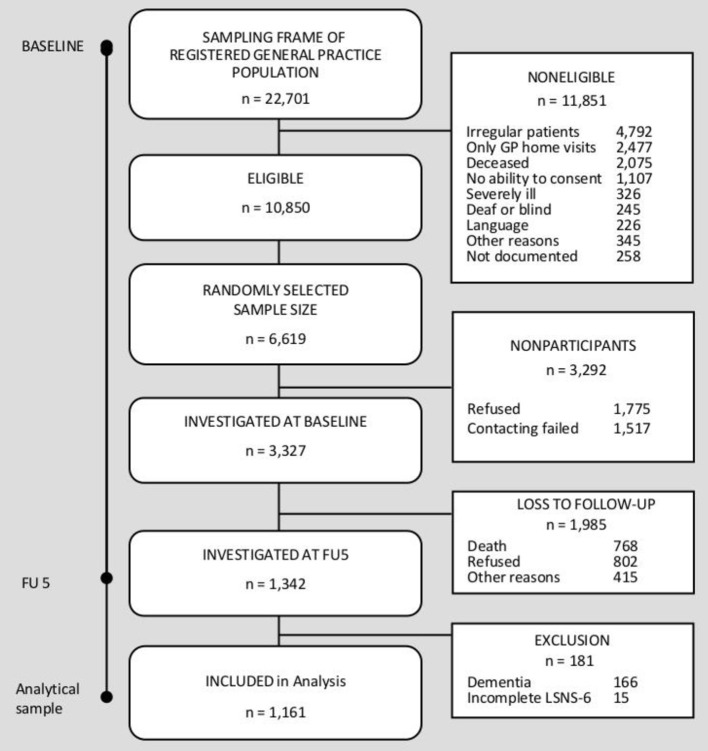
Analyses were based on follow-up (FU) 5-9 of the longitudinal German study AgeCoDe/AgeQualiDe. Social isolation was assessed using the short form of the Lubben Social Network Scale (LSNS-6), with a score ≤ 12 indicating social isolation. Structured interviews were used to identify dementia cases. Competing risk analysis based on the Fine-Gray model was conducted to test the association between social isolation and incident dementia.
Excluding participants with prevalent dementia, = 1,161 individuals were included. Their mean age was 86.6 ( = 3.1) years and 67.0% were female. The prevalence of social isolation was 34.7% at FU 5, 9.7% developed dementia and 36.0% died during a mean FU time of 4.3 ( = 0.4) years. Adjusting for covariates and cumulative mortality risk, social isolation was not significantly associated with incident dementia; neither in the total sample (sHR: 1.07, 95%CI 0.65-1.76, = 0.80), nor if stratified by sex (men: sHR: 0.71, 95%CI 0.28-1.83, = 0.48; women: sHR: 1.39, 95%CI 0.77-2.51, = 0.27).
In contrast to the findings of previous studies, we did not find an association between social isolation and incident dementia in the oldest-old. However, our analysis took into account the competing risk of death and the FU period was rather short. Future studies, especially with longer FU periods and more comprehensive assessment of qualitative social network characteristics (e.g., loneliness and satisfaction with social relationships) may be useful for clarification.
社会隔离被认为是痴呆症的一个风险因素。然而,关于社会隔离与痴呆症在死亡竞争风险方面的关系,我们了解得较少,尤其是在年龄最大的老年人中,他们面临社会隔离、痴呆症和死亡的风险最高。因此,我们旨在对一组年龄最大的个体样本进行这些关联研究。
分析基于德国纵向研究AgeCoDe/AgeQualiDe的随访(FU)5-9。使用鲁本社交网络量表简版(LSNS-6)评估社会隔离情况,得分≤12表明存在社会隔离。通过结构化访谈识别痴呆症病例。基于Fine-Gray模型进行竞争风险分析,以检验社会隔离与新发痴呆症之间的关联。
排除患有痴呆症的参与者后,纳入了1161名个体。他们的平均年龄为86.6(标准差 = 3.1)岁,67.0%为女性。在随访5时,社会隔离的患病率为34.7%,9.7%的人患上痴呆症,在平均4.3(标准差 = 0.4)年的随访期内,36.0%的人死亡。在调整协变量和累积死亡风险后,社会隔离与新发痴呆症无显著关联;在总样本中(标准化风险比:1.07,95%置信区间0.65-1.76,P = 0.80),按性别分层后也无关联(男性:标准化风险比:0.71,95%置信区间0.28-1.83,P = 0.48;女性:标准化风险比:1.39,95%置信区间0.77-2.51,P = 0.27)。
与先前研究的结果相反,我们在年龄最大的老年人中未发现社会隔离与新发痴呆症之间存在关联。然而,我们的分析考虑了死亡的竞争风险,且随访期较短。未来的研究,尤其是随访期更长且对社会网络定性特征(如孤独感和对社会关系的满意度)进行更全面评估的研究,可能有助于阐明这一问题。