Röhr Susanne, Löbner Margrit, Gühne Uta, Heser Kathrin, Kleineidam Luca, Pentzek Michael, Fuchs Angela, Eisele Marion, Kaduszkiewicz Hanna, König Hans-Helmut, Brettschneider Christian, Wiese Birgitt, Mamone Silke, Weyerer Siegfried, Werle Jochen, Bickel Horst, Weeg Dagmar, Maier Wolfgang, Scherer Martin, Wagner Michael, Riedel-Heller Steffi G
Institute of Social Medicine, Occupational Health and Public Health (ISAP), Medical Faculty, University of Leipzig, Leipzig, Germany.
Department for Neurodegenerative Diseases and Geriatric Psychiatry, University Hospital Bonn, Bonn, Germany.
Front Psychiatry. 2020 May 4;11:330. doi: 10.3389/fpsyt.2020.00330. eCollection 2020.
Social isolation is increasing in aging societies and several studies have shown a relation with worse cognition in old age. However, less is known about the association in the oldest-old (85+); the group that is at highest risk for both social isolation dementia.
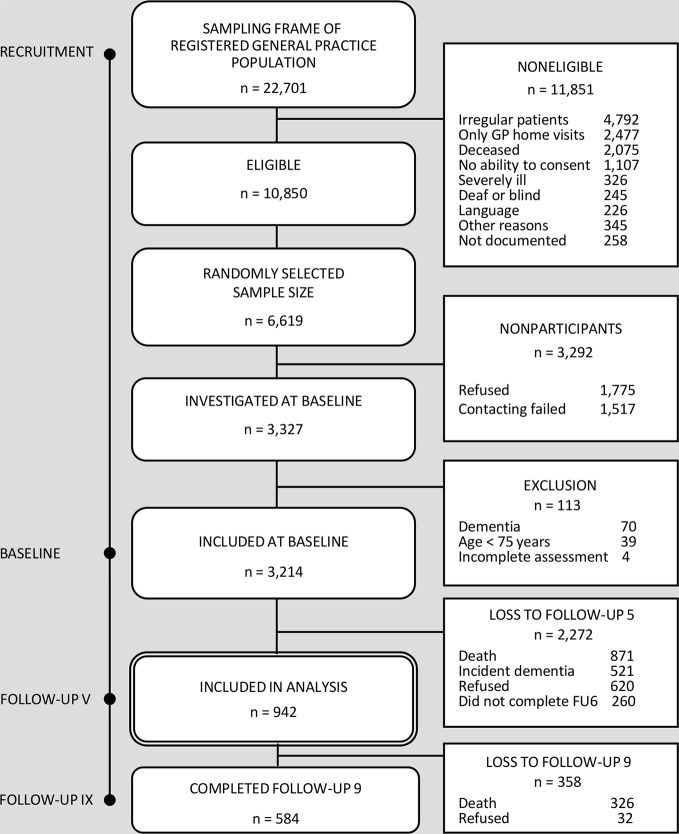
Analyses were based on follow-up 5 to 9 of the longitudinal German study on aging, cognition, and dementia in primary care patients (AgeCoDe) and the study on needs, health service use, costs, and health-related quality of life in a large sample of oldest-old primary care patients (AgeQualiDe), a multi-center population-based prospective cohort study. Measurements included the Lubben Social Network Scale (LSNS-6), with a score below 12 indicating social isolation, as well as the Mini-Mental Status Examination (MMSE) as an indicator of cognitive function.
Dementia-free study participants (n = 942) were = 86.4 ( = 3.0) years old at observation onset, 68.2% were women. One third (32.3%) of them were socially isolated. Adjusted linear hybrid mixed effects models revealed significantly lower cognitive function in individuals with smaller social networks ( = 0.5, 95% CI = 0.3-0.7, < .001). Moreover, changes in an individual's social network size were significantly associated with cognitive changes over time ( = 0.2, 95% CI = 0.1-0.4, = .003), indicating worse cognitive function with shrinking social networks.
Social isolation is highly prevalent among oldest-old individuals, being a risk factor for decreases in cognitive function. Consequently, it is important to maintain a socially active lifestyle into very old age. Likewise, this calls for effective ways to prevent social isolation.
在老龄化社会中,社会隔离现象日益增加,多项研究表明其与老年人认知能力下降有关。然而,对于年龄最大的老年人(85岁及以上)之间的关联了解较少;这一群体是社会隔离和痴呆症风险最高的群体。
分析基于德国一项关于初级保健患者衰老、认知和痴呆的纵向研究(AgeCoDe)的5至9年随访,以及一项针对大量高龄初级保健患者的需求、医疗服务使用、成本和健康相关生活质量的研究(AgeQualiDe),这是一项基于多中心人群的前瞻性队列研究。测量指标包括鲁本社交网络量表(LSNS - 6),得分低于12分表明存在社会隔离,以及简易精神状态检查表(MMSE)作为认知功能指标。
无痴呆症的研究参与者(n = 942)在观察开始时的年龄为 = 86.4( = 3.0)岁,其中68.2%为女性。其中三分之一(32.3%)存在社会隔离。调整后的线性混合效应模型显示,社交网络较小的个体认知功能显著较低( = 0.5,95%置信区间 = 0.3 - 0.7, <.001)。此外,个体社交网络规模的变化与随时间的认知变化显著相关( = 0.2,95%置信区间 = 0.1 - 0.4, = .003),表明社交网络缩小会导致认知功能变差。
社会隔离在高龄个体中非常普遍,是认知功能下降的一个风险因素。因此,在高龄阶段保持积极社交的生活方式很重要。同样,这也需要有效的方法来预防社会隔离。