Ching Pao-Yuan, Hsu Tien-Wei, Chen Guan-Wei, Pan Chih-Chuan, Chu Che-Sheng, Chou Po-Han
Department of Psychiatric, Kaohsiung Veterans General Hospital, Kaohsiung, Taiwan.
Center for Geriatric and Gerontology, Kaohsiung Veterans General Hospital, Kaohsiung, Taiwan.
Front Psychiatry. 2022 Jun 9;13:899040. doi: 10.3389/fpsyt.2022.899040. eCollection 2022.
We aimed to investigate the efficacy and tolerability of cranial electrotherapy stimulation (CES) for patients with anxiety symptoms.
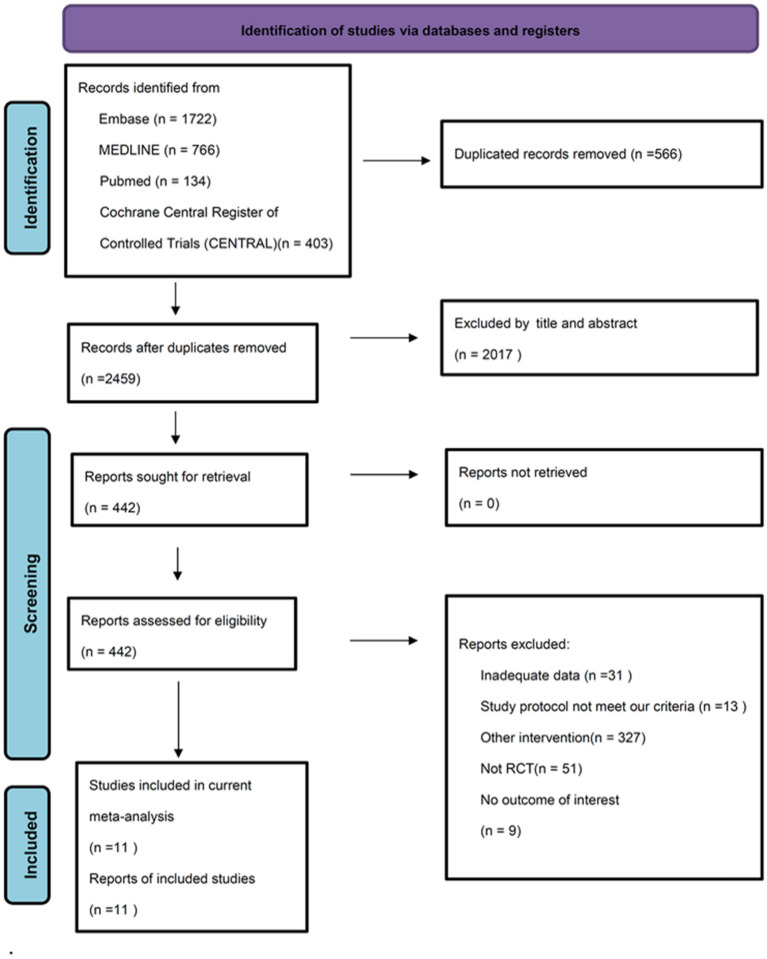
We searched the Pubmed, Cochrane Central Register of Controlled Trials (CENTRAL), Embase and Medline for randomized control trials (RCTs) from the time of inception until November 15, 2021, following Preferred Reporting Items for Systematic Reviews and Meta-analyses guidelines. Data were pooled using a random-effects model. The primary outcomes were the mean change scores for anxiety symptoms. The secondary outcomes were the mean change scores for depressive symptoms.
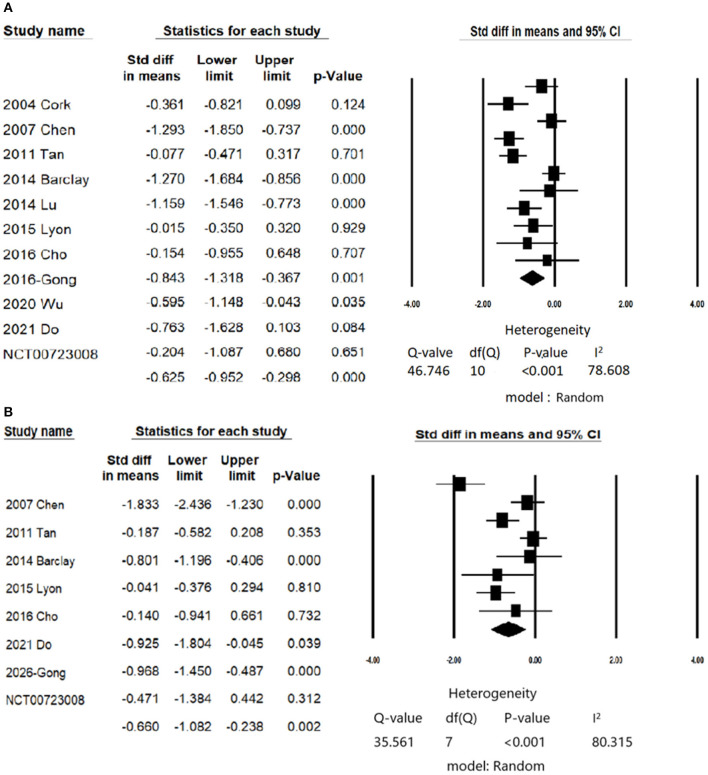
Eleven RCTs were eligible ( = 794, mean age: 41.4, mean population of female: 64.8%). CES significantly reduced the anxiety symptoms compared to the control group [ = 11, = 692, Hedge's g = -0.625, 95% confidence intervals (CIs) = -0.952 to -0.298, < 0.001] with moderate effect size. The subgroup analysis showed that CES reduced both primary and secondary anxiety (primary anxiety, =3, = 288, Hedges' g = -1.218, 95% CIs = -1.418 to -0.968, = 0.007; secondary anxiety, = 8, = 504, Hedges' g = -0.334, 95% CIs = -0.570 to -0.098, = 0.006). After performing between group analysis, we found CES has significant better efficacy for patients with primary anxiety than those with secondary anxiety ( < 0.001). For secondary outcome, CES significantly reduced depressive symptoms in patients with anxiety disorders ( = 8, = 552, Hedges' g = -0.648, 95% CIs = -1.062 to -0.234, = 0.002). No severe side effects were reported and the most commonly reported adverse events were ear discomfort and ear pain.
We found CES is effective in reducing anxiety symptoms with moderate effect size in patients with both primary and secondary anxiety. Furthermore, CES was well-tolerated and acceptable. PROSPERO, https://www.crd.york.ac.uk/prospero/display_record.php?ID=CRD42021267916.
我们旨在研究颅电刺激(CES)对有焦虑症状患者的疗效和耐受性。
我们按照系统评价和Meta分析的首选报告项目指南,检索了从创刊至2021年11月15日的PubMed、Cochrane对照试验中心注册库(CENTRAL)、Embase和Medline中的随机对照试验(RCT)。使用随机效应模型汇总数据。主要结局是焦虑症状的平均变化分数。次要结局是抑郁症状的平均变化分数。
11项RCT符合条件(n = 794,平均年龄:41.4岁,女性平均占比:64.8%)。与对照组相比,CES显著减轻了焦虑症状[n = 11,n = 692,Hedges' g = -0.625,95%置信区间(CI)= -0.952至-0.298,P < 0.001],效应量中等。亚组分析表明,CES减轻了原发性和继发性焦虑(原发性焦虑,n = 3,n = 288,Hedges' g = -1.218,95% CI = -1.418至-0.968,P = 0.007;继发性焦虑,n = 8,n = 504,Hedges' g = -0.334,95% CI = -0.570至-0.098,P = 0.006)。在进行组间分析后,我们发现CES对原发性焦虑患者的疗效显著优于继发性焦虑患者(P < 0.001)。对于次要结局,CES显著减轻了焦虑症患者的抑郁症状(n = 8,n = 552,Hedges' g = -0.648,95% CI = -1.062至-0.234,P = 0.002)。未报告严重副作用,最常报告的不良事件是耳部不适和耳痛。
我们发现CES在减轻原发性和继发性焦虑患者的焦虑症状方面有效,效应量中等。此外,CES耐受性良好且可接受。PROSPERO,https://www.crd.york.ac.uk/prospero/display_record.php?ID=CRD42021267916。