Mocek Anja, Weber Valeria, Schmölders Johanna, Witt Henning, Gothe Holger
IGES Institut GmbH, Friedrichstr. 180, 10117 Berlin, Germany.
Bristol Myers Squibb GmbH & Co. KGaA, Arnulfstr. 29, 80636 München, Germany.
Prev Med Rep. 2022 Jun 13;28:101861. doi: 10.1016/j.pmedr.2022.101861. eCollection 2022 Aug.
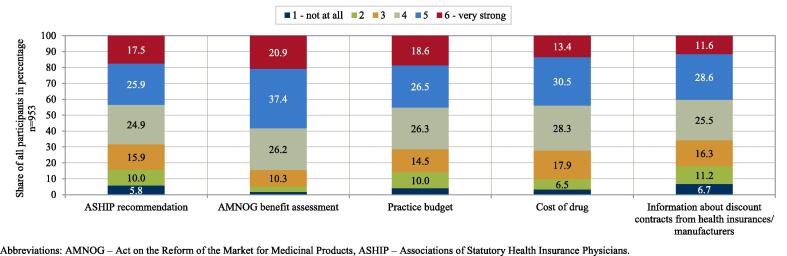
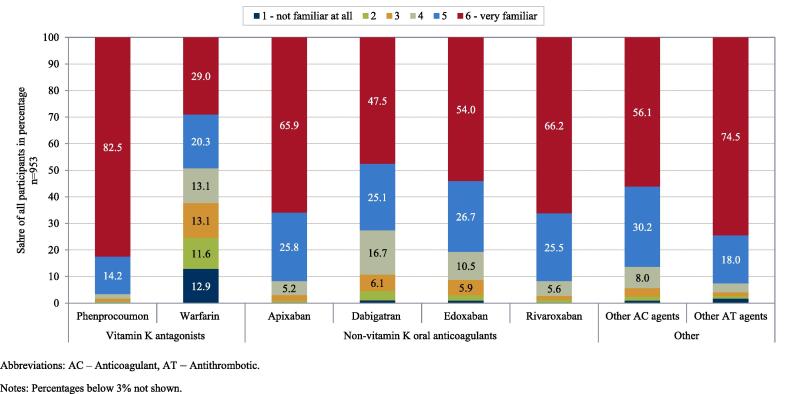
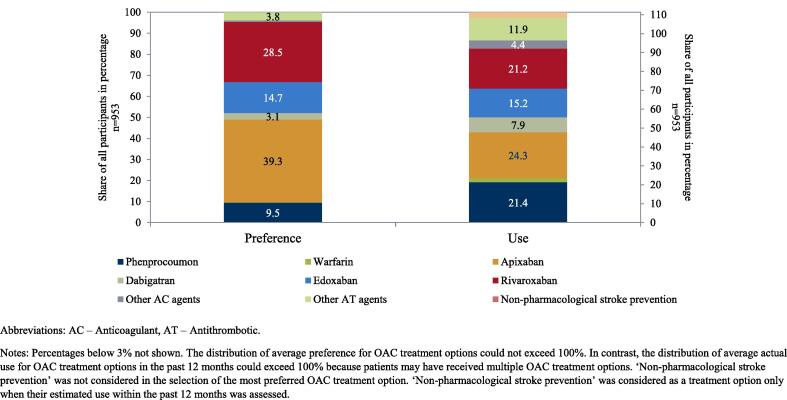
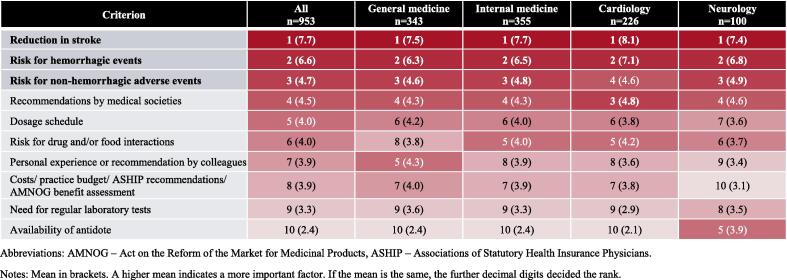
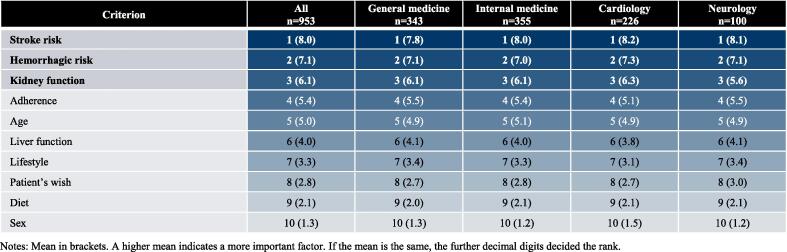
In Germany, there is little real-world evidence on physicians' choice of oral anticoagulants (OACs). Our study aimed at assessing preferences for and prescribing patterns of treatment options for stroke prevention in atrial fibrillation in clinical practice in Germany. We conducted a nationwide quantitative online survey among office-based physicians in Germany. Physicians were asked about their preference for and use of treatment options as well as factors influencing their choice of a specific OAC. A total of n = 953 physicians was surveyed in September and October 2020 (general physicians: 36.0%; internists: 37.3%; cardiologists: 23.7%; neurologists: 10.5%; multiple specialties possible). Preference and use were highest for non-vitamin K oral anticoagulants (NOACs); followed by vitamin K antagonists (VKAs). Most preferred OACs were apixaban (39.3%), rivaroxaban (28.5%) and edoxaban (14.7%). Most used OACs were apixaban (24.3%), rivaroxaban (21.2%) and phenprocoumon (21.4%). NOACs were preferred more often than used (85.6% > 68.6%). VKAs were preferred less often than used (9.6% < 23.5%). OAC attributes and patient characteristics related to efficacy and safety, as well as patients' kidney function were most important when selecting a specific OAC. Federal and regional governance instruments likely influenced treatment decision-making. We found a high divergence between preferences for and use of available treatment options in clinical practice. Further exploration of the importance of OAC attributes, patient characteristics as well as federal and regional governance instruments for physicians' choice of a specific OAC may help to further optimize the healthcare of patients with atrial fibrillation in the long-term.
在德国,几乎没有关于医生选择口服抗凝剂(OACs)的真实世界证据。我们的研究旨在评估德国临床实践中房颤患者预防中风治疗方案的偏好和处方模式。我们在德国的门诊医生中进行了一项全国性的定量在线调查。医生们被问及他们对治疗方案的偏好和使用情况,以及影响他们选择特定OAC的因素。2020年9月和10月共对n = 953名医生进行了调查(全科医生:36.0%;内科医生:37.3%;心脏病专家:23.7%;神经科医生:10.5%;可能涉及多个专科)。非维生素K口服抗凝剂(NOACs)的偏好和使用程度最高;其次是维生素K拮抗剂(VKAs)。最受青睐的OAC是阿哌沙班(39.3%)、利伐沙班(28.5%)和依度沙班(14.7%)。使用最多的OAC是阿哌沙班(24.3%)、利伐沙班(21.2%)和苯丙香豆素(21.4%)。NOACs的偏好率高于使用率(85.6% > 68.6%)。VKAs的偏好率低于使用率(9.6% < 23.5%)。在选择特定OAC时,与疗效和安全性相关的OAC属性、患者特征以及患者的肾功能最为重要。联邦和地区治理工具可能影响了治疗决策。我们发现临床实践中可用治疗方案的偏好和使用之间存在很大差异。进一步探讨OAC属性、患者特征以及联邦和地区治理工具对医生选择特定OAC的重要性,可能有助于长期进一步优化房颤患者的医疗保健。