Department of Biology, York University, Toronto, Ontario, Canada.
Department of Vertebrate Zoology, National Museum of Natural History, Smithsonian Institution, Washington DC, USA.
BMC Biol. 2022 Jun 28;20(1):138. doi: 10.1186/s12915-022-01341-z.
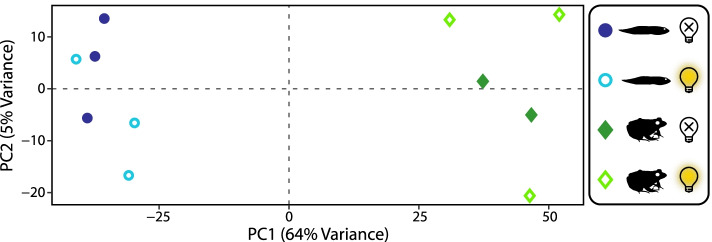
Differences in morphology, ecology, and behavior through ontogeny can result in opposing selective pressures at different life stages. Most animals, however, transition through two or more distinct phenotypic phases, which is hypothesized to allow each life stage to adapt more freely to its ecological niche. How this applies to sensory systems, and in particular how sensory systems adapt across life stages at the molecular level, is not well understood. Here, we used whole-eye transcriptomes to investigate differences in gene expression between tadpole and juvenile southern leopard frogs (Lithobates sphenocephalus), which rely on vision in aquatic and terrestrial light environments, respectively. Because visual physiology changes with light levels, we also tested the effect of light and dark exposure.
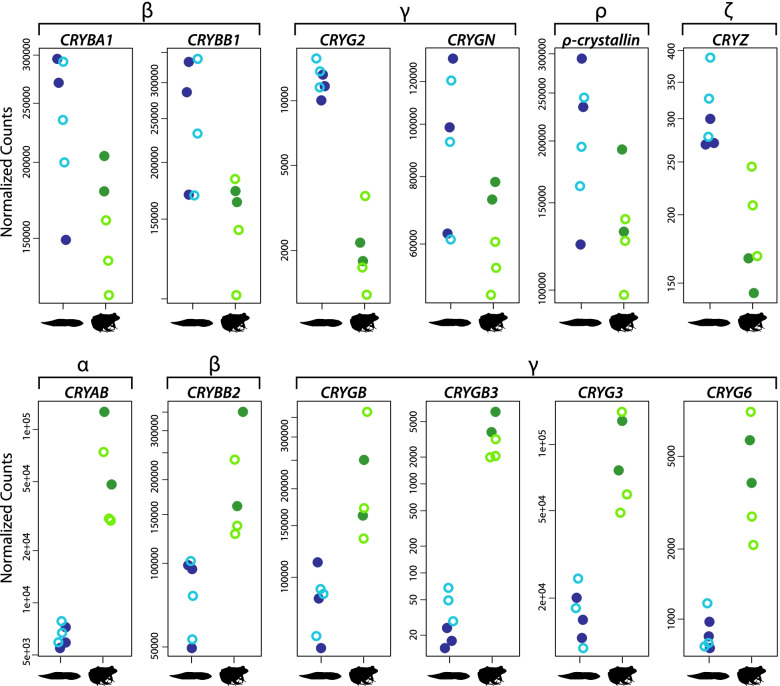
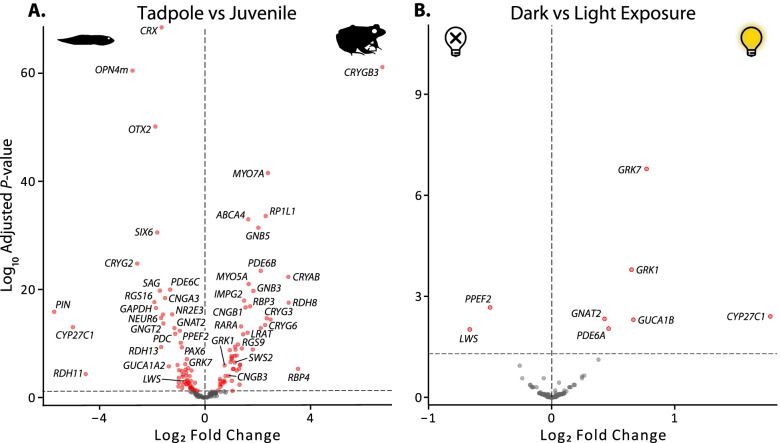
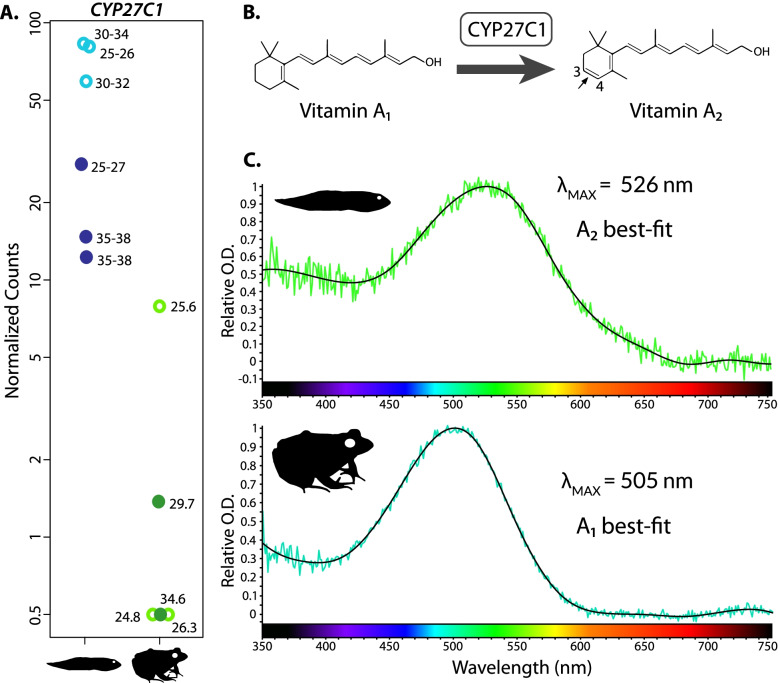
We found 42% of genes were differentially expressed in the eyes of tadpoles versus juveniles and 5% for light/dark exposure. Analyses targeting a curated subset of visual genes revealed significant differential expression of genes that control aspects of visual function and development, including spectral sensitivity and lens composition. Finally, microspectrophotometry of photoreceptors confirmed shifts in spectral sensitivity predicted by the expression results, consistent with adaptation to distinct light environments.
Overall, we identified extensive expression-level differences in the eyes of tadpoles and juveniles related to observed morphological and physiological changes through metamorphosis and corresponding adaptive shifts to improve vision in the distinct aquatic and terrestrial light environments these frogs inhabit during their life cycle. More broadly, these results suggest that decoupling of gene expression can mediate the opposing selection pressures experienced by organisms with complex life cycles that inhabit different environmental conditions throughout ontogeny.
个体发育过程中形态、生态和行为的差异会导致不同生命阶段的选择压力相反。然而,大多数动物都会经历两个或更多不同的表型阶段,这被假设为使每个生命阶段能够更自由地适应其生态位。这如何适用于感觉系统,特别是感觉系统如何在分子水平上适应不同的生命阶段,还不太清楚。在这里,我们使用全眼转录组来研究南方豹蛙(Lithobates sphenocephalus)蝌蚪和幼体之间的基因表达差异,它们分别依赖于水生和陆生光环境中的视觉。由于视觉生理学随光照水平而变化,我们还测试了光照和黑暗暴露的影响。
我们发现,在蝌蚪和幼体的眼睛中,有 42%的基因表达存在差异,而光照/黑暗暴露则有 5%的基因表达存在差异。针对一组经过精心挑选的视觉基因的分析显示,控制视觉功能和发育的基因存在显著的差异表达,包括光谱敏感性和晶状体组成。最后,对光感受器的微分光光度测定证实了表达结果预测的光谱敏感性的变化,这与适应不同的光环境相一致。
总的来说,我们在蝌蚪和幼体的眼睛中发现了广泛的表达水平差异,这些差异与形态和生理变化有关,这些变化是通过变态过程观察到的,并且与这些青蛙在生命周期中栖息的不同水生和陆生光环境中改善视觉的相应适应性变化有关。更广泛地说,这些结果表明,基因表达的解耦可以介导具有复杂生命周期并在个体发育过程中栖息在不同环境条件下的生物体所经历的相反选择压力。