• 文献检索
  • 文档翻译
  • 深度研究
  • 学术资讯
  • Suppr Zotero 插件Zotero 插件
  • 邀请有礼
  • 套餐&价格
  • 历史记录
应用&插件
Suppr Zotero 插件Zotero 插件浏览器插件Mac 客户端Windows 客户端微信小程序
定价
高级版会员购买积分包购买API积分包
服务
文献检索文档翻译深度研究API 文档MCP 服务
关于我们
关于 Suppr公司介绍联系我们用户协议隐私条款
关注我们

Suppr 超能文献

核心技术专利:CN118964589B侵权必究
粤ICP备2023148730 号-1Suppr @ 2026

文献检索

告别复杂PubMed语法,用中文像聊天一样搜索,搜遍4000万医学文献。AI智能推荐,让科研检索更轻松。

立即免费搜索

文件翻译

保留排版,准确专业,支持PDF/Word/PPT等文件格式,支持 12+语言互译。

免费翻译文档

深度研究

AI帮你快速写综述,25分钟生成高质量综述,智能提取关键信息,辅助科研写作。

立即免费体验

两栖动物基因组学联盟:推进两栖动物研究与保护的基因组和遗传资源。

The Amphibian Genomics Consortium: advancing genomic and genetic resources for amphibian research and conservation.

作者信息

Kosch Tiffany A, Torres-Sánchez María, Liedtke H Christoph, Summers Kyle, Yun Maximina H, Crawford Andrew J, Maddock Simon T, Ahammed Md Sabbir, Araújo Victor L N, Bertola Lorenzo V, Bucciarelli Gary M, Carné Albert, Carneiro Céline M, Chan Kin O, Chen Ying, Crottini Angelica, da Silva Jessica M, Denton Robert D, Dittrich Carolin, Themudo Gonçalo Espregueira, Farquharson Katherine A, Forsdick Natalie J, Gilbert Edward, Che Jing, Katzenback Barbara A, Kotharambath Ramachandran, Levis Nicholas A, Márquez Roberto, Mazepa Glib, Mulder Kevin P, Müller Hendrik, O'Connell Mary J, Orozco-terWengel Pablo, Palomar Gemma, Petzold Alice, Pfennig David W, Pfennig Karin S, Reichert Michael S, Robert Jacques, Scherz Mark D, Siu-Ting Karen, Snead Anthony A, Stöck Matthias, Stuckert Adam M M, Stynoski Jennifer L, Tarvin Rebecca D, Wollenberg Valero Katharina C

机构信息

One Health Research Group, Melbourne Veterinary School, Faculty of Science, University of Melbourne, Werribee, Victoria, Australia.

Department of Biodiversity, Ecology, and Evolution, Complutense University of Madrid, 28040 Madrid, Spain.

出版信息

bioRxiv. 2024 Oct 3:2024.06.27.601086. doi: 10.1101/2024.06.27.601086.

DOI:10.1101/2024.06.27.601086
PMID:39005434
原文链接:https://pmc.ncbi.nlm.nih.gov/articles/PMC11244923/
Abstract

Amphibians represent a diverse group of tetrapods, marked by deep divergence times between their three systematic orders and families. Studying amphibian biology through the genomics lens increases our understanding of the features of this animal class and that of other terrestrial vertebrates. The need for amphibian genomic resources is more urgent than ever due to the increasing threats to this group. Amphibians are one of the most imperiled taxonomic groups, with approximately 41% of species threatened with extinction due to habitat loss, changes in land use patterns, disease, climate change, and their synergistic effects. Amphibian genomic resources have provided a better understanding of ontogenetic diversity, tissue regeneration, diverse life history and reproductive modes, antipredator strategies, and resilience and adaptive responses. They also serve as essential models for studying broad genomic traits, such as evolutionary genome expansions and contractions, as they exhibit the widest range of genome sizes among all animal taxa and possess multiple mechanisms of genetic sex determination. Despite these features, genome sequencing of amphibians has significantly lagged behind that of other vertebrates, primarily due to the challenges of assembling their large, repeat-rich genomes and the relative lack of societal support. The emergence of long-read sequencing technologies, combined with advanced molecular and computational techniques that improve scaffolding and reduce computational workloads, is now making it possible to address some of these challenges. To promote and accelerate the production and use of amphibian genomics research through international coordination and collaboration, we launched the Amphibian Genomics Consortium (AGC, https://mvs.unimelb.edu.au/amphibian-genomics-consortium) in early 2023. This burgeoning community already has more than 282 members from 41 countries. The AGC aims to leverage the diverse capabilities of its members to advance genomic resources for amphibians and bridge the implementation gap between biologists, bioinformaticians, and conservation practitioners. Here we evaluate the state of the field of amphibian genomics, highlight previous studies, present challenges to overcome, and call on the research and conservation communities to unite as part of the AGC to enable amphibian genomics research to "leap" to the next level.

摘要

两栖动物是四足动物中的一个多样化群体,其三个系统目和科之间的分化时间很深。通过基因组学视角研究两栖动物生物学,能增进我们对这一动物类群以及其他陆地脊椎动物特征的理解。由于该类群面临的威胁日益增加,对两栖动物基因组资源的需求比以往任何时候都更加迫切。两栖动物是最濒危的分类群体之一,约41%的物种因栖息地丧失、土地利用模式变化、疾病、气候变化及其协同效应而面临灭绝威胁。两栖动物基因组资源有助于更好地理解个体发育多样性、组织再生、多样的生活史和繁殖模式、反捕食策略以及恢复力和适应性反应。它们也是研究广泛基因组特征(如进化基因组的扩张和收缩)的重要模型,因为它们在所有动物类群中展现出最广泛的基因组大小范围,并且拥有多种遗传性别决定机制。尽管具有这些特征,但两栖动物的基因组测序仍显著落后于其他脊椎动物,主要原因是组装其庞大且富含重复序列的基因组存在挑战,以及相对缺乏社会支持。长读长测序技术的出现,结合先进的分子和计算技术,这些技术可改善支架搭建并减少计算工作量,现在使得应对其中一些挑战成为可能。为通过国际协调与合作促进并加速两栖动物基因组学研究的产出与应用,我们于2023年初发起了两栖动物基因组学联盟(AGC,https://mvs.unimelb.edu.au/amphibian-genomics-consortium)。这个新兴的群体已经有来自41个国家的282多名成员。AGC旨在利用其成员的多样能力,推进两栖动物的基因组资源,并弥合生物学家、生物信息学家和保护从业者之间的实施差距。在此,我们评估两栖动物基因组学领域的现状,突出以往的研究,提出需要克服的挑战,并呼吁研究和保护界作为AGC的一部分团结起来,使两栖动物基因组学研究能够“跃”上新台阶。
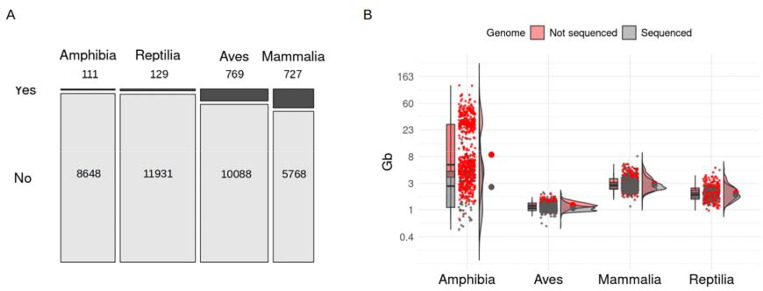
https://cdn.ncbi.nlm.nih.gov/pmc/blobs/6268/11455499/a857d45beb65/nihpp-2024.06.27.601086v2-f0005.jpg
https://cdn.ncbi.nlm.nih.gov/pmc/blobs/6268/11455499/9d75953737e3/nihpp-2024.06.27.601086v2-f0001.jpg
https://cdn.ncbi.nlm.nih.gov/pmc/blobs/6268/11455499/2008a597ab3d/nihpp-2024.06.27.601086v2-f0002.jpg
https://cdn.ncbi.nlm.nih.gov/pmc/blobs/6268/11455499/6b4b8c6024d8/nihpp-2024.06.27.601086v2-f0003.jpg
https://cdn.ncbi.nlm.nih.gov/pmc/blobs/6268/11455499/e6062d80c33c/nihpp-2024.06.27.601086v2-f0004.jpg
https://cdn.ncbi.nlm.nih.gov/pmc/blobs/6268/11455499/a857d45beb65/nihpp-2024.06.27.601086v2-f0005.jpg
https://cdn.ncbi.nlm.nih.gov/pmc/blobs/6268/11455499/9d75953737e3/nihpp-2024.06.27.601086v2-f0001.jpg
https://cdn.ncbi.nlm.nih.gov/pmc/blobs/6268/11455499/2008a597ab3d/nihpp-2024.06.27.601086v2-f0002.jpg
https://cdn.ncbi.nlm.nih.gov/pmc/blobs/6268/11455499/6b4b8c6024d8/nihpp-2024.06.27.601086v2-f0003.jpg
https://cdn.ncbi.nlm.nih.gov/pmc/blobs/6268/11455499/e6062d80c33c/nihpp-2024.06.27.601086v2-f0004.jpg
https://cdn.ncbi.nlm.nih.gov/pmc/blobs/6268/11455499/a857d45beb65/nihpp-2024.06.27.601086v2-f0005.jpg

相似文献

1
The Amphibian Genomics Consortium: advancing genomic and genetic resources for amphibian research and conservation.两栖动物基因组学联盟:推进两栖动物研究与保护的基因组和遗传资源。
bioRxiv. 2024 Oct 3:2024.06.27.601086. doi: 10.1101/2024.06.27.601086.
2
The Amphibian Genomics Consortium: advancing genomic and genetic resources for amphibian research and conservation.两栖动物基因组联盟:推进基因组和遗传资源,促进两栖动物研究和保护。
BMC Genomics. 2024 Nov 1;25(1):1025. doi: 10.1186/s12864-024-10899-7.
3
Comparative analysis of amphibian genomes: An emerging resource for basic and applied research.两栖动物基因组的比较分析:基础研究与应用研究的新兴资源。
Mol Ecol Resour. 2025 Jan;25(1):e14025. doi: 10.1111/1755-0998.14025. Epub 2024 Oct 4.
4
5
Threatened Species Initiative: Empowering conservation action using genomic resources.濒危物种倡议:利用基因组资源增强保护行动。
Proc Natl Acad Sci U S A. 2022 Jan 25;119(4). doi: 10.1073/pnas.2115643118.
6
Sperm collection and storage for the sustainable management of amphibian biodiversity.为了可持续地管理两栖动物生物多样性而进行的精子采集和储存。
Theriogenology. 2019 Jul 15;133:187-200. doi: 10.1016/j.theriogenology.2019.03.035.
7
Genomic insights into the conservation of wild and domestic animal diversity: A review.基因组视角下的野生动物和家养动物多样性保护:综述。
Gene. 2023 Nov 30;886:147719. doi: 10.1016/j.gene.2023.147719. Epub 2023 Aug 18.
8
The role of genomics in conservation and reproductive sciences.基因组学在保护和生殖科学中的作用。
Adv Exp Med Biol. 2014;753:71-96. doi: 10.1007/978-1-4939-0820-2_5.
9
10
Amphibian Assisted Reproductive Technologies: Moving from Technology to Application.两栖动物辅助生殖技术:从技术走向应用。
Adv Exp Med Biol. 2019;1200:413-463. doi: 10.1007/978-3-030-23633-5_14.

引用本文的文献

1
The Amphibian Major Histocompatibility Complex-A Review and Future Outlook.两栖动物主要组织相容性复合体——综述与未来展望
J Mol Evol. 2025 Feb;93(1):38-61. doi: 10.1007/s00239-024-10223-7. Epub 2025 Jan 7.

本文引用的文献

1
Comparative analysis of amphibian genomes: An emerging resource for basic and applied research.两栖动物基因组的比较分析:基础研究与应用研究的新兴资源。
Mol Ecol Resour. 2025 Jan;25(1):e14025. doi: 10.1111/1755-0998.14025. Epub 2024 Oct 4.
2
The genomes of all lungfish inform on genome expansion and tetrapod evolution.所有肺鱼的基因组都为基因组扩张和四足动物进化提供了信息。
Nature. 2024 Oct;634(8032):96-103. doi: 10.1038/s41586-024-07830-1. Epub 2024 Aug 14.
3
A candidate sex determination locus in amphibians which evolved by structural variation between X- and Y-chromosomes.
在两栖动物中存在一个候选性别决定基因座,它是通过 X 染色体和 Y 染色体之间的结构变异进化而来的。
Nat Commun. 2024 Jun 5;15(1):4781. doi: 10.1038/s41467-024-49025-2.
4
The only "lungless" frog has a glottis and lungs.唯一没有肺的青蛙有气管和肺。
Curr Biol. 2024 May 20;34(10):R492-R493. doi: 10.1016/j.cub.2024.03.017.
5
Indigenous peoples and local communities as partners in the sequencing of global eukaryotic biodiversity.原住民和当地社区作为全球真核生物多样性测序的合作伙伴。
NPJ Biodivers. 2023;2(1):8. doi: 10.1038/s44185-023-00013-7. Epub 2023 Apr 3.
6
Diversity and Evolution of Frog Visual Opsins: Spectral Tuning and Adaptation to Distinct Light Environments.青蛙视觉视蛋白的多样性与进化:光谱调谐与适应不同的光环境。
Mol Biol Evol. 2024 Apr 2;41(4). doi: 10.1093/molbev/msae049.
7
Complexity of avian evolution revealed by family-level genomes.鸟类进化的复杂性由家族水平基因组揭示。
Nature. 2024 May;629(8013):851-860. doi: 10.1038/s41586-024-07323-1. Epub 2024 Apr 1.
8
Milk provisioning in oviparous caecilian amphibians.卵生蚓螈两栖动物的乳汁分泌
Science. 2024 Mar 8;383(6687):1092-1095. doi: 10.1126/science.adi5379. Epub 2024 Mar 7.
9
Advances in Managing Chytridiomycosis for Australian Frogs: .管理澳大利亚蛙类壶菌病的进展: 。
Annu Rev Anim Biosci. 2024 Feb 15;12:113-133. doi: 10.1146/annurev-animal-021122-100823.
10
Conserved chromatin and repetitive patterns reveal slow genome evolution in frogs.保守的染色质和重复模式揭示了青蛙缓慢的基因组进化。
Nat Commun. 2024 Jan 17;15(1):579. doi: 10.1038/s41467-023-43012-9.