• 文献检索
  • 文档翻译
  • 深度研究
  • 学术资讯
  • Suppr Zotero 插件Zotero 插件
  • 邀请有礼
  • 套餐&价格
  • 历史记录
应用&插件
Suppr Zotero 插件Zotero 插件浏览器插件Mac 客户端Windows 客户端微信小程序
定价
高级版会员购买积分包购买API积分包
服务
文献检索文档翻译深度研究API 文档MCP 服务
关于我们
关于 Suppr公司介绍联系我们用户协议隐私条款
关注我们

Suppr 超能文献

核心技术专利:CN118964589B侵权必究
粤ICP备2023148730 号-1Suppr @ 2026

文献检索

告别复杂PubMed语法,用中文像聊天一样搜索,搜遍4000万医学文献。AI智能推荐,让科研检索更轻松。

立即免费搜索

文件翻译

保留排版,准确专业,支持PDF/Word/PPT等文件格式,支持 12+语言互译。

免费翻译文档

深度研究

AI帮你快速写综述,25分钟生成高质量综述,智能提取关键信息,辅助科研写作。

立即免费体验

医学领域中评估人工智能研究的系统评价呈指数级增长:挑战与机遇并存。

Exponential growth of systematic reviews assessing artificial intelligence studies in medicine: challenges and opportunities.

机构信息

Department of Anaesthesiology, Intensive Care and Pain Medicine, University Hospital Münster, Münster, Germany.

German Federal Institute for Risk Assessment, Berlin, Germany.

出版信息

Syst Rev. 2022 Jun 28;11(1):132. doi: 10.1186/s13643-022-01984-7.

DOI:10.1186/s13643-022-01984-7
PMID:35761303
原文链接:https://pmc.ncbi.nlm.nih.gov/articles/PMC9238033/
Abstract

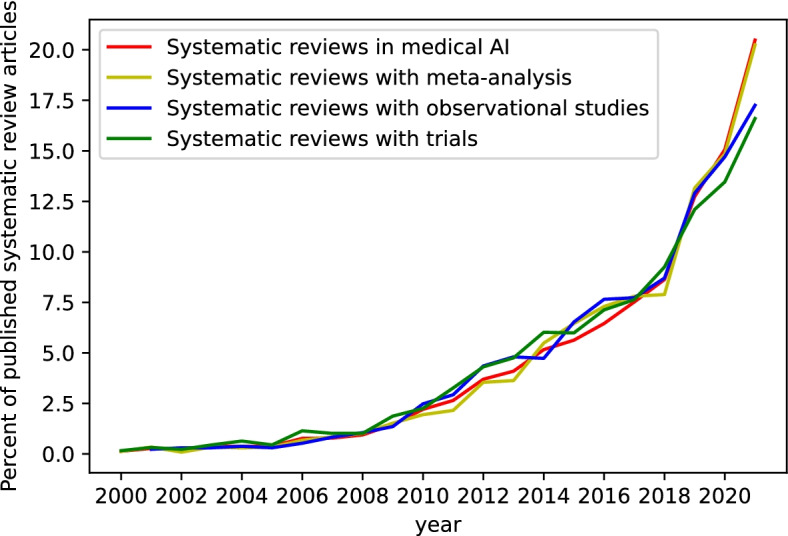
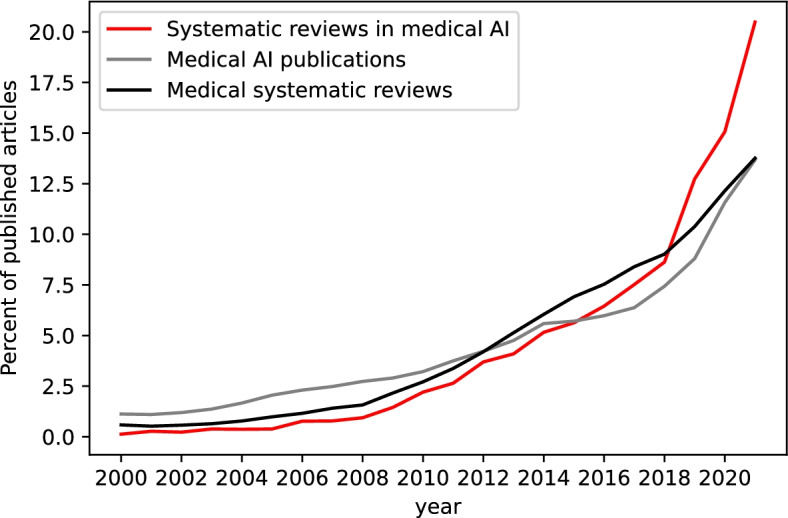
The evidence-based medicine (EBM) movement is stepping up its efforts to assess medical artificial intelligence (AI) and data science studies. Since 2017, there has been a marked increase in the number of published systematic reviews that assess medical AI studies. Increasingly, data from observational studies are used in systematic reviews of medical AI studies. Assessment of risk of bias is especially important in medical AI studies to detect possible "AI bias".

摘要

循证医学(EBM)运动正在加大力度评估医学人工智能(AI)和数据科学研究。自 2017 年以来,评估医学 AI 研究的已发表系统评价数量显著增加。越来越多的观察性研究数据被用于医学 AI 研究的系统评价。在医学 AI 研究中,评估偏倚风险尤其重要,以发现可能的“AI 偏差”。
https://cdn.ncbi.nlm.nih.gov/pmc/blobs/68fb/9238033/6b0bed9d403d/13643_2022_1984_Fig2_HTML.jpg
https://cdn.ncbi.nlm.nih.gov/pmc/blobs/68fb/9238033/7280032855cf/13643_2022_1984_Fig1_HTML.jpg
https://cdn.ncbi.nlm.nih.gov/pmc/blobs/68fb/9238033/6b0bed9d403d/13643_2022_1984_Fig2_HTML.jpg
https://cdn.ncbi.nlm.nih.gov/pmc/blobs/68fb/9238033/7280032855cf/13643_2022_1984_Fig1_HTML.jpg
https://cdn.ncbi.nlm.nih.gov/pmc/blobs/68fb/9238033/6b0bed9d403d/13643_2022_1984_Fig2_HTML.jpg

相似文献

1
Exponential growth of systematic reviews assessing artificial intelligence studies in medicine: challenges and opportunities.医学领域中评估人工智能研究的系统评价呈指数级增长:挑战与机遇并存。
Syst Rev. 2022 Jun 28;11(1):132. doi: 10.1186/s13643-022-01984-7.
2
Using artificial intelligence methods for systematic review in health sciences: A systematic review.利用人工智能方法进行健康科学系统评价:系统评价。
Res Synth Methods. 2022 May;13(3):353-362. doi: 10.1002/jrsm.1553. Epub 2022 Feb 28.
3
The use of artificial intelligence for automating or semi-automating biomedical literature analyses: A scoping review.人工智能在自动化或半自动化生物医学文献分析中的应用:范围综述。
J Biomed Inform. 2023 Jun;142:104389. doi: 10.1016/j.jbi.2023.104389. Epub 2023 May 13.
4
Artificial intelligence and automation of systematic reviews in women's health.人工智能和系统综述在女性健康领域的自动化。
Curr Opin Obstet Gynecol. 2020 Oct;32(5):335-341. doi: 10.1097/GCO.0000000000000643.
5
The promise of artificial intelligence: a review of the opportunities and challenges of artificial intelligence in healthcare.人工智能的前景:人工智能在医疗保健领域的机遇与挑战综述。
Br Med Bull. 2021 Sep 10;139(1):4-15. doi: 10.1093/bmb/ldab016.
6
Strengths, weaknesses, opportunities, and threats of using AI-enabled technology in sleep medicine: a commentary.利用人工智能技术在睡眠医学中的优势、劣势、机遇和威胁:述评。
J Clin Sleep Med. 2024 Jul 1;20(7):1183-1191. doi: 10.5664/jcsm.11132.
7
Legal concerns in health-related artificial intelligence: a scoping review protocol.健康相关人工智能的法律问题:范围综述方案
Syst Rev. 2022 Jun 17;11(1):123. doi: 10.1186/s13643-022-01939-y.
8
Artificial intelligence in systematic reviews: promising when appropriately used.系统评价中的人工智能:恰当使用时前景广阔。
BMJ Open. 2023 Jul 7;13(7):e072254. doi: 10.1136/bmjopen-2023-072254.
9
Artificial Intelligence in Health: New Opportunities, Challenges, and Practical Implications.健康领域的人工智能:新机遇、挑战与实际影响。
Yearb Med Inform. 2019 Aug;28(1):174-178. doi: 10.1055/s-0039-1677935. Epub 2019 Aug 16.
10
Application of Artificial Intelligence in Community-Based Primary Health Care: Systematic Scoping Review and Critical Appraisal.人工智能在社区基层医疗中的应用:系统范围综述和批判性评估。
J Med Internet Res. 2021 Sep 3;23(9):e29839. doi: 10.2196/29839.

引用本文的文献

1
Chatbot -assisted self-assessment (CASA): Co-designing an AI -powered behaviour change intervention for ethnic minorities.聊天机器人辅助自我评估(CASA):为少数民族共同设计一种由人工智能驱动的行为改变干预措施。
PLOS Digit Health. 2025 Feb 13;4(2):e0000724. doi: 10.1371/journal.pdig.0000724. eCollection 2025 Feb.
2
Ariadne's thread in the age of artificial intelligence: parallels between the greek myth and WAME's recommendations.人工智能时代的阿里阿德涅之线:希腊神话与世界医学教育联合会建议之间的相似之处
Colomb Med (Cali). 2024 Feb 23;55(1):e7005957. doi: 10.25100/cm.v55i1.5957. eCollection 2024 Jan-Mar.
3
CarD-T: Interpreting Carcinomic Lexicon via Transformers.

本文引用的文献

1
A short guide for medical professionals in the era of artificial intelligence.人工智能时代医学专业人员简短指南。
NPJ Digit Med. 2020 Sep 24;3:126. doi: 10.1038/s41746-020-00333-z. eCollection 2020.
2
Evolution and impact of bias in human and machine learning algorithm interaction.人类与机器学习算法交互中的偏差演变与影响。
PLoS One. 2020 Aug 13;15(8):e0235502. doi: 10.1371/journal.pone.0235502. eCollection 2020.
3
Intelligent health data analytics: A convergence of artificial intelligence and big data.智能健康数据分析:人工智能与大数据的融合
CarD-T:通过Transformer解释癌基因词汇
medRxiv. 2024 Aug 31:2024.08.13.24311948. doi: 10.1101/2024.08.13.24311948.
4
Diagnostic Accuracy of Machine-Learning Models on Predicting Chemo-Brain in Breast Cancer Survivors Previously Treated with Chemotherapy: A Meta-Analysis.机器学习模型预测既往接受过化疗的乳腺癌幸存者化疗脑的诊断准确性:一项荟萃分析。
Int J Environ Res Public Health. 2022 Dec 15;19(24):16832. doi: 10.3390/ijerph192416832.
Healthc Manage Forum. 2019 Jul;32(4):178-182. doi: 10.1177/0840470419846134. Epub 2019 May 22.
4
Artificial intelligence, bias and clinical safety.人工智能、偏差与临床安全。
BMJ Qual Saf. 2019 Mar;28(3):231-237. doi: 10.1136/bmjqs-2018-008370. Epub 2019 Jan 12.
5
High-performance medicine: the convergence of human and artificial intelligence.高性能医学:人机智能融合。
Nat Med. 2019 Jan;25(1):44-56. doi: 10.1038/s41591-018-0300-7. Epub 2019 Jan 7.
6
Meta-research: Why research on research matters.元研究:为何研究研究很重要。
PLoS Biol. 2018 Mar 13;16(3):e2005468. doi: 10.1371/journal.pbio.2005468. eCollection 2018 Mar.