Drug Development Unit, The Institute of Cancer Research and Royal Marsden Hospital, London, UK.
Clinical Trials and Statistics Unit, The Institute of Cancer Research, Sutton, UK.
Oncologist. 2022 Sep 2;27(9):768-777. doi: 10.1093/oncolo/oyac117.
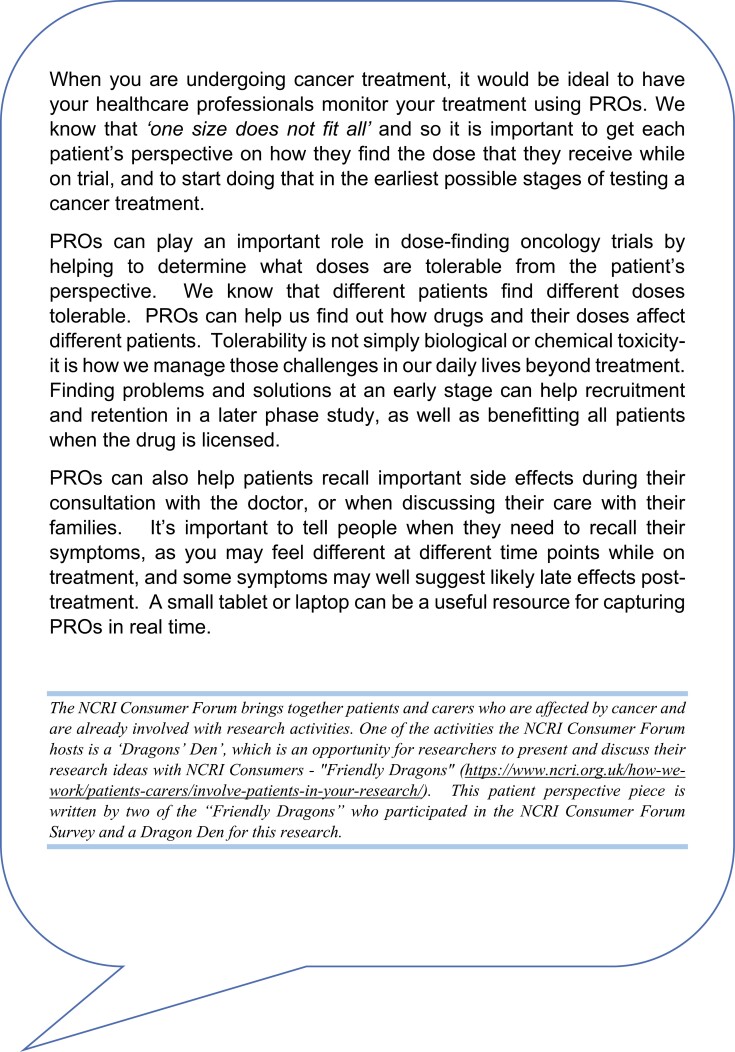
Patient-reported adverse events may be a useful adjunct for assessing a drug's tolerability in dose-finding oncology trials (DFOT). We conducted surveys of international stakeholders and the National Cancer Research Institute (NCRI) Consumer Forum to understand attitudes about patient-reported outcome (PRO) use in DFOT.
A 35-question survey of clinicians, trial managers, statisticians, funders, and regulators of DFOT was distributed via professional bodies examining experience using PROs, benefits/barriers, and their potential role in defining tolerable doses. An 8-question survey of the NCRI Consumer Forum explored similar themes.
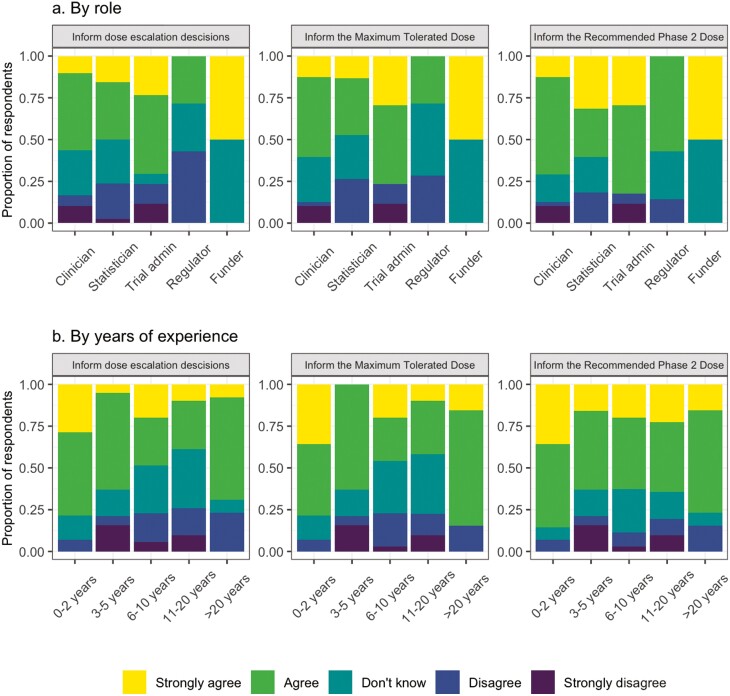
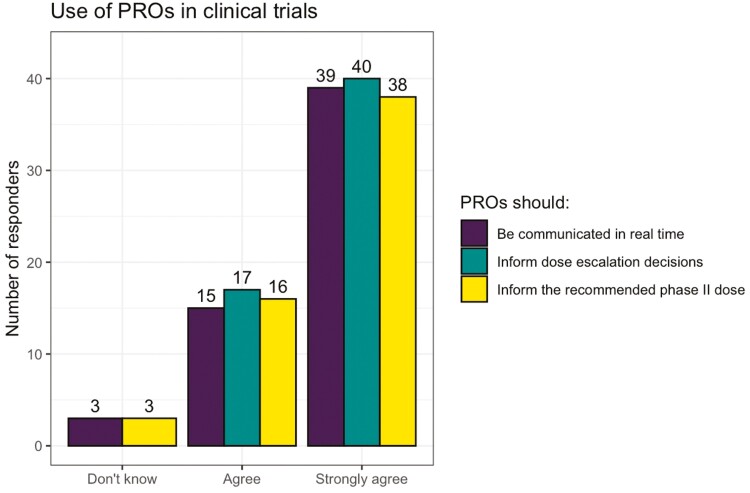
International survey: 112 responses from 15 September-30 November 2020; 103 trialists [48 clinicians (42.9%), 38 statisticians (34.0%), 17 trial managers (15.2%)], 7 regulators (6.3%), 2 funders (1.8%)]. Most trialists had no experience designing (73, 70.9%), conducting (52, 50.5%), or reporting (88, 85.4%) PROs in DFOT. Most agreed that PROs could identify new toxicities (75, 67.0%) and provide data on the frequency (86, 76.8%) and duration (81, 72.3%) of toxicities. The top 3 barriers were lack of guidance regarding PRO selection (73/103, 70.9%), missing PRO data (71/103, 68.9%), and overburdening staff (68/103, 66.0%). NCRI survey: 57 responses on 21 March 2021. A total of 28 (49.1%) were willing to spend <15 min/day completing PROs. Most (55, 96.5%) preferred to complete PROs online. 61 (54.5%) trialists and 57 (100%) consumers agreed that patient-reported adverse events should be used to inform dose-escalation decisions.
Stakeholders reported minimal experience using PROs in DFOT but broadly supported their use. Guidelines are needed to standardize PRO selection, analysis, and reporting in DFOT.
患者报告的不良事件(adverse events)可能是评估肿瘤学剂量发现试验(dose-finding oncology trials,DFOT)中药物耐受性的有用辅助手段。我们对国际利益相关者和国家癌症研究所(National Cancer Research Institute,NCRI)消费者论坛进行了调查,以了解他们对患者报告结局(patient-reported outcome,PRO)在 DFOT 中的使用的态度。
我们向从事 DFOT 的临床医生、试验经理、统计学家、资助者和监管者分发了一份包含 35 个问题的调查问卷,调查他们使用 PRO 的经验、益处/障碍以及 PRO 在确定可耐受剂量方面的潜在作用。NCRI 消费者论坛的一份 8 个问题的调查问卷则探讨了类似的主题。
国际调查:2020 年 9 月 15 日至 11 月 30 日期间共收到 112 份回应,其中包括 103 名试验人员(48 名临床医生(42.9%)、38 名统计学家(34.0%)、17 名试验经理(15.2%))、7 名监管者(6.3%)和 2 名资助者(1.8%)。大多数试验人员没有设计(73 名,70.9%)、开展(52 名,50.5%)或报告(88 名,85.4%)DFOT 中的 PRO 的经验。大多数试验人员认为 PRO 可以识别新的毒性(75 名,67.0%),并提供毒性的频率(86 名,76.8%)和持续时间(81 名,72.3%)的数据。前 3 大障碍是缺乏 PRO 选择方面的指导(73/103,70.9%)、缺乏 PRO 数据(71/103,68.9%)和工作人员负担过重(68/103,66.0%)。NCRI 调查:2021 年 3 月 21 日共收到 57 份回应。共有 28 人(49.1%)愿意每天花费 <15 分钟完成 PRO。大多数(55 名,96.5%)更喜欢在线完成 PRO。61 名试验人员和 57 名消费者(100%)均同意应使用患者报告的不良事件来为剂量递增决策提供信息。
利益相关者报告在 DFOT 中使用 PRO 的经验很少,但普遍支持使用 PRO。需要指南来规范 DFOT 中 PRO 的选择、分析和报告。