Department of Epidemiology and Public Health, Faculty of Medicine, University of Ostrava, 703 00, Ostrava, Czech Republic.
Department of Otorhinolaryngology and Head and Neck Surgery, 1st Faculty of Medicine Charles University in Prague and Motol University Hospital, Postgraduate Medical School, 150 06, Prague 5, Czech Republic.
Eur Arch Otorhinolaryngol. 2023 Feb;280(2):565-572. doi: 10.1007/s00405-022-07498-1. Epub 2022 Jun 28.
This study aimed to determine hearing thresholds in an otologically normal population without occupational noise exposure aged 18 to 64 years using extended high-frequency audiometry (EHFA).
Individuals from the general population who have never had hearing problems and whose job was not associated with noise exposure were included in the study and classified by age into 5 categories: 18-24 and, further, by 10 years of age. Each of these groups was further divided according to gender. All subjects underwent tympanometry, conventional pure-tone audiometry within the 0.125-8 kHz range, and extended high-frequency audiometry within the 9-16 kHz range, performed according to the standards. The significance level for statistical testing was set at 5%.
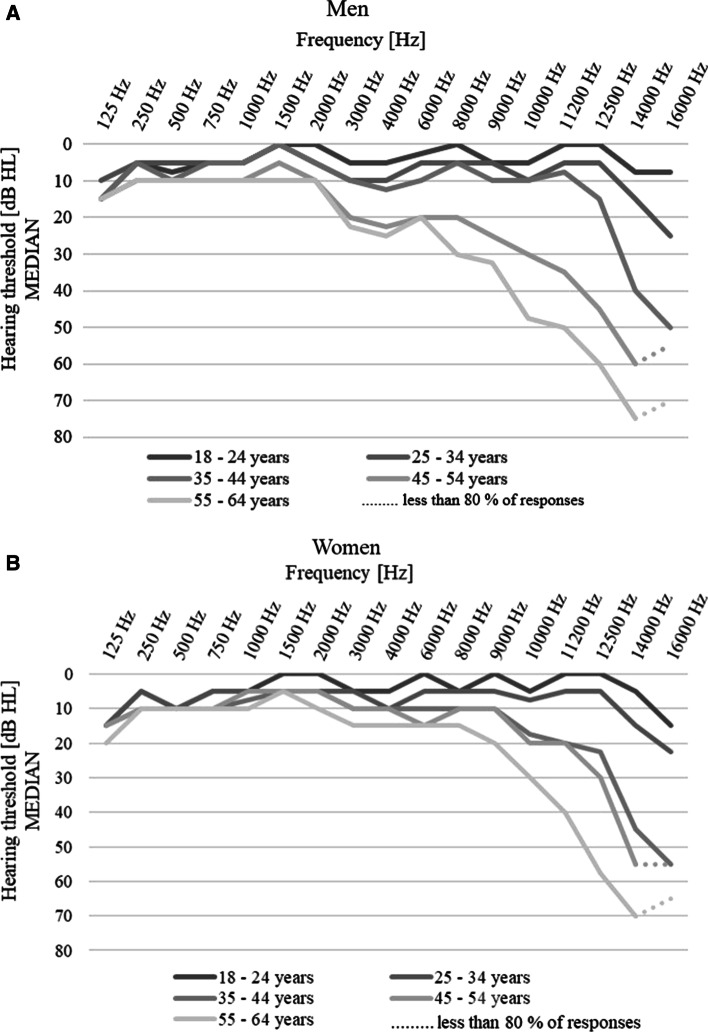
Here, we established hearing thresholds in an otologically healthy population within the extended high-frequency (EHF) range (9-16 kHz). We found the EHFA to be a highly sensitive method for early detection of hearing loss, with hearing thresholds decreasing as soon as 35 years of age. In males, the hearing thresholds grew with age more rapidly than in women. The ability to respond at EHF gradually decreased with age and increasing frequency.
Our results can help improve the knowledge of EHF hearing thresholds for individual sexes and age groups. So far, the standard 7029:2017 is not binding and, moreover, it only reaches up to the frequency of 12.5 kHz. EHFA is a highly sensitive method for the evaluation of hearing loss depending on age and sex.
本研究旨在通过扩展高频测听(EHFA)来确定无职业噪声暴露的 18 至 64 岁耳科正常人群的听力阈值。
本研究纳入了从未有过听力问题且职业不与噪声接触的一般人群,并按年龄分为 5 组:18-24 岁,进一步每 10 岁为一组。每组再按性别分组。所有受试者均接受鼓室图、0.125-8 kHz 范围内的常规纯音测听和 9-16 kHz 范围内的扩展高频测听,测试均按标准进行。统计检验的显著性水平设为 5%。
在此,我们确定了耳科健康人群在扩展高频(EHF)范围内(9-16 kHz)的听力阈值。我们发现 EHFA 是一种非常敏感的早期听力损失检测方法,听力阈值早在 35 岁时就开始下降。在男性中,听力阈值随年龄的增长比女性更快。在 EHF 处的听力响应能力随年龄和频率的增加而逐渐下降。
我们的结果有助于提高对个体性别和年龄组 EHF 听力阈值的认识。到目前为止,标准 7029:2017 不具约束力,而且只达到 12.5 kHz 的频率。EHFA 是一种非常敏感的方法,可根据年龄和性别评估听力损失。