Sarraju Ashish, Seninger Clark, Parameswaran Vijaya, Petlura Christina, Bazouzi Tamara, Josan Kiranbir, Grewal Upinder, Viethen Thomas, Mundl Hardi, Luithle Joachim, Basobas Leonard, Touros Alexis, Senior Michael J T, De Lombaert Koen, Mahaffey Kenneth W, Turakhia Mintu P, Dash Rajesh
Division of Cardiovascular Medicine & Cardiovascular Institute, Stanford University School of Medicine, Palo Alto, California, USA.
Center for Digital Health, Stanford University School of Medicine, Palo Alto, CA, USA.
NPJ Digit Med. 2022 Jun 28;5(1):80. doi: 10.1038/s41746-022-00622-9.
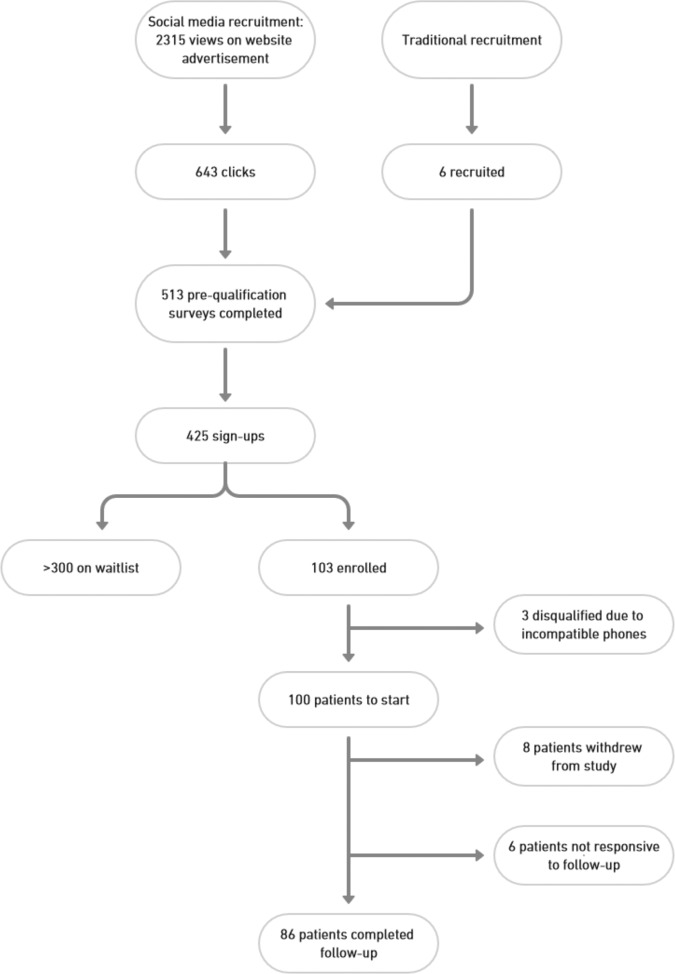
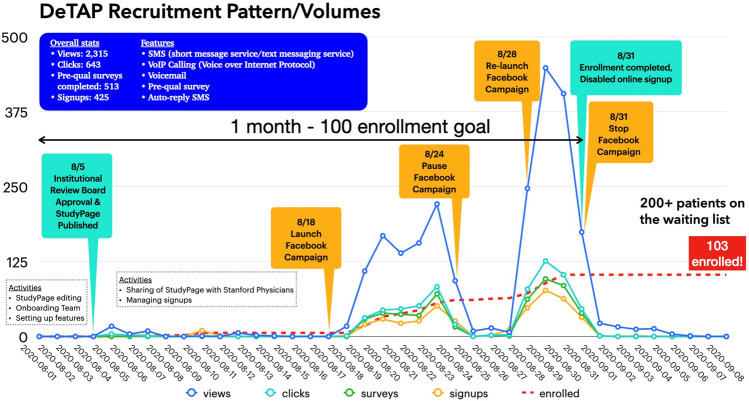
The Coronavirus Disease 2019 (COVID-19) pandemic curtailed clinical trial activity. Decentralized clinical trials (DCTs) can expand trial access and reduce exposure risk but their feasibility remains uncertain. We evaluated DCT feasibility for atrial fibrillation (AF) patients on oral anticoagulation (OAC). DeTAP (Decentralized Trial in Afib Patients, NCT04471623) was a 6-month, single-arm, 100% virtual study of 100 AF patients on OAC aged >55 years, recruited traditionally and through social media. Participants enrolled and participated virtually using a mobile application and remote blood pressure (BP) and six-lead electrocardiogram (ECG) sensors. Four engagement-based primary endpoints included changes in pre- versus end-of-study OAC adherence (OACA), and % completion of televisits, surveys, and ECG and BP measurements. Secondary endpoints included survey-based nuisance bleeding and patient feedback. 100 subjects (mean age 70 years, 44% women, 90% White) were recruited in 28 days (traditional: 6 pts; social media: 94 pts in 12 days with >300 waitlisted). Study engagement was high: 91% televisits, 85% surveys, and 99% ECG and 99% BP measurement completion. OACA was unchanged at 6 months (baseline: 97 ± 9%, 6 months: 96 ± 15%, p = 0.39). In patients with low baseline OACA (<90%), there was significant 6-month improvement (85 ± 16% to 96 ± 6%, p < 0.01). 86% of respondents (69/80) expressed willingness to continue in a longer trial. The DeTAP study demonstrated rapid recruitment, high engagement, and physiologic reporting via the integration of digital technologies and dedicated study coordination. These findings may inform DCT designs for future cardiovascular trials.
2019年冠状病毒病(COVID-19)大流行减少了临床试验活动。去中心化临床试验(DCT)可以扩大试验准入范围并降低暴露风险,但其可行性仍不确定。我们评估了DCT在接受口服抗凝治疗(OAC)的心房颤动(AF)患者中的可行性。DeTAP(房颤患者去中心化试验,NCT04471623)是一项为期6个月的单臂、100%虚拟研究,纳入了100名年龄大于55岁、接受OAC治疗的AF患者,通过传统方式和社交媒体进行招募。参与者通过移动应用程序以及远程血压(BP)和六导联心电图(ECG)传感器进行虚拟注册和参与。四个基于参与度的主要终点包括研究开始前与结束时OAC依从性(OACA)的变化,以及远程就诊、调查、ECG和BP测量的完成率。次要终点包括基于调查的轻微出血和患者反馈。在28天内招募了100名受试者(平均年龄70岁;44%为女性;90%为白人)(传统方式:6名受试者;社交媒体:12天内招募了94名受试者,另有300多名在等待名单中)。研究参与度很高:远程就诊完成率为91%,调查完成率为85%,ECG测量完成率为99%,BP测量完成率为99%。6个月时OACA无变化(基线:97±9%,6个月:96±15%,p = 0.39)。在基线OACA较低(<90%)的患者中,6个月时有显著改善(85±16%至96±6%,p < 0.……此处原文有误,应为p < 0.01)。86%的受访者(69/80)表示愿意继续参加更长时间的试验。DeTAP研究通过数字技术的整合和专门的研究协调,展示了快速招募、高参与度和生理数据报告。这些发现可能为未来心血管试验的DCT设计提供参考。