Universitat Politècnica de Catalunya-BarcelonaTech, 08034 Barcelona, Spain.
Institute for Bioengineering of Catalonia (IBEC), The Barcelona Institute of Science and Technology, 08034 Barcelona, Spain.
J R Soc Interface. 2022 Jun;19(191):20220183. doi: 10.1098/rsif.2022.0183. Epub 2022 Jun 29.
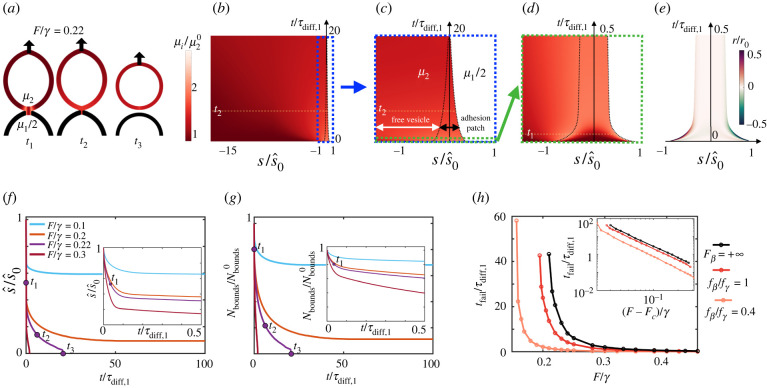
Biological adhesion is a critical mechanical function of complex organisms. At the scale of cell-cell contacts, adhesion is remarkably tunable to enable both cohesion and malleability during development, homeostasis and disease. It is physically supported by transient and laterally mobile molecular bonds embedded in fluid membranes. Thus, unlike specific adhesion at solid-solid or solid-fluid interfaces, peeling at fluid-fluid interfaces can proceed by breaking bonds, by moving bonds or by a combination of both. How the additional degree of freedom provided by bond mobility changes the mechanics of peeling is not understood. To address this, we develop a theoretical model coupling diffusion, reactions and mechanics. Mobility and reaction rates determine distinct peeling regimes. In a diffusion-dominated Stefan-like regime, bond motion establishes self-stabilizing dynamics that increase the effective fracture energy. In a reaction-dominated regime, peeling proceeds by travelling fronts where marginal diffusion and unbinding control peeling speed. In a mixed reaction-diffusion regime, strengthening by bond motion competes with weakening by bond breaking in a force-dependent manner, defining the strength of the adhesion patch. In turn, patch strength depends on molecular properties such as bond stiffness, force sensitivity or crowding. We thus establish the physical rules enabling tunable cohesion in cellular tissues and in engineered biomimetic systems.
生物黏附是复杂生物的关键力学功能。在细胞-细胞接触的尺度上,黏附具有显著的可调节性,能够在发育、稳态和疾病过程中实现内聚和可塑性。它由嵌入在流体膜中的瞬时和横向可移动的分子键提供物理支撑。因此,与固-固或固-液界面的特异性黏附不同,在液-液界面上的剥离可以通过打破键、移动键或两者的组合来进行。键的可移动性提供的额外自由度如何改变剥离的力学性质尚不清楚。为了解决这个问题,我们开发了一个耦合扩散、反应和力学的理论模型。可移动性和反应速率决定了不同的剥离状态。在扩散主导的类似于 Stefan 的状态下,键的运动建立了自我稳定的动力学,增加了有效断裂能。在反应主导的状态下,剥离通过前沿进行,其中边缘扩散和去束缚控制着剥离速度。在混合的扩散-反应状态下,键的运动增强与键断裂的削弱以力依赖的方式竞争,从而定义了黏附片的强度。反过来,片的强度取决于分子特性,如键的刚性、力敏感性或拥挤程度。因此,我们确立了在细胞组织和工程仿生系统中实现可调内聚的物理规则。