Instituto Nacional Cardiovascular INCOR, Essalud, Lima, Peru.
Universidad Científica del Sur, Lima, Peru.
BMC Cardiovasc Disord. 2022 Jun 29;22(1):296. doi: 10.1186/s12872-022-02730-6.
The primary percutaneous coronary intervention (PPCI) is the preferred reperfusion strategy for ST-segment elevation myocardial infarction (STEMI). The pharmacoinvasive strategy (PIs) is a reasonable alternative when prompt PPCI is not possible, especially in resource-limited regions. We aimed to compare PPCI versus PIs outcomes in Peru.
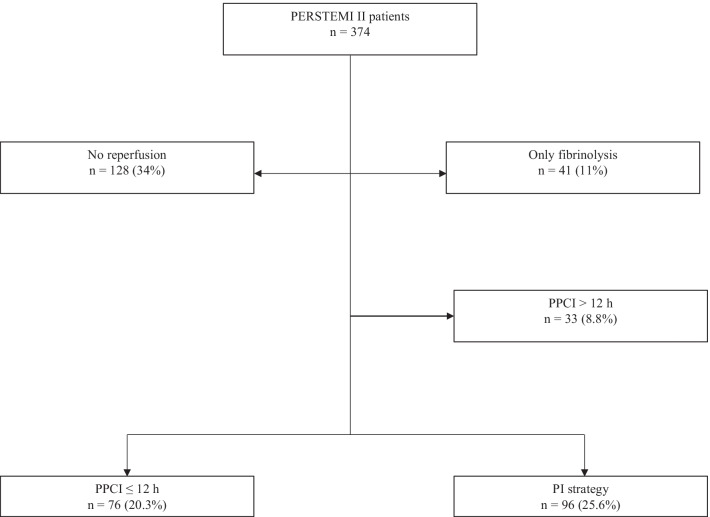
This was a retrospective cohort study based on the second Peruvian Registry of STEMI (PERSTEMI II). We compared the characteristics, in-hospital outcomes and 30-day mortality of patients undergoing PPCI during the first 12 h and those receiving a PIs. A propensity score-matched analysis was conducted to compare the effects of each treatment strategy on clinical outcomes.
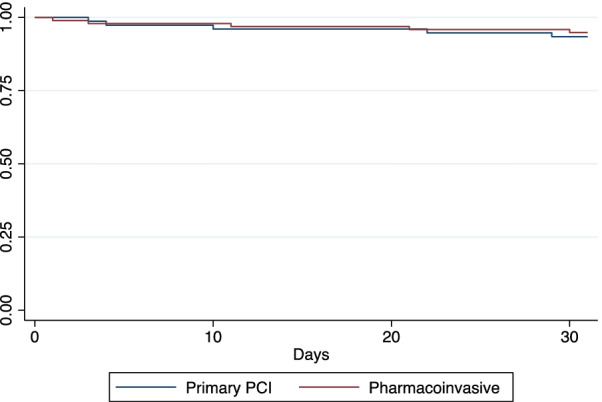
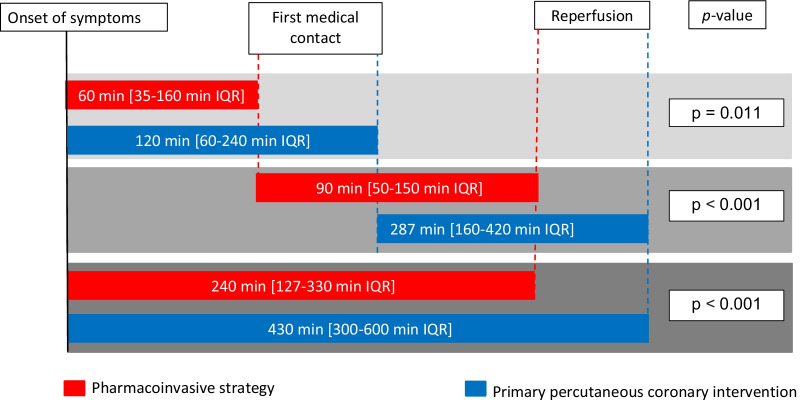
PIs patients were younger than PPCI patients, had a shorter first medical contact time, first medical contact to reperfusion time, and total ischemic time until reperfusion. Successful PCI was more frequent in the PIs group (84.4% vs. 71.1%, p = 0.035). There were no differences between PIs and PPCI in terms of total in-hospital mortality (5.2% vs. 6.6%, p = 0.703), cardiovascular mortality (4.2% vs. 5.3%, p = 0.735), cardiogenic shock (8.3% vs. 13.2%, p = 0.326), heart failure (19.8% vs. 30.3%, p = 0.112), or major bleeding (0% vs. 2.6%, p = 0.194). In the propensity score-matched analysis, the rates of cardiovascular mortality, postinfarction heart failure and successful reperfusion were similar.
In this real-world study, no differences were found in the in-hospital outcomes between patients with STEMI who received PIs or PPCI.
经皮冠状动脉介入治疗(PPCI)是治疗 ST 段抬高型心肌梗死(STEMI)的首选再灌注策略。当不能立即进行 PPCI 时,药物介入策略(PIs)是一种合理的替代方案,特别是在资源有限的地区。我们旨在比较秘鲁的 PPCI 与 PIs 的结果。
这是一项基于第二次秘鲁 STEMI 注册研究(PERSTEMI II)的回顾性队列研究。我们比较了在首次 12 小时内接受 PPCI 和接受 PIs 的患者的特征、住院期间结局和 30 天死亡率。进行倾向评分匹配分析比较两种治疗策略对临床结局的影响。
PIs 患者比 PPCI 患者年轻,首次医疗接触时间、首次医疗接触至再灌注时间和总缺血时间至再灌注时间较短。PIs 组的 PCI 成功率更高(84.4% vs. 71.1%,p=0.035)。在总住院死亡率(5.2% vs. 6.6%,p=0.703)、心血管死亡率(4.2% vs. 5.3%,p=0.735)、心源性休克(8.3% vs. 13.2%,p=0.326)、心力衰竭(19.8% vs. 30.3%,p=0.112)或主要出血(0% vs. 2.6%,p=0.194)方面,PIs 和 PPCI 之间无差异。在倾向评分匹配分析中,心血管死亡率、梗死后心力衰竭和再灌注成功的发生率相似。
在这项真实世界的研究中,接受 PIs 或 PPCI 的 STEMI 患者的住院期间结局无差异。