Chacón-Diaz Manuel, Rodríguez Olivares René, Miranda Noé David, Custodio-Sánchez Piero, Montesinos Cárdenas Alexander, Yábar Galindo Germán, Rotta Rotta Aida, Isla Bazán Roger, Rojas de la Cuba Paol, Llerena Navarro Nassip, López Rojas Marcos, García Cárdenas Mauricio, Hernández Vásquez Akram
Instituto Nacional Cardiovascular INCOR, EsSalud. Lima, Perú Instituto Nacional Cardiovascular INCOR, EsSalud Lima Perú.
Hospital Nacional Almanzor Aguinaga Asenjo, EsSalud. Chiclayo, Perú Hospital Nacional Almanzor Aguinaga Asenjo, EsSalud Chiclayo Perú.
Arch Peru Cardiol Cir Cardiovasc. 2021 Jun 30;2(2):86-95. doi: 10.47487/apcyccv.v2i2.132. eCollection 2021 Apr-Jun.
ST-segment elevation myocardial infarction (STEMI), is an important cause of morbidity and mortality worldwide, and myocardial reperfusion, when adequate, reduces the complications of this entity. The aim of the study was to describe the clinical and treatment characteristics of STEMI in Peru and the relationship of successful reperfusion with in-hospital adverse events.
Prospective, multicenter cohort of STEMI patients attended during 2020 in public hospitals in Peru. We evaluated the clinical, therapeutic characteristics and in-hospital adverse events, also the relationship between successful reperfusion and adverse events.
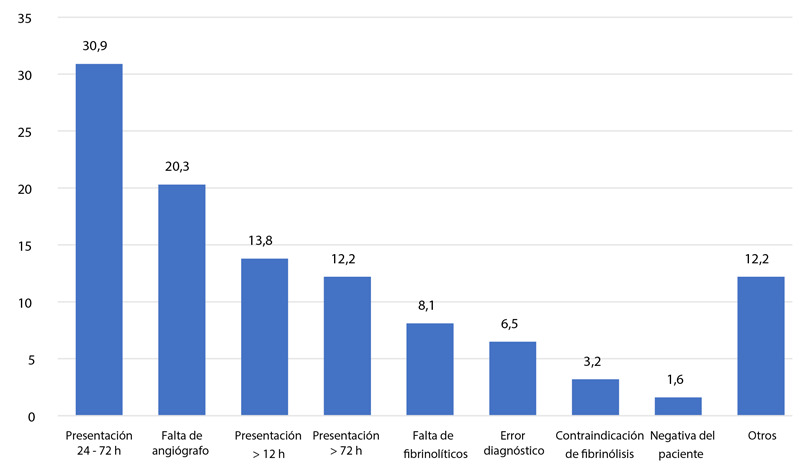
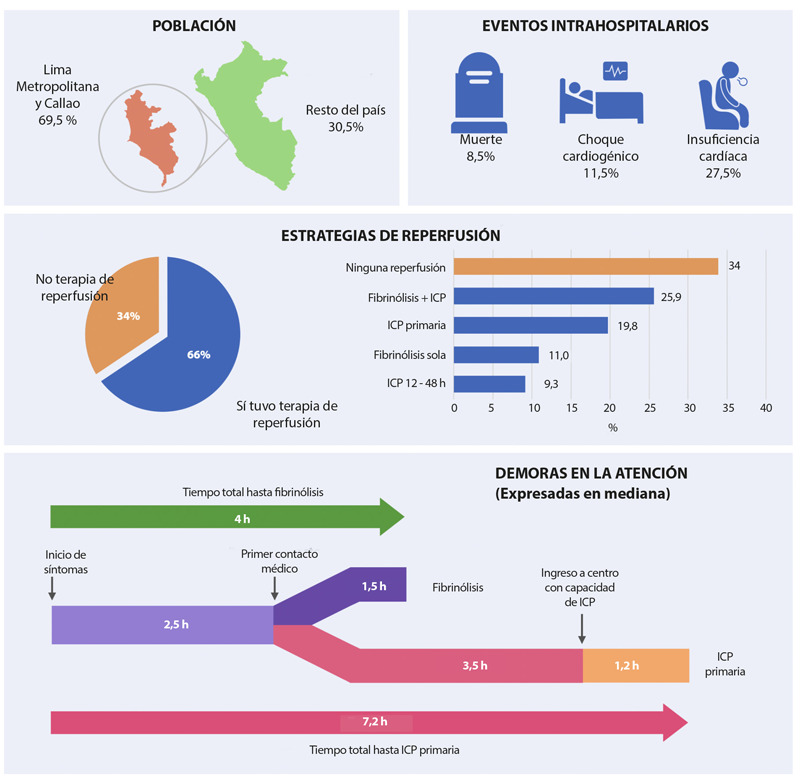
A total of 374 patients were included, 69.5% in Lima and Callao. Fibrinolysis was used in 37% of cases (pharmacoinvasive 26% and fibrinolysis alone 11%), primary angioplasty with < 12 hours of evolution in 20%, late angioplasty in 9% and 34% did not access adequate reperfusion therapies, mainly due to late presentation. Ischemia time was longer in patients with primary angioplasty compared to fibrinolysis (median 7.7 hours (RIQ 5-10) and 4 hours (RIQ 2.3-5.5) respectively). Mortality was 8.5%, the incidence of post-infarction heart failure was 27.8% and of cardiogenic shock 11.5%. Successful reperfusion was associated with lower cardiovascular mortality (RR:0.28; 95%CI: 0.12-0.66, p=0.003) and lower incidence of heart failure during hospitalization (RR: 0.61; 95%CI: 0.43-0.85, p=0.004).
Fibrinolysis continues to be the most frequent reperfusion therapy in public hospitals in Peru. Shorter ischemia-to-reperfusion time was associated with reperfusion success, and in turn with fewer in-hospital adverse events.
ST段抬高型心肌梗死(STEMI)是全球发病和死亡的重要原因,充分的心肌再灌注可减少该疾病的并发症。本研究的目的是描述秘鲁STEMI的临床和治疗特征,以及成功再灌注与院内不良事件的关系。
对2020年在秘鲁公立医院就诊的STEMI患者进行前瞻性、多中心队列研究。我们评估了临床、治疗特征和院内不良事件,以及成功再灌注与不良事件之间的关系。
共纳入374例患者,69.5%来自利马和卡亚俄。37%的病例采用了溶栓治疗(药物介入治疗占26%,单纯溶栓治疗占11%),20%的患者在发病12小时内进行了直接血管成形术,9%的患者进行了延迟血管成形术,34%的患者未接受充分的再灌注治疗,主要原因是就诊延迟。与溶栓治疗相比,直接血管成形术患者的缺血时间更长(中位数分别为7.7小时(四分位间距5-10)和4小时(四分位间距2.3-5.5))。死亡率为8.5%,梗死后心力衰竭的发生率为27.8%,心源性休克的发生率为