Koszewicz Magdalena, Szydlo Mariusz, Gosk Jerzy, Wieczorek Malgorzata, Slotwinski Krzysztof, Budrewicz Slawomir
Department of Neurology, Wroclaw Medical University, Wroclaw, Poland.
Department of Trauma and Orthopedic Surgery, Regional Specialist Hospital, Wroclaw, Poland.
Front Neurol. 2022 Jun 13;13:900562. doi: 10.3389/fneur.2022.900562. eCollection 2022.
The gold standards for the diagnosis and treatment of carpal tunnel syndrome (CTS) and its outcome are undecided. Using clinical and electrophysiological methods, we tried to establish which fibers achieved full postoperative recovery, and the possibility of using non-standard electrophysiological tests as outcome predictors.
The study group consisted of 35 patients and controls. The Historical-Objective Scale, standard neurography, conduction velocity distribution tests (CVD), and quantitative sensory testing (QST) were performed before and after CTS surgery.
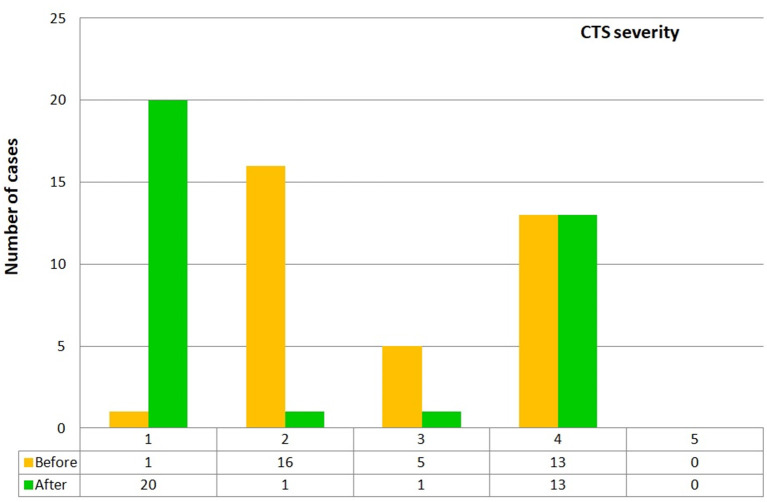
Clinical improvement was observed on average in 54.3% of the patients, higher in less advanced CTS. All parameters improved significantly after surgery, except for CVD; most remained worse than in the controls. Only QST parameters fully returned to normal limits. Patient age and CTS severity were important in the estimation of the risk of no improvement.
The efficiency of minimally invasive CTS surgery is higher in younger patients with less advanced CTS. Complete recovery was present only in small fibers; larger fibers could most likely be responsible for residual signs. We did not notice any benefits in CTS diagnosis using methods of small fiber assessment. QST seemed to be useful in the diagnosis of residual signs, and in deciding upon possible reoperation.
腕管综合征(CTS)诊断、治疗的金标准及其结果尚无定论。我们运用临床和电生理方法,试图确定哪些纤维在术后实现了完全恢复,以及使用非标准电生理测试作为结果预测指标的可能性。
研究组包括35例患者和对照组。在CTS手术前后进行了历史-客观量表、标准神经电图、传导速度分布测试(CVD)和定量感觉测试(QST)。
平均54.3%的患者临床症状得到改善,在病情较轻的CTS患者中改善率更高。除CVD外,术后所有参数均显著改善;大多数参数仍比对照组差。只有QST参数完全恢复到正常范围。患者年龄和CTS严重程度对评估无改善风险很重要。
微创CTS手术在病情较轻的年轻患者中效率更高。只有小纤维实现了完全恢复;较大纤维很可能是残留体征的原因。我们未发现使用小纤维评估方法对CTS诊断有任何益处。QST似乎对残留体征的诊断以及决定是否可能再次手术有用。