Department of Translational Medicine - Hand Surgery, Lund University, Skåne University Hospital, Jan Waldenströms gata 5, 205 02, Malmö, Sweden.
Department of Hand Surgery, Skåne University Hospital, Jan Waldenströms gata 5, 205 02, Malmö, Sweden.
Sci Rep. 2020 Aug 10;10(1):13472. doi: 10.1038/s41598-020-70543-8.
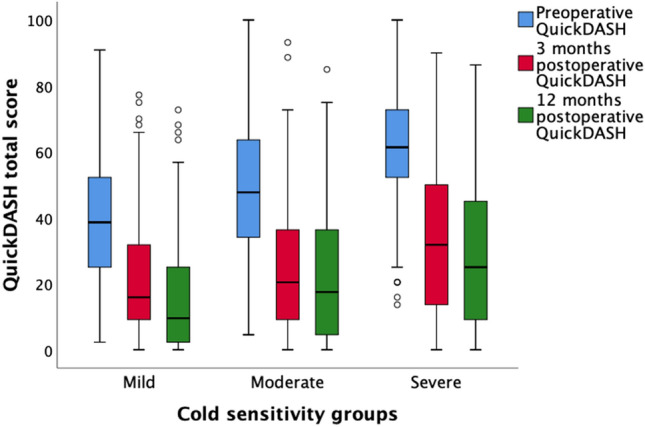
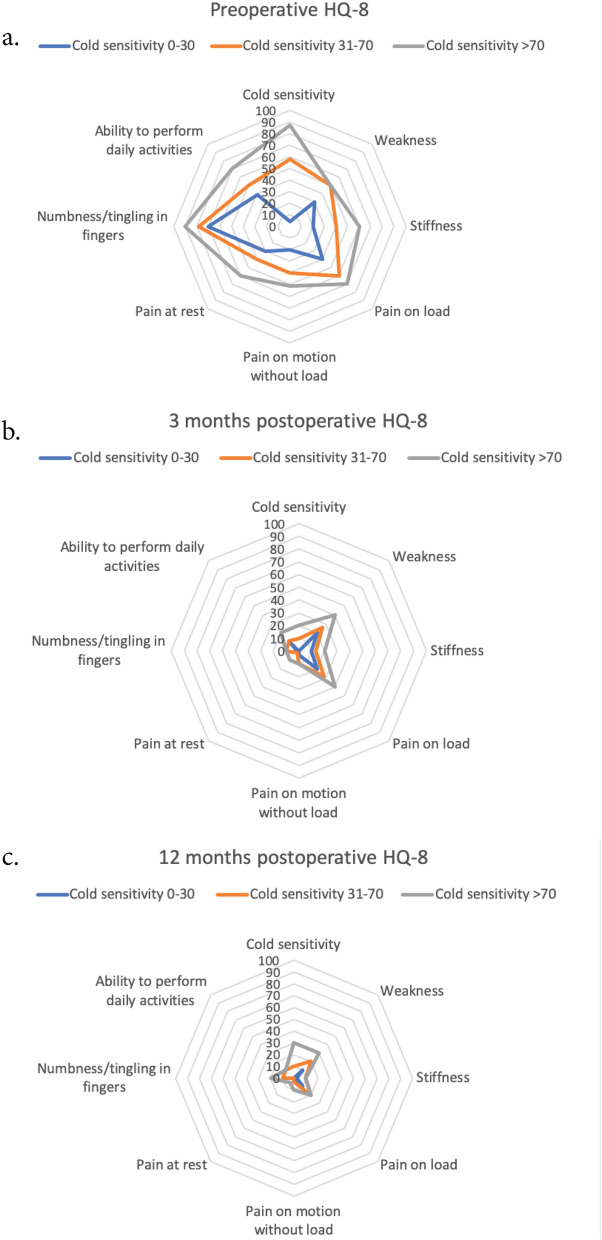
Cold sensitivity is common following nerve injuries in the upper extremity, but is less well studied in carpal tunnel syndrome (CTS). We investigated cold sensitivity in CTS and its effects on surgical outcome. A search of the Swedish National Registry for Hand Surgery (HAKIR) for open carpal tunnel releases (OCTR) from 2010-2016 identified 10,746 cases. Symptom severity questionnaires (HQ-8; HAKIR questionnaire 8, eight Likert-scale items scored 0-100, one item on cold sensitivity) and QuickDASH scores before and after surgery were collected. Patient mean age was 56 ± SD 16 years, and 7,150/10,746 (67%) were women. Patients with severe cold sensitivity (defined as cold intolerance symptom severity score > 70; n = 951), scored significantly higher on QuickDASH at all time points compared to those with mild cold sensitivity (cold intolerance symptom severity scores ≤ 30, n = 1,532); preoperatively 64 [50-75] vs. 40 [25-55], at three months 32 [14-52] vs. 18 [9-32] and at 12 months 25 [7-50] vs. 9 [2-23]; all p < 0.0001. Severe cold sensitivity predicted higher postoperative QuickDASH scores at three [12.9 points (95% CI 10.2-15.6; p < 0.0001)] and at 12 months [14.8 points (11.3-18.4; p < 0.0001)] compared to mild cold sensitivity, and adjustment for a concomitant condition in the hand/arm, including ulnar nerve compression, did not influence the results. Cold sensitivity improves after OCTR. A higher preoperative degree of cold sensitivity is associated with more preoperative and postoperative disability and symptoms than a lower degree of cold sensitivity, but with the same improvement in QuickDASH score.
上肢神经损伤后常出现冷敏感,但在腕管综合征(CTS)中研究较少。我们研究了 CTS 中的冷敏感及其对手术结果的影响。对手腕隧道松解术(OCTR)的瑞典国家手部手术登记处(HAKIR)进行了 2010-2016 年的开放式腕管松解术搜索,共发现 10746 例病例。收集了症状严重程度问卷(HQ-8;HAKIR 问卷 8,8 项李克特量表项目,评分 0-100,一项关于冷敏感的项目)和手术前后的 QuickDASH 评分。患者平均年龄为 56±16 岁,7150/10746(67%)为女性。与轻度冷敏感(冷不耐受症状严重程度评分≤30,n=1532)相比,严重冷敏感(定义为冷不耐受症状严重程度评分>70,n=951)的患者在所有时间点的 QuickDASH 评分均显著较高;术前为 64[50-75] vs. 40[25-55],术后 3 个月为 32[14-52] vs. 18[9-32],术后 12 个月为 25[7-50] vs. 9[2-23];所有 p<0.0001。严重冷敏感预测术后 3 个月[12.9 分(95%CI 10.2-15.6;p<0.0001)]和 12 个月[14.8 分(11.3-18.4;p<0.0001)]的术后 QuickDASH 评分更高,在手/臂中存在并存疾病(包括尺神经压迫)的调整后,结果没有影响。OCTR 后冷敏感性改善。术前较高的冷敏感程度与术前和术后残疾和症状比较低的冷敏感程度更相关,但 QuickDASH 评分的改善相同。