Manuel Matthias M, Feng Sing-Yi, Yen Kenneth, Patel Faisalmohemed
Division of Emergency Medicine Department of Pediatrics University of Texas Southwestern Medical Center/Children's Health Dallas Texas USA.
North Texas Poison Center Parkland Health and Hospital System Dallas Texas USA.
J Am Coll Emerg Physicians Open. 2022 Jun 20;3(3):e12766. doi: 10.1002/emp2.12766. eCollection 2022 Jun.
Focused research on pediatric agitation is lacking despite being a common mental and behavioral health (MBH) emergency. Prevalence of pediatric agitation remains unknown, and prior reports may have underestimated the rate of restraint use for pediatric agitation. This is the largest study to provide a focused evaluation of the prevalence and predictors of pediatric agitation and restraint use as well as the emergency department (ED) length of stay (LOS) and admission rates for agitated patients.
We reviewed records of patients aged ≤18 years with MBH needs who visited the pediatric ED of a tertiary care hospital during a 3-year-period. We identified and ascertained agitated/aggressive patients using documented signs/symptoms, codes, and Behavioral Activity Rating Scale scores. We performed descriptive and multivariable analyses using SAS 9.4 (SAS Institute).
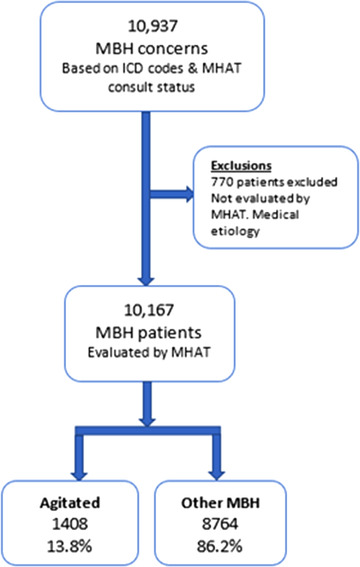
Of 10,172 patients with MBH needs, 1408 (13.8%) were agitated/aggressive. Of these (n = 1408), 63.7% were boys, and the mean age was 11.9 years. Among agitated patients, the prevalence of restraint use was 28.7%, with a predominance of pharmacologic restraint with atypical antipsychotics. Non-Hispanic Blacks were more likely to be agitated (adjusted odd ratio [aOR], 1.8; 95% CI, 1.2-2.7), but not restrained (aOR, 0.8; 95% CI, 0.3-1.8). Predictors of restraint use include history of attention deficit hyperactivity disorder (aOR, 2.2; 95% CI, 1.5-3.3), autism (aOR, 2.9; 95% CI, 1.9-4.5), conduct disorder (aOR, 1.7; 95% CI, 1.2-2.5), psychosis (aOR, 14.3; 95% CI, 2.5-271.8), and substance use/overdose states (aOR, 1.9; CI, 1.2-3.2). Restrained agitated patients had longer ED LOS (8.4 vs 5.0 hours; < 0.0001) and higher admission rates (aOR, 2.6; 95% CI, 2.0-3.5). Depression (aOR, 0.4; 95% CI, 0.3-0.5) and suicidality (aOR, 0.2; 95% CI, 0.1-0.3) were protective against agitation and restraint use.
Prevalence of acute agitation and restraint use in pediatric EDs may be much higher than previously reported. Predictors of acute agitation and restraint use among MBH patients were consistent with prior reports. Restrained agitated patients had longer ED LOS and higher admission rates.
尽管小儿躁动是常见的精神和行为健康(MBH)急症,但针对其的专门研究仍很缺乏。小儿躁动的患病率尚不清楚,先前的报告可能低估了小儿躁动时使用约束措施的比例。这是规模最大的一项研究,重点评估小儿躁动及约束措施使用的患病率和预测因素,以及躁动患者在急诊科(ED)的住院时长(LOS)和住院率。
我们回顾了一家三级护理医院儿科急诊科在3年期间接诊的年龄≤18岁有MBH需求患者的记录。我们通过记录的体征/症状、编码和行为活动评分量表分数来识别和确定躁动/攻击性行为患者。我们使用SAS 9.4(SAS研究所)进行描述性和多变量分析。
在10172名有MBH需求的患者中,1408名(13.8%)出现躁动/攻击性行为。其中(n = 1408),63.7%为男孩,平均年龄为11.9岁。在躁动患者中,使用约束措施的比例为28.7%,主要是使用非典型抗精神病药物进行药物约束。非西班牙裔黑人更易出现躁动(调整后的优势比[aOR],1.8;95%置信区间[CI],1.2 - 2.7),但较少受到约束(aOR,0.8;95% CI,0.3 - 1.8)。使用约束措施的预测因素包括注意力缺陷多动障碍病史(aOR,2.2;95% CI,1.5 - 3.3)、自闭症(aOR,2.9;95% CI,1.9 - 4.5)、品行障碍(aOR,1.7;95% CI,1.2 - 2.5)、精神病(aOR,14.3;95% CI,2.5 - 271.8)以及物质使用/过量状态(aOR,1.9;CI,1.2 - 3.2)。受到约束的躁动患者在急诊科的住院时间更长(8.4小时对5.0小时;<0.0001),住院率更高(aOR,2.6;95% CI,2.0 - 3.5)。抑郁(aOR,0.4;95% CI,0.3 - 0.5)和自杀倾向(aOR,0.2;95% CI,0.1 - 0.3)可预防躁动和约束措施的使用。
儿科急诊科急性躁动和约束措施使用的患病率可能远高于先前报告。MBH患者中急性躁动和约束措施使用的预测因素与先前报告一致。受到约束的躁动患者在急诊科的住院时间更长,住院率更高。