Department of Obstetrics, Reproduction and Development Research Institute, Amsterdam UMC, Vrije Universiteit Medical Center, Amsterdam, The Netherlands.
Department of Obstetrics, Reproduction and Development Research Institute, Amsterdam UMC, Amsterdam Medical Center, Amsterdam, The Netherlands.
PLoS One. 2022 Jun 30;17(6):e0268248. doi: 10.1371/journal.pone.0268248. eCollection 2022.
Spontaneous preterm birth (SPTB) is a major cause of neonatal morbidity and mortality worldwide and defining its risk factors is necessary to reduce its prevalence. Recent studies have pointed out that bacterial vaginosis, a disturbance in the vaginal microbiome, is associated with SPTB. It is hypothesized that vaginal hygiene practices can alter the vaginal microbiome and are therefore associated with SPTB, but there are no studies investigating this matter.
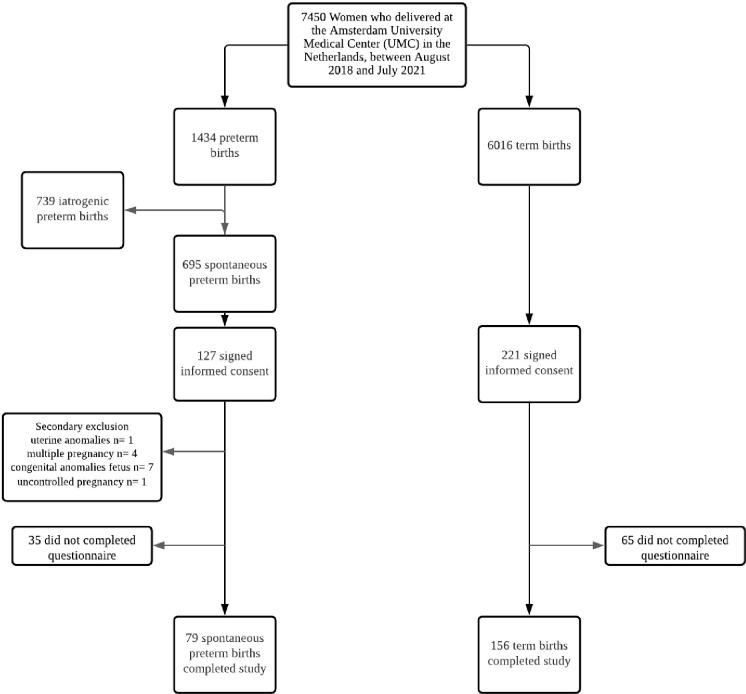
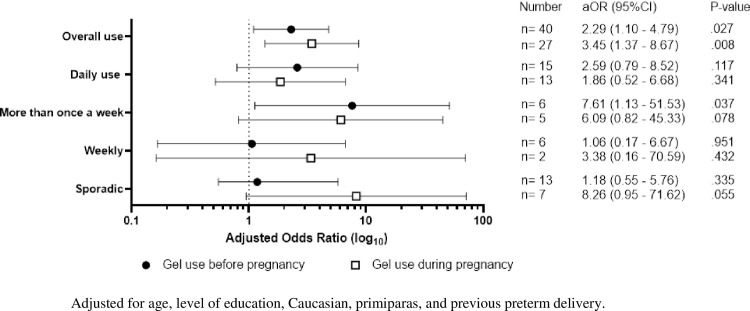
A case-control study was conducted between August 2018 and July 2021 in two affiliated university medical centers in Amsterdam, the Netherlands. We included a total of 79 women with a SPTB and compared them with 156 women with a term birth. Women with uterine anomalies, a history of cervical surgery or major congenital anomalies of the fetus were excluded. All participants filled in a questionnaire about vaginal washing with water, soap or gel, the use of intravaginal douches and vaginal steaming, both before and during pregnancy. Most women washed vaginally with water, 144 (61.3%) women before pregnancy and 135 (57.4%) women during pregnancy. A total of 43 (18.3%) washed with soap before and 36 (15.3%) during pregnancy. Before pregnancy, 40 (17.0%) women washed with vaginal gel and 27 (11.5%) during pregnancy. We found that the use of vaginal gel before pregnancy (aOR 2.29, 95% CI: 1.08-4.84) and even more during pregnancy, was associated with SPTB (aOR 3.45, 95% CI: 1.37-8.67). No association was found between washing with water or soap, intravaginal douching, or vaginal steaming and SPTB.
Our findings suggest that the use of vaginal gel is associated with SPTB. Women should be informed that vaginal use of gels might not be safe.
自发性早产(SPTB)是全球新生儿发病率和死亡率的主要原因,确定其危险因素对于降低其发生率至关重要。最近的研究指出,细菌性阴道病,即阴道微生物组的紊乱,与 SPTB 有关。有人假设阴道卫生习惯可以改变阴道微生物组,因此与 SPTB 有关,但目前尚无研究对此进行调查。
2018 年 8 月至 2021 年 7 月期间,在荷兰阿姆斯特丹的两家附属大学医学中心进行了一项病例对照研究。我们共纳入了 79 名 SPTB 孕妇,并将其与 156 名足月分娩孕妇进行了比较。排除了患有子宫畸形、宫颈手术史或胎儿严重先天性畸形的妇女。所有参与者都填写了一份关于用水、肥皂或凝胶冲洗阴道、在怀孕前后使用阴道冲洗器和阴道熏蒸的问卷。大多数妇女用水冲洗阴道,怀孕前有 144 名(61.3%)妇女,怀孕期间有 135 名(57.4%)妇女。怀孕前共有 43 名(18.3%)妇女用肥皂冲洗,怀孕期间有 36 名(15.3%)妇女用肥皂冲洗。怀孕前,有 40 名(17.0%)妇女使用阴道凝胶冲洗,怀孕期间有 27 名(11.5%)妇女使用阴道凝胶冲洗。我们发现,怀孕前使用阴道凝胶(aOR 2.29,95%CI:1.08-4.84),甚至在怀孕期间使用阴道凝胶(aOR 3.45,95%CI:1.37-8.67)与 SPTB 有关。用水或肥皂冲洗、阴道冲洗或阴道熏蒸与 SPTB 之间没有关联。
我们的研究结果表明,使用阴道凝胶与 SPTB 有关。应该告知妇女,阴道使用凝胶可能不安全。