Department of Neurology, University of Ulm, Germany.
Department of Neurology, University of Ulm, Germany; German Center for Neurodegenerative Diseases (DZNE), Ulm, Germany.
Neuroimage Clin. 2022;35:103094. doi: 10.1016/j.nicl.2022.103094. Epub 2022 Jun 21.
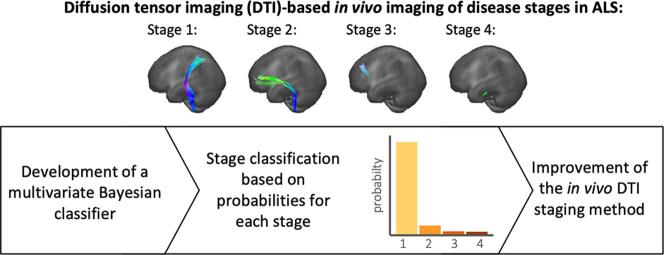
Diffusion tensor imaging (DTI) can be used to tract-wise map correlates of the sequential disease progression and, therefore, to assess disease stages of amyotrophic lateral sclerosis (ALS) in vivo. According to a threshold-based sequential scheme, a classification of ALS patients into disease stages is possible, however, several patients cannot be staged for methodological reasons. This study aims to implement a multivariate Bayesian classification algorithm for disease stage prediction at an individual ALS patient level based on DTI metrics of involved tract systems to improve disease stage mapping.
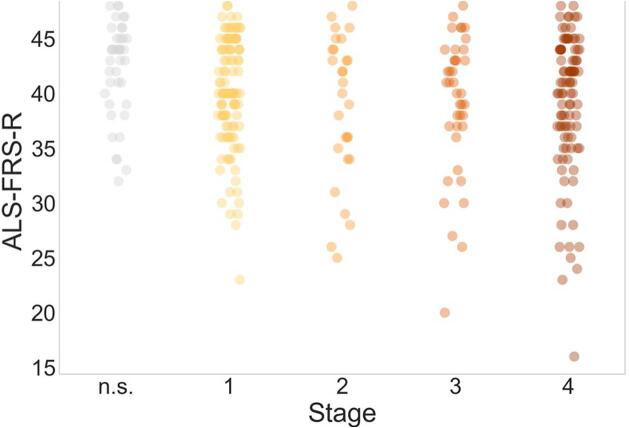
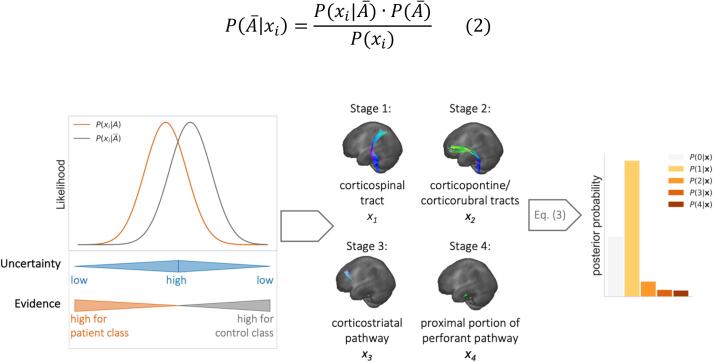
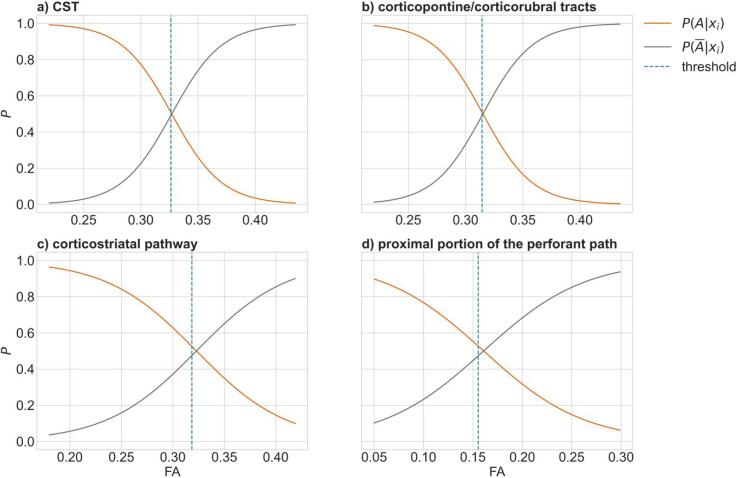
The analysis of fiber tracts involved in each stage of ALS was performed in 325 ALS patients and 130 age- and gender-matched healthy controls. Based on Bayes' theorem and in accordance with the sequential disease progression, a multistage classifier was implemented. Patients were categorized into in vivo DTI stages using the threshold-based method and the Bayesian algorithm. By the margin of confidence, the reliability of the Bayesian categorizations was accessible.
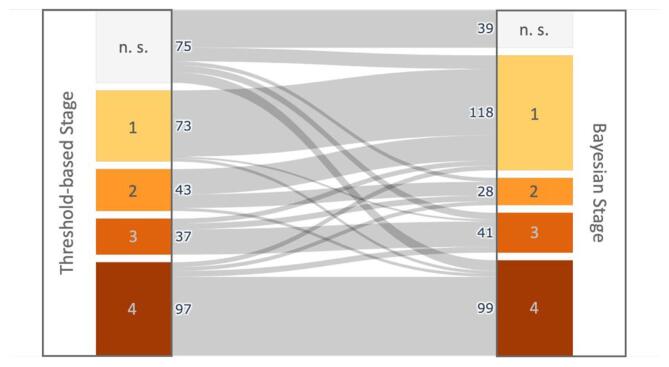
Based on the Bayesian multistage classifier, 88% of all ALS patients could be assigned into an ALS stage compared to 77% using the threshold-based staging scheme. Additionally, the confidence of all classifications could be estimated.
By the application of the multi-stage Bayesian classifier, an individualized in vivo cerebral staging of ALS patients was possible based on the sequentially involved tract systems and, furthermore, the reliability of the respective classifications could be determined. The Bayesian classification algorithm is an improvement of the threshold-based staging method and could provide a framework for extending the DTI-based in vivo cerebral staging in ALS.
弥散张量成像(DTI)可用于追踪疾病进展的相关变化,从而在体内评估肌萎缩侧索硬化症(ALS)的疾病阶段。根据基于阈值的顺序方案,可以对 ALS 患者进行疾病阶段分类,但由于方法学原因,有几个患者无法进行分期。本研究旨在基于受累束系统的 DTI 指标,为每个 ALS 患者实施基于多元贝叶斯分类算法的疾病阶段预测,以改善疾病阶段的映射。
对 325 名 ALS 患者和 130 名年龄和性别匹配的健康对照者的各个 ALS 阶段涉及的纤维束进行分析。基于贝叶斯定理并根据疾病的顺序进展,实施了一个多阶段分类器。采用基于阈值的方法和贝叶斯算法将患者分为体内 DTI 阶段。通过置信区间,可以获得贝叶斯分类的可靠性。
基于贝叶斯多阶段分类器,与基于阈值的分期方案相比,88%的 ALS 患者可以归入 ALS 阶段,而基于阈值的分期方案仅为 77%。此外,还可以估计所有分类的置信度。
通过应用多阶段贝叶斯分类器,可以根据依次受累的束系统对 ALS 患者进行个体化的体内大脑分期,并且可以确定相应分类的可靠性。贝叶斯分类算法是基于阈值的分期方法的改进,可以为扩展 ALS 中基于 DTI 的体内大脑分期提供框架。