Department of Clinical Medicine, Miguel Hernández University of Elche, Ctra N332 s/n, 03550, Sant Joan d'Alacant, Alicante, Spain.
Department of Internal Medicine, Instituto de Investigación Biomédica de Málaga (IBIMA), Regional University Hospital of Málaga & University of Málaga, Málaga, Spain.
BMC Geriatr. 2022 Jun 30;22(1):546. doi: 10.1186/s12877-022-03191-4.
Old age is one of the most important risk factors for severe COVID-19. Few studies have analyzed changes in the clinical characteristics and prognosis of COVID-19 among older adults before the availability of vaccines. This work analyzes differences in clinical features and mortality in unvaccinated very old adults during the first and successive COVID-19 waves in Spain.
This nationwide, multicenter, retrospective cohort study analyzes unvaccinated patients ≥ 80 years hospitalized for COVID-19 in 150 Spanish hospitals (SEMI-COVID-19 Registry). Patients were classified according to whether they were admitted in the first wave (March 1-June 30, 2020) or successive waves (July 1-December 31, 2020). The endpoint was all-cause in-hospital mortality, expressed as the case fatality rate (CFR).
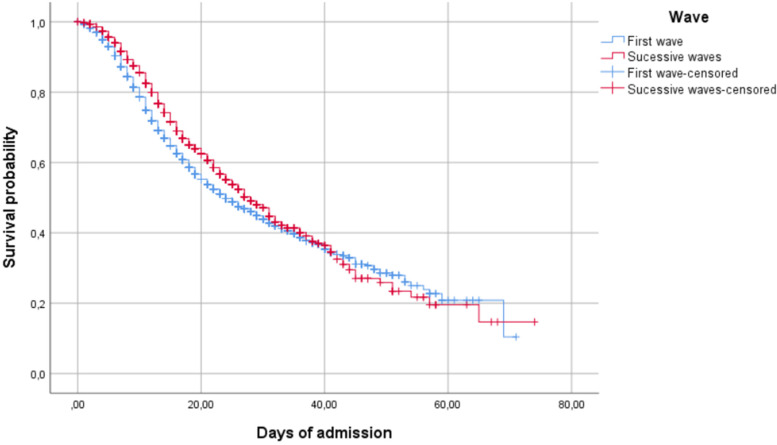
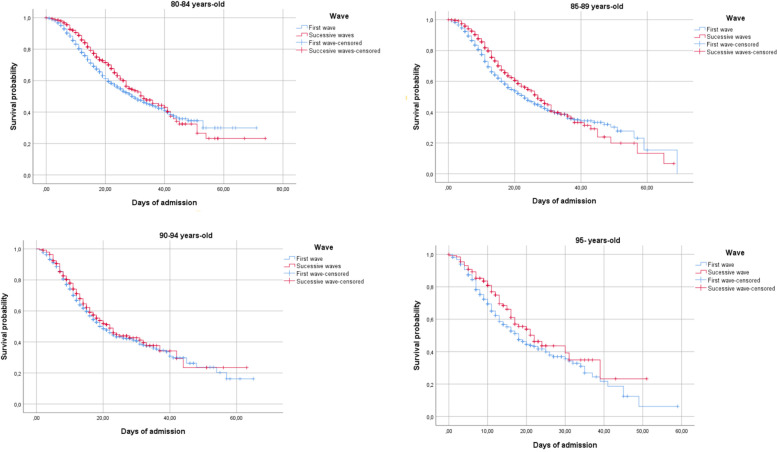
Of the 21,461 patients hospitalized with COVID-19, 5,953 (27.7%) were ≥ 80 years (mean age [IQR]: 85.6 [82.3-89.2] years). Of them, 4,545 (76.3%) were admitted during the first wave and 1,408 (23.7%) during successive waves. Patients hospitalized in successive waves were older, had a greater Charlson Comorbidity Index and dependency, less cough and fever, and met fewer severity criteria at admission (qSOFA index, PO2/FiO2 ratio, inflammatory parameters). Significant differences were observed in treatments used in the first (greater use of antimalarials, lopinavir, and macrolides) and successive waves (greater use of corticosteroids, tocilizumab and remdesivir). In-hospital complications, especially acute respiratory distress syndrome and pneumonia, were less frequent in patients hospitalized in successive waves, except for heart failure. The CFR was significantly higher in the first wave (44.1% vs. 33.3%; -10.8%; p < 0.001) and was higher among patients ≥ 95 years (54.4% vs. 38.5%; -15.9%; p < 0.001). After adjustments to the model, the probability of death was 33% lower in successive waves (OR: 0.67; 95% CI: 0.57-0.79).
Mortality declined significantly between the first and successive waves in very old unvaccinated patients hospitalized with COVID-19 in Spain. This decline could be explained by a greater availability of hospital resources and more effective treatments as the pandemic progressed, although other factors such as changes in SARS-CoV-2 virulence cannot be ruled out.
老年是 COVID-19 重症的最重要危险因素之一。很少有研究分析在疫苗可用之前,老年 COVID-19 患者的临床特征和预后变化。这项工作分析了西班牙在第一次和随后的 COVID-19 浪潮期间,未接种疫苗的非常高龄老年人的临床特征和死亡率差异。
这是一项全国性的、多中心的回顾性队列研究,分析了在西班牙 150 家医院(SEMI-COVID-19 登记处)住院的 COVID-19 未接种疫苗的 ≥80 岁患者。根据他们是在第一波(2020 年 3 月 1 日至 6 月 30 日)还是随后的波(2020 年 7 月 1 日至 12 月 31 日)入院,对患者进行分类。终点是全因院内死亡率,以病死率(CFR)表示。
在 COVID-19 住院的 21461 名患者中,有 5953 名(27.7%) ≥80 岁(平均年龄[IQR]:85.6 [82.3-89.2] 岁)。其中,4545 名(76.3%)在第一波入院,1408 名(23.7%)在随后的波入院。在随后的波中入院的患者年龄更大,合并症指数和依赖性更高,咳嗽和发热较少,入院时符合较少的严重程度标准(qSOFA 指数、PO2/FiO2 比值、炎症参数)。在第一波(更广泛使用抗疟药、洛匹那韦和大环内酯类药物)和随后的波(更广泛使用皮质类固醇、托珠单抗和瑞德西韦)中观察到治疗方法存在显著差异。在随后的波中,住院并发症,尤其是急性呼吸窘迫综合征和肺炎的发生率较低,但心力衰竭除外。第一波的 CFR 明显更高(44.1%比 33.3%;-10.8%;p<0.001),并且在 ≥95 岁的患者中更高(54.4%比 38.5%;-15.9%;p<0.001)。在对模型进行调整后,在随后的波中死亡的概率降低了 33%(OR:0.67;95%CI:0.57-0.79)。
在西班牙 COVID-19 住院的未接种疫苗的非常高龄老年人中,第一波和随后的波之间死亡率显著下降。这种下降可能是由于随着大流行的发展,医院资源更加充足,治疗效果更好,但不能排除 SARS-CoV-2 毒力变化等其他因素。