Chiumello Davide, Tavelli Alessandro, Serio Lorenzo, De Benedittis Sara, Pozzi Tommaso, Maj Roberta, Velati Mara, Brusatori Serena, D'Albo Rosanna, Zinnato Carmelo, Marchetti Giulia, Camporota Luigi, Coppola Silvia, D'Arminio Monforte Antonella
Department of Anesthesia and Intensive Care, ASST Santi Paolo e Carlo, San Paolo University Hospital, Via Di Rudini 9, Milan, Italy.
Department of Health Sciences, University of Milan, Milan, Italy.
Ann Intensive Care. 2023 Apr 3;13(1):24. doi: 10.1186/s13613-023-01103-2.
To evaluate the differences in the clinical characteristics and severity of lung impairment, assessed by quantitative lung CT scan, between vaccinated and non-vaccinated hospitalized patients with COVID-19; and to identify the variables with best prognostic prediction according to SARS-CoV-2 vaccination status. We recorded clinical, laboratory and quantitative lung CT scan data in 684 consecutive patients [580 (84.8%) vaccinated, and 104 (15.2%) non-vaccinated], admitted between January and December 2021.
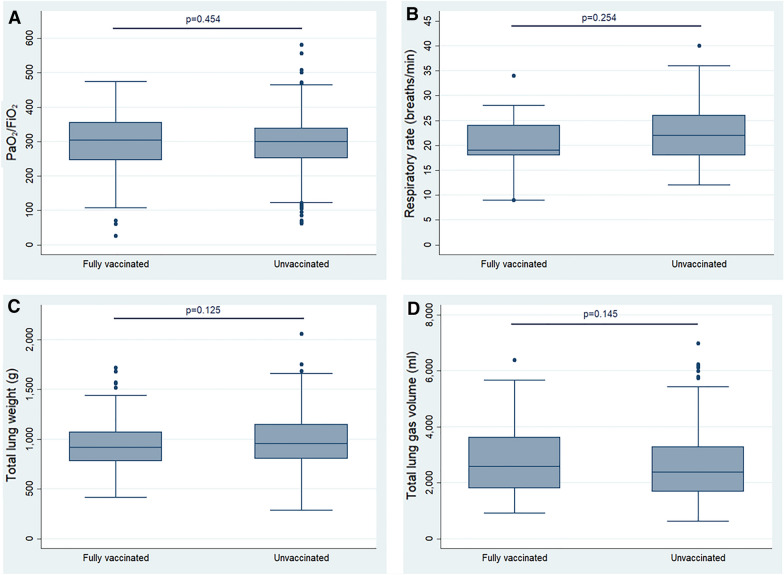
Vaccinated patients were significantly older 78 [69-84] vs 67 [53-79] years and with more comorbidities. Vaccinated and non-vaccinated patients had similar PaO/FiO (300 [252-342] vs 307 [247-357] mmHg; respiratory rate 22 [8-26] vs 19 [18-26] bpm); total lung weight (918 [780-1069] vs 954 [802-1149] g), lung gas volume (2579 [1801-3628] vs 2370 [1675-3289] mL) and non-aerated tissue fraction (10 [7.3-16.0] vs 8.5 [6.0-14.1] %). The overall crude hospital mortality was similar between the vaccinated and non-vaccinated group (23.1% vs 21.2%). However, Cox regression analysis, adjusted for age, ethnicity, age unadjusted Charlson Comorbidity Index and calendar month of admission, showed a 40% reduction in hospital mortality in the vaccinated patients (HR = 0.60, 95%CI 0.38-0.95).
Hospitalized vaccinated patients with COVID-19, although older and with more comorbidities, presented a similar impairment in gas exchange and lung CT scan compared to non-vaccinated patients, but were at a lower risk of mortality.
通过定量肺部CT扫描评估接种疫苗和未接种疫苗的COVID-19住院患者肺部损伤的临床特征和严重程度差异;并根据SARS-CoV-2疫苗接种状况确定具有最佳预后预测价值的变量。我们记录了2021年1月至12月期间收治的684例连续患者的临床、实验室和定量肺部CT扫描数据[580例(84.8%)接种疫苗,104例(15.2%)未接种疫苗]。
接种疫苗的患者年龄显著更大,分别为78[69-84]岁和67[53-79]岁,且合并症更多。接种疫苗和未接种疫苗的患者的动脉血氧分压/吸入氧浓度比值相似(分别为300[252-342]mmHg和307[247-357]mmHg);呼吸频率相似(分别为22[8-26]次/分钟和19[18-26]次/分钟);肺总重量相似(分别为918[780-1069]g和954[802-1149]g),肺气体容积相似(分别为2579[1801-3628]mL和2370[1675-3289]mL),非充气组织比例相似(分别为10[7.3-16.0]%和8.5[6.0-14.1]%)。接种疫苗组和未接种疫苗组的总体粗住院死亡率相似(分别为23.1%和21.2%)。然而,在对年龄、种族、未调整年龄的Charlson合并症指数和入院日历月进行调整的Cox回归分析中,接种疫苗的患者住院死亡率降低了40%(风险比=0.6),95%置信区间为0.38-0.95)。
COVID-19住院接种疫苗患者虽然年龄更大且合并症更多,但与未接种疫苗的患者相比,气体交换和肺部CT扫描显示的损伤相似,但死亡风险更低。