Forsthoefel Matthew, Hankins Ryan, Ballew Elizabeth, Frame Cara, DeBlois David, Pang Dalong, Krishnan Pranay, Unger Keith, Kowalczyk Keith, Lynch John, Dritschilo Anatoly, Collins Sean P, Lischalk Jonathan W
Department of Radiation Medicine, Georgetown University Hospital, Washington, DC, USA.
Department of Urology, Georgetown University Hospital, Washington, DC, USA.
Int J Part Ther. 2022 Apr 6;9(1):28-41. doi: 10.14338/IJPT-21-00039. eCollection 2022 Summer.
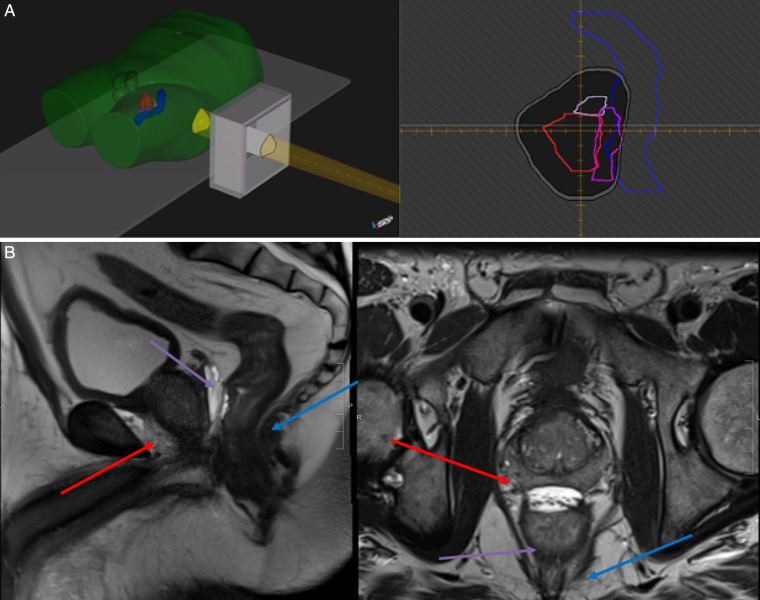
Proton beam radiotherapy (PBT) has been used for the definitive treatment of localized prostate cancer with low rates of high-grade toxicity and excellent patient-reported quality-of-life metrics. Technological advances such as pencil beam scanning (PBS), Monte Carlo dose calculations, and polyethylene glycol gel rectal spacers have optimized prostate proton therapy. Here, we report the early clinical outcomes of patients treated for localized prostate cancer using modern PBS-PBT with hydrogel rectal spacing and fiducial tracking without the use of endorectal balloons.
This is a single institutional review of consecutive patients treated with histologically confirmed localized prostate cancer. Prior to treatment, all patients underwent placement of fiducials into the prostate and insertion of a hydrogel rectal spacer. Patients were typically given a prescription dose of 7920 cGy at 180 cGy per fraction using a Monte Carlo dose calculation algorithm. Acute and late toxicity were evaluated using the Common Terminology Criteria for Adverse Events (CTCAE), version 5. Biochemical failure was defined using the Phoenix definition.
From July 2018 to April 2020, 33 patients were treated (median age, 75 years). No severe acute toxicities were observed. The most common acute toxicity was urinary frequency. With a median follow-up of 18 months, there were no high-grade genitourinary late toxicities; however, one grade 3 gastrointestinal toxicity was observed. Late erectile dysfunction was common. One treatment failure was observed at 21 months in a patient treated for high-risk prostate cancer.
Early clinical outcomes of patients treated with PBS-PBT using Monte Carlo-based planning, fiducial placement, and rectal spacers sans endorectal balloons demonstrate minimal treatment-related toxicity with good oncologic outcomes. Rectal spacer stabilization without the use of endorectal balloons is feasible for the use of PBS-PBT.
质子束放射治疗(PBT)已用于局限性前列腺癌的根治性治疗,其高级别毒性发生率低,患者报告的生活质量指标良好。笔形束扫描(PBS)、蒙特卡洛剂量计算和聚乙二醇凝胶直肠间隔器等技术进步优化了前列腺质子治疗。在此,我们报告使用现代PBS-PBT结合水凝胶直肠间隔和基准跟踪且不使用直肠内气囊治疗局限性前列腺癌患者的早期临床结果。
这是一项对经组织学证实为局限性前列腺癌的连续患者进行的单机构回顾性研究。治疗前,所有患者均在前列腺内放置基准标记并插入水凝胶直肠间隔器。使用蒙特卡洛剂量计算算法,患者通常接受每分次180 cGy、总处方剂量7920 cGy的治疗。使用不良事件通用术语标准(CTCAE)第5版评估急性和晚期毒性。生化失败采用Phoenix定义。
2018年7月至2020年4月,共治疗33例患者(中位年龄75岁)。未观察到严重急性毒性反应。最常见的急性毒性反应是尿频。中位随访18个月,未观察到高级别泌尿生殖系统晚期毒性反应;然而,观察到1例3级胃肠道毒性反应。晚期勃起功能障碍很常见。1例高危前列腺癌患者在21个月时出现1次治疗失败。
使用基于蒙特卡洛的计划、基准标记放置和直肠间隔器且不使用直肠内气囊的PBS-PBT治疗患者的早期临床结果显示,与治疗相关的毒性极小,肿瘤学结果良好。不使用直肠内气囊的直肠间隔器稳定化对于PBS-PBT的使用是可行的。