Vereen Rhyan N, Krajewski Taylor J, Wu Euphy Y, Zhang Jonathan H, Sanzo Nora, Noar Seth M
Hussman School of Journalism and Media, University of North Carolina at Chapel Hill, Chapel Hill, NC, USA.
Gillings School of Global Public Health, University of North Carolina at Chapel Hill, Chapel Hill, NC, USA.
Prev Med Rep. 2022 Jun 17;28:101864. doi: 10.1016/j.pmedr.2022.101864. eCollection 2022 Aug.
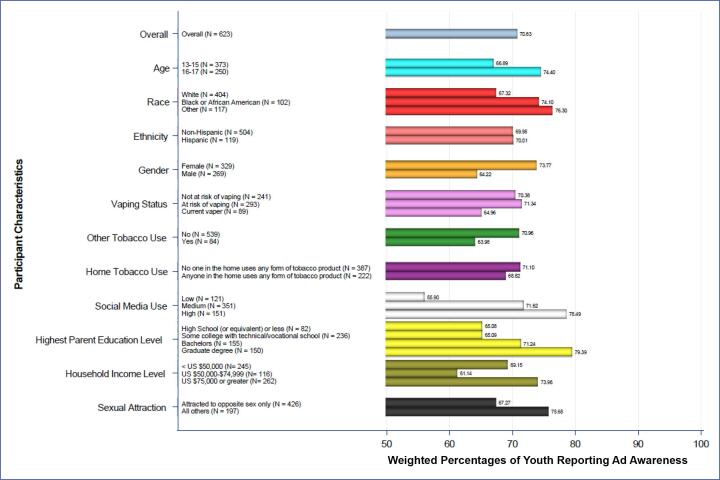
E-cigarette use among youth remains a significant public health concern. In 2018, campaign began disseminating messages about the harms of vaping, primarily using digital media. We sought to determine the prevalence of aided recall of e-cigarette prevention ads and identify potential differences by participant characteristics. Participants were a nationally representative sample of adolescents living in United States (US) households recruited by the National Opinion Research Center (NORC) at the University of Chicago's AmeriSpeak panel in September and October of 2020. A total of 623 adolescents completed the survey. Analyses were weighted to represent the distribution of youth in the US, and effect sizes for individual characteristics were estimated using an adjusted marginalized two-part model. Seventy-one percent of adolescents recalled at least one of the five e-cigarette prevention ads, with individual ad recall ranging from a low of 38.8% (for ) to a high of 50.1% (for Adjusted estimates of aided recall identified significantly higher recall among Black adolescents and those that used social media at medium or high frequencies (p < 0.05). Results support ongoing efforts by the FDA to reach youth with e-cigarette prevention messages using primarily digital media.
青少年使用电子烟仍然是一个重大的公共卫生问题。2018年,一场运动开始传播有关吸电子烟危害的信息,主要通过数字媒体。我们试图确定对电子烟预防广告的辅助回忆率,并根据参与者特征确定潜在差异。参与者是由芝加哥大学美国国家民意研究中心(NORC)在2020年9月和10月通过其AmeriSpeak小组招募的美国家庭中具有全国代表性的青少年样本。共有623名青少年完成了调查。分析经过加权以代表美国青少年的分布情况,并使用调整后的边际两部分模型估计个体特征的效应大小。71%的青少年回忆起了五个电子烟预防广告中的至少一个,单个广告的回忆率从低至38.8%(针对[此处原文缺失具体广告名称])到高至50.1%(针对[此处原文缺失具体广告名称])不等。辅助回忆的调整估计表明,黑人青少年以及中高频率使用社交媒体的青少年的回忆率显著更高(p < 0.05)。结果支持了美国食品药品监督管理局(FDA)目前主要通过数字媒体向青少年传达电子烟预防信息的努力。