Division of Infectious Diseases, Harbor-UCLA Medical Center, Torrance, CA, USA.
The Lundquist Institute for Biomedical Innovation at Harbor-UCLA Medical Center, Torrance, CA, USA.
Mucosal Immunol. 2022 May;15(5):829-836. doi: 10.1038/s41385-022-00536-5. Epub 2022 Jul 1.
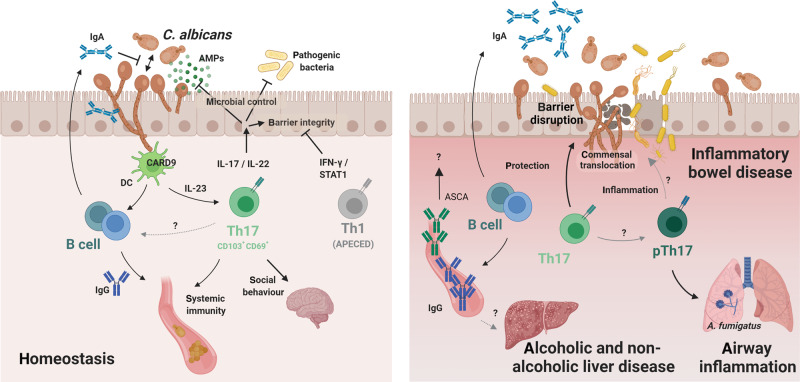
The fungal microbiota (mycobiota) is an integral part of the microbial community colonizing the body surfaces and is involved in many key aspects of human physiology, while an imbalance of the fungal communities, termed fungal dysbiosis, has been described in pathologies ranging from infections to inflammatory bowel disease. Commensal organisms, such as the fungus Candida albicans, induce antigen-specific immune responses that maintain immune homeostasis. Adaptive immune mechanisms are vital in this process, while deficiencies in adaptive immunity are linked to fungal infections. We start to understand the mechanisms by which a shift in mycobiota composition, in particular in C. albicans abundance, is linked to immunopathological conditions. This review discusses the mechanisms that ensure continuous immunosurveillance of C. albicans during mucosal colonization, how these protective adaptive immune responses can also promote immunopathology, and highlight therapeutic advances against C. albicans-associated disease.
真菌微生物群(真菌群落)是定植于体表的微生物群落的一个组成部分,参与了许多人类生理学的关键方面,而真菌群落的失衡,即真菌失调,已在从感染到炎症性肠病等各种疾病中被描述。共生生物体,如真菌白色念珠菌,诱导维持免疫稳态的抗原特异性免疫反应。适应性免疫机制在这个过程中至关重要,而适应性免疫缺陷与真菌感染有关。我们开始了解真菌群落组成(特别是白色念珠菌丰度)变化与免疫病理状况相关的机制。这篇综述讨论了确保黏膜定植过程中对白色念珠菌进行持续免疫监视的机制,这些保护性适应性免疫反应如何也能促进免疫病理学,并强调针对白色念珠菌相关疾病的治疗进展。