Scheid Christof, Kudernatsch Robert, Eckart Marie, Feig Chiara, Straub Vincent, Libutzki Berit, Mahlich Jörg
Universitätsklinikum Köln (AöR), Kerpener Str. 62, 50937, Cologne, Germany.
Janssen-Cilag GmbH, Johnson & Johnson Platz 1, 41470, Neuss, Germany.
Drugs Real World Outcomes. 2022 Dec;9(4):577-588. doi: 10.1007/s40801-022-00320-8. Epub 2022 Jul 2.
Although chronic graft-versus-host-disease (cGvHD) is an important long-term complication after allogenic hematopoietic cell transplantation (allo-HCT) and is associated with increased healthcare resource utilization, real-world evidence is scarce.
The aim of the study was to evaluate survival of patients with cGvHD in Germany and to analyze hospitalization and treatment patterns.
Based on a German claims database with 4.9 million enrollees, a retrospective longitudinal analysis covering a 6-year period between 2013 and 2018 was conducted. Patients with allo-HCT in 2014 or 2015 (index date) and no record of transplantation or documentation of GvHD 365 days prior to index were included. Patients who subsequently developed a cGVHD were compared with those who did not develop a cGVHD within 3 years after index date. cGVHD cases were identified based on documented International Classification of Diseases, Tenth Revision (ICD-10) diagnosis and treatment algorithms. Since the onset of cGvHD is defined at 100 days after allo-HCT, only those alive beyond day 100 were considered in the survival analysis. Patients who did not survive the first 100 days after allo-HCT were censored to prevent a selection bias due to early mortality within patients without GvHD. Survival rates were plotted using the Kaplan-Meier estimator. The number of hospitalizations and average lengths of stay as well as treatment patterns were descriptively examined.
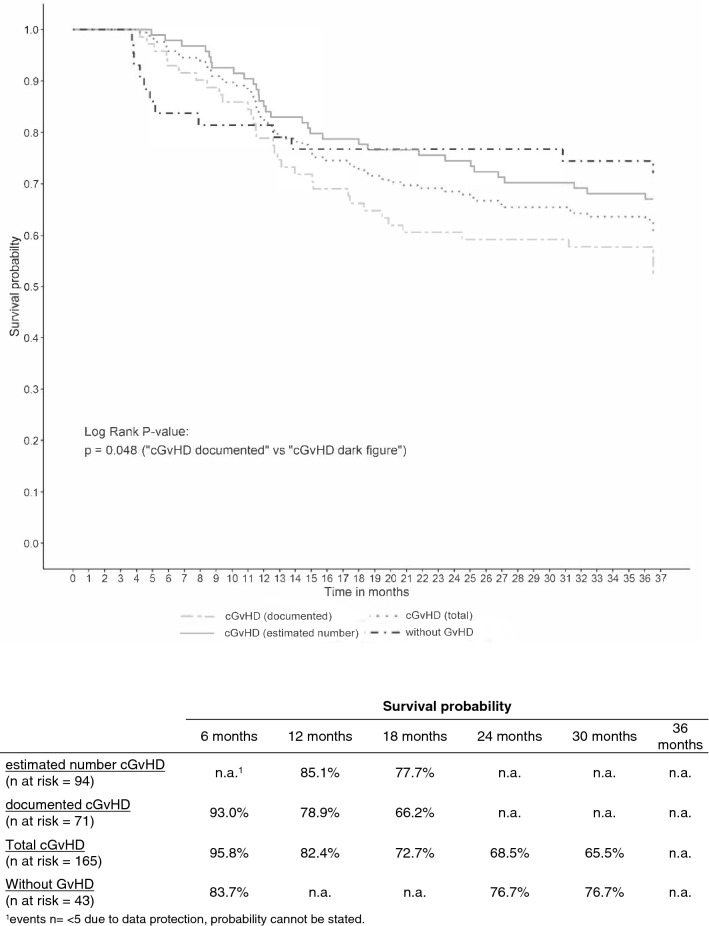
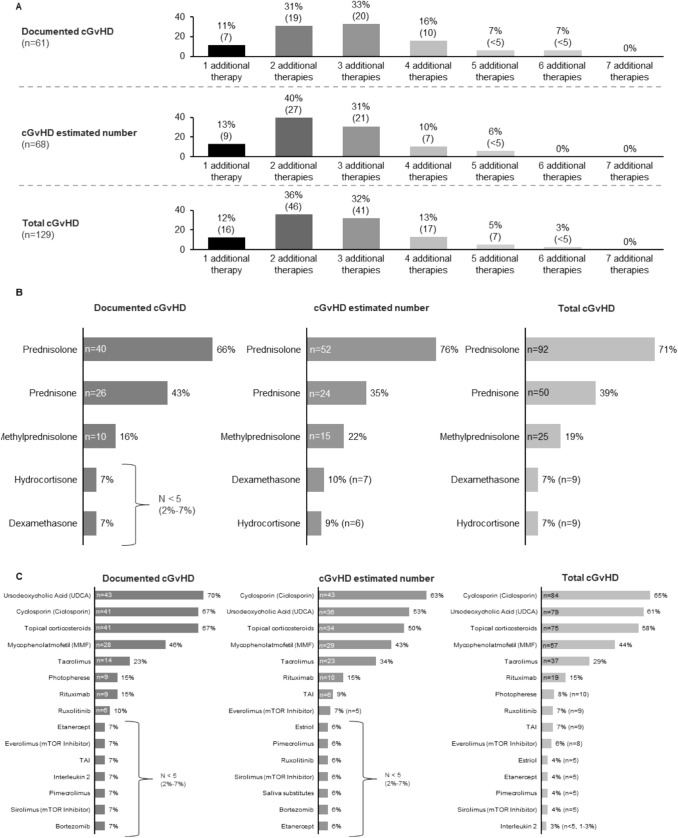
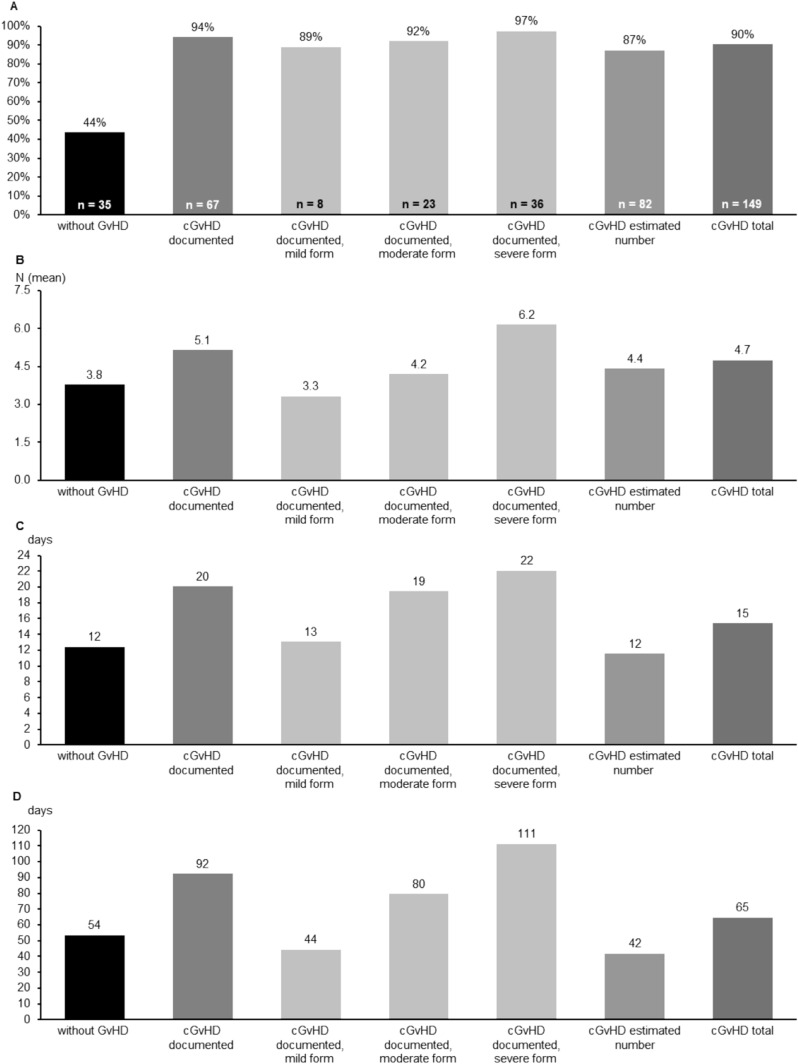
Overall, 165 cGvHD patients were identified and compared with 43 patients without cGVHD. Short-term survival rates were better for patients with cGvHD; the 6-month survival probability was 95.8% for patients with cGVHD and 83.7% for patients without cGVHD. However, long-term survival was better in patients without GvHD; The 30-month survival probability was 65.5% for patients with cGVHD and 76.7% for patients without cGVHD. While overall 90% of cGvHD patients were hospitalized at least once, the share was only half for patients without GvHD (44%). 78.2% of patients with cGVHD received corticosteroids in combination with other predefined immunosuppressants.
Findings from this study reveal a high disease burden associated with cGvHD. This underlines the high medical need for new interventional strategies to improve survival and morbidity after allo-HCT.
尽管慢性移植物抗宿主病(cGvHD)是异基因造血细胞移植(allo-HCT)后一种重要的长期并发症,且与医疗资源利用增加相关,但真实世界证据却很匮乏。
本研究旨在评估德国cGvHD患者的生存率,并分析住院和治疗模式。
基于一个拥有490万参保者的德国索赔数据库,进行了一项回顾性纵向分析,涵盖2013年至2018年的6年时间。纳入2014年或2015年(索引日期)接受allo-HCT且在索引日期前365天无移植记录或移植物抗宿主病记录的患者。将随后发生cGVHD的患者与索引日期后3年内未发生cGVHD的患者进行比较。cGVHD病例根据国际疾病分类第十版(ICD-10)记录的诊断和治疗算法进行识别。由于cGvHD的发病定义为allo-HCT后100天,因此生存分析中仅考虑存活超过100天的患者。对allo-HCT后前100天内未存活的患者进行截尾处理,以防止无移植物抗宿主病患者因早期死亡导致选择偏倚。使用Kaplan-Meier估计量绘制生存率。对住院次数、平均住院时间以及治疗模式进行描述性分析。
总体而言,共识别出165例cGvHD患者,并与43例无cGVHD的患者进行比较。cGvHD患者的短期生存率较好;cGVHD患者的6个月生存概率为95.8%,无cGVHD患者为83.7%。然而,无移植物抗宿主病患者的长期生存率更好;cGVHD患者的30个月生存概率为65.5%,无cGVHD患者为76.7%。虽然总体上90%的cGvHD患者至少住院一次,但无移植物抗宿主病患者的这一比例仅为一半(44%)。78.2%的cGVHD患者接受了皮质类固醇与其他预定义免疫抑制剂的联合治疗。
本研究结果揭示了cGvHD相关的高疾病负担。这凸显了对新的干预策略的高度医疗需求,以改善allo-HCT后的生存率和发病率。