Robergs Robert A, Opeyemi Olumide, Torrens Samuel
School of Exercise and Nutrition Sciences, O Block, A Wing, Level 4, Room A419, Faculty of Health, Queensland University of Technology, Kelvin Grove, Queensland, Australia.
School of Exercise and Nutrition Sciences, O Block, A Wing, Level 4, Faculty of Health, Queensland University of Technology, Kelvin Grove, Queensland, Australia.
Sports Med Health Sci. 2022 Apr 14;4(2):140-146. doi: 10.1016/j.smhs.2022.04.001. eCollection 2022 Jun.
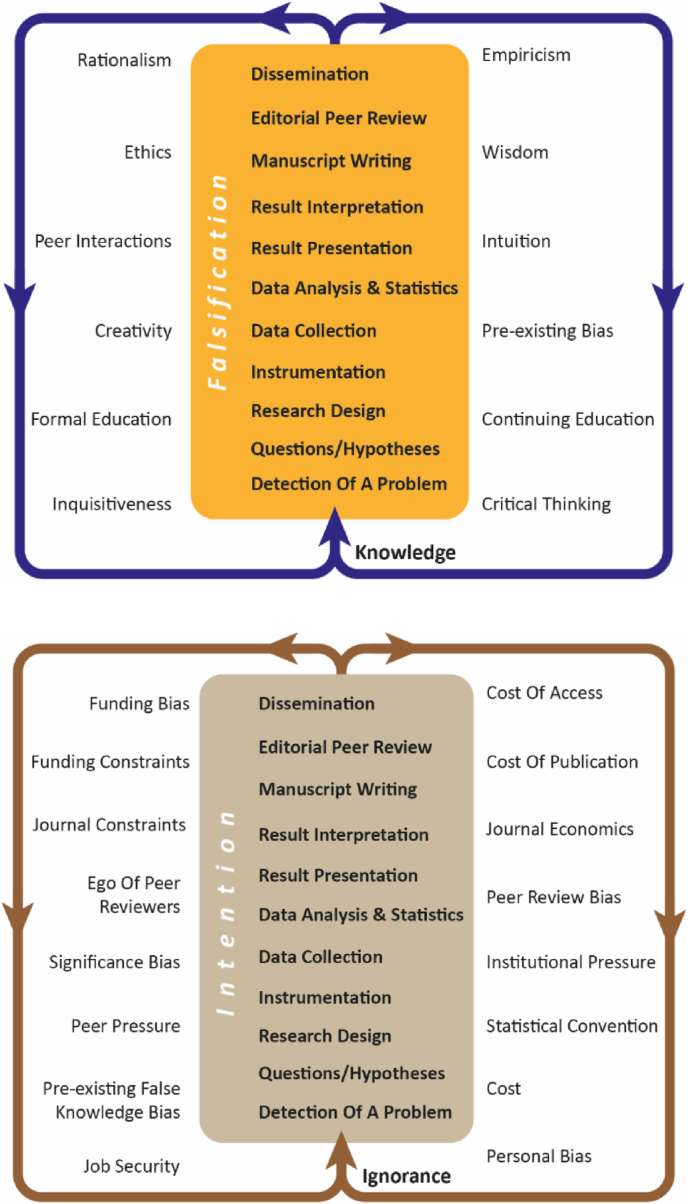
What is science? While a simple question, the answer is complex. Science is a process involving human behaviour, and due to the human influence, science is often not pursued correctly. In fact, one can argue that we still do not know what the "correct" pursuit of science should entail. This is because science remains a work in progress, differs for different questions, and we often are not aware of the mistakes made until years, or decades, later. Such mistakes are common, regardless of the discipline. Within exercise physiology, mistakes have been frequent and led to eventual corrections; the replacement of the post-exercise rate of oxygen consumption (V̇O) debt concept with that of excess post-exercise V̇O; the invalidation of the cellular production of lactic acid; improvements to maximal heart rate estimation; and on-going debate over the Central Governor Model. Improved training and education in the historical development of science and the contributions from scientific philosophy are important in providing an understanding of science, and more importantly, how to pursue "better" vs. "inferior" forms of science. The writings of Popper and Kuhn are core to enhanced understanding of how to improve the quality of science pursued. Unfortunately, quality education and training in the historical and philosophical development of science remain poor in most countries. Until inadequate educational training is overcome, there is sustained risk for the pursuit of science to remain inadequate, which in turn has a potential widespread detriment to humanity and the planet we live on.
什么是科学?这虽是个简单的问题,但其答案却很复杂。科学是一个涉及人类行为的过程,由于受到人类因素的影响,科学常常得不到正确的探索。事实上,可以说我们仍然不知道对科学的“正确”探索应该包含哪些内容。这是因为科学仍在发展之中,针对不同的问题会有所不同,而且我们常常要等到数年甚至数十年后才会意识到所犯的错误。这类错误很常见,无论在哪个学科都是如此。在运动生理学领域,错误屡见不鲜,最终得以纠正;用运动后过量耗氧量的概念取代了运动后氧耗(V̇O)债的概念;细胞产生乳酸的说法被证明是无效的;最大心率估算方法得到了改进;关于中枢调节模型的争论仍在继续。加强对科学历史发展以及科学哲学贡献的培训和教育,对于理解科学,更重要的是理解如何追求“更好”而非“较差”的科学形式非常重要。波普尔和库恩的著作对于加深理解如何提高所追求科学的质量至关重要。不幸的是,在大多数国家,关于科学历史和哲学发展的高质量教育和培训仍然匮乏。在克服教育训练不足的问题之前,追求科学的方式持续存在不足的风险,这反过来可能会对人类以及我们生活的星球造成广泛的损害。