Tokavanich Nicha, Wein Marc N, English Jeryl D, Ono Noriaki, Ono Wanida
Endocrine Unit, Massachusetts General Hospital and Harvard Medical School, Boston, MA, United States.
Department of Developmental Biology, Harvard School of Dental Medicine, Boston, MA, United States.
Front Dent Med. 2021;2. doi: 10.3389/fdmed.2021.769134. Epub 2021 Nov 12.
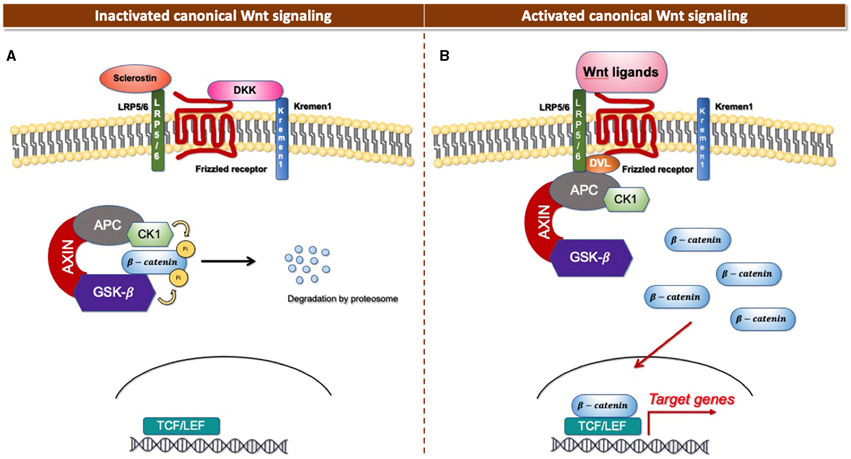
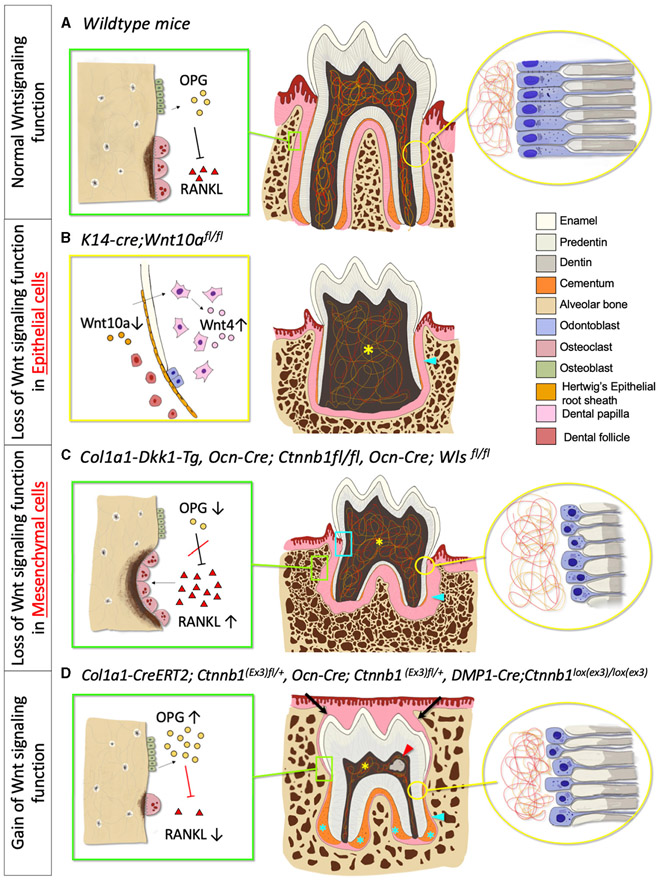
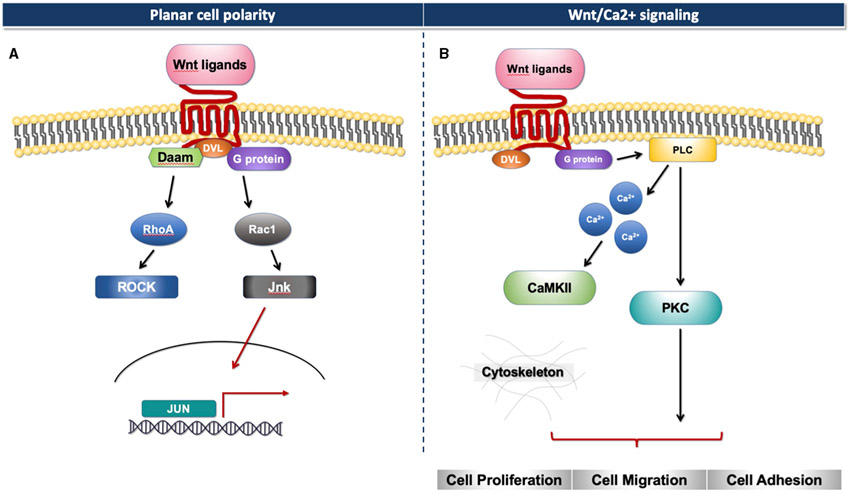
Appropriate tooth root formation and tooth eruption are critical for achieving and maintaining good oral health and quality of life. Tooth eruption is the process through which teeth emerge from their intraosseous position to their functional position in the oral cavity. This temporospatial process occurs simultaneously with tooth root formation through a cascade of interactions between the epithelial and adjoining mesenchymal cells. Here, we will review the role of the Wnt system in postnatal tooth root development. This signaling pathway orchestrates the process of tooth root formation and tooth eruption in conjunction with several other major signaling pathways. The Wnt signaling pathway is comprised of the canonical, or Wnt/β-catenin, and the non-Canonical signaling pathway. The expression of multiple Wnt ligands and their downstream transcription factors including β-catenin is found in the cells in the epithelia and mesenchyme starting from the initiation stage of tooth development. The inhibition of canonical Wnt signaling in an early stage arrests odontogenesis. Wnt transcription factors continue to be present in dental follicle cells, the progenitor cells responsible for differentiation into cells constituting the tooth root and the periodontal tissue apparatus. This expression occurs concurrently with osteogenesis and cementogenesis. The conditional ablation of β-catenin in osteoblast and odontoblast causes the malformation of the root dentin and cementum. On the contrary, the overexpression of β-catenin led to shorter molar roots with thin and hypo-mineralized dentin, along with the failure of tooth eruption. Therefore, the proper expression of Wnt signaling during dental development is crucial for regulating the proliferation, differentiation, as well as epithelial-mesenchymal interaction essential for tooth root formation and tooth eruption.
适当的牙根形成和牙齿萌出对于实现和维持良好的口腔健康及生活质量至关重要。牙齿萌出是牙齿从其骨内位置萌出至口腔中功能位置的过程。这个时空过程通过上皮细胞和相邻间充质细胞之间一系列的相互作用与牙根形成同时发生。在此,我们将综述Wnt系统在出生后牙根发育中的作用。该信号通路与其他几个主要信号通路共同协调牙根形成和牙齿萌出的过程。Wnt信号通路由经典的Wnt/β-连环蛋白信号通路和非经典信号通路组成。从牙齿发育起始阶段开始,在上皮和间充质细胞中就发现了多种Wnt配体及其下游转录因子(包括β-连环蛋白)的表达。早期抑制经典Wnt信号会阻止牙发生。Wnt转录因子持续存在于牙囊细胞中,牙囊细胞是负责分化为构成牙根和牙周组织器官细胞的祖细胞。这种表达与成骨和牙骨质形成同时发生。在成骨细胞和成牙本质细胞中条件性敲除β-连环蛋白会导致牙根牙本质和牙骨质畸形。相反,β-连环蛋白的过表达导致磨牙根变短,牙本质薄且矿化不足,同时牙齿萌出失败。因此,牙齿发育过程中Wnt信号的正确表达对于调节增殖、分化以及牙根形成和牙齿萌出所必需的上皮-间充质相互作用至关重要。