Sonmez A Irem, Lewis Charles P, Port John D, Athreya Arjun P, Choi Doo-Sop, Zaccariello Michael J, Shekunov Julia, Blacker Caren J, Croarkin Paul E
Department of Psychiatry and Psychology, Mayo Clinic College of Medicine and Science, Rochester, MN, USA.
Department of Psychiatry and Behavioral Sciences, University of Minnesota Medical School, Minneapolis, MN, USA.
Biomark Neuropsychiatry. 2021 Dec;5. doi: 10.1016/j.bionps.2021.100043. Epub 2021 Oct 2.
Childhood adversity is a global health problem affecting 25-50% of children worldwide. Few prior studies have examined the underlying neurochemistry of adversity in adolescents. This cross-sectional study examined spectroscopic markers of trauma in a cohort of adolescents with major depressive disorder (MDD) and healthy controls. We hypothesized that historical adversity would have a negative relationship with spectroscopic measures of glutamate metabolites in anterior cingulate cortex.
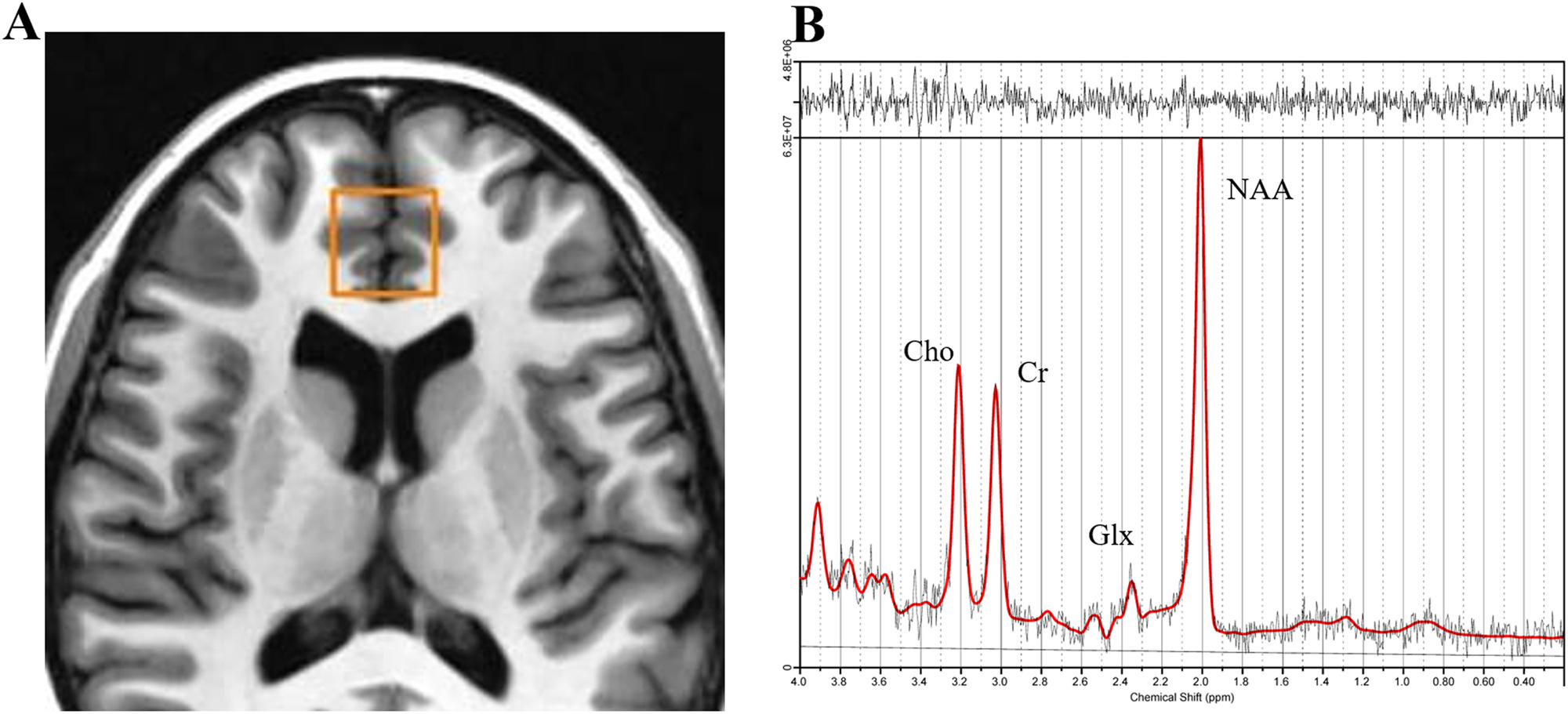
Adolescent participants (aged 13-21) underwent a semi-structured diagnostic interview and clinical assessment, which included the self-report Childhood Trauma Questionnaire (CTQ), a 28-item assessment of childhood adversity. Proton magnetic resonance spectroscopy (H-MRS) scans at 3 Tesla of an anterior cingulate cortex (ACC) voxel (8 cm) encompassing both hemispheres were collected using a 2-dimensional -averaged sequence to assess -acetylaspartate (NAA), Glx (glutamate+glutamine) and [NAA]/[Glx] concentrations. Generalized linear models assessed the relationships between CTQ scores and metabolite levels in ACC.
Thirty-nine participants (17 healthy controls, 22 depressed participants) underwent H-MRS and completed the CTQ measures. There were decrements in [NAA]/[Glx] ratio in the ACC of participants with childhood adversity while no significant relationship between CTQ total score and any of the ACC metabolites was found in the combined sample. Exploratory results revealed a positive association between Glx levels and CTQ scores in depressed participants. Conversely the [NAA]/[Glx] ratio had a negative association with total CTQ scores in the depressed participants. Emotional Abuse Scale showed a significant negative relationship with [NAA]/[Glx] ratio in the combined sample when adjusted for depression severity.
Our findings suggest that childhood adversity may impact brain neurochemical profiles. Further longitudinal studies should examine neurochemical correlates of childhood adversity throughout development and in populations with other psychiatric disorders.
童年逆境是一个全球性的健康问题,影响着全球25%至50%的儿童。此前很少有研究探讨青少年逆境背后的神经化学机制。这项横断面研究在一组患有重度抑郁症(MDD)的青少年和健康对照组中,研究了创伤的光谱学标志物。我们假设,既往逆境与前扣带回皮质中谷氨酸代谢物的光谱学测量值呈负相关。
青少年参与者(年龄在13至21岁之间)接受了半结构化诊断访谈和临床评估,其中包括自我报告的儿童创伤问卷(CTQ),这是一项对童年逆境的28项评估。使用二维平均序列,在3特斯拉磁场下对包含两个半球的前扣带回皮质(ACC)体素(8立方厘米)进行质子磁共振波谱(H-MRS)扫描,以评估N-乙酰天门冬氨酸(NAA)、Glx(谷氨酸+谷氨酰胺)和[NAA]/[Glx]浓度。广义线性模型评估了CTQ分数与ACC中代谢物水平之间的关系。
39名参与者(17名健康对照者,22名抑郁症患者)接受了H-MRS检查并完成了CTQ测量。童年有逆境的参与者ACC中[NAA]/[Glx]比值降低,而在合并样本中未发现CTQ总分与ACC中的任何代谢物之间存在显著关系。探索性结果显示,抑郁症患者中Glx水平与CTQ分数呈正相关。相反,抑郁症患者中[NAA]/[Glx]比值与CTQ总分呈负相关。在根据抑郁严重程度进行调整后,情感虐待量表显示在合并样本中与[NAA]/[Glx]比值呈显著负相关。
我们的研究结果表明,童年逆境可能会影响大脑神经化学特征。进一步的纵向研究应考察童年逆境在整个发育过程中以及在患有其他精神疾病的人群中的神经化学相关性。