Sabião Thaís S, Mendonça Raquel D, Meireles Adriana L, Machado-Coelho George L L, Carraro Júlia C C
Universidade Federal de Ouro Preto, School of Nutrition, Postgraduate Program in Health and Nutrition, Research and Study Group on Nutrition and Public Health (GPENSC), Campus Morro do Cruzeiro, 35400-000, Ouro Preto, Minas Gerais, Brazil.
Universidade Federal de Ouro Preto, Department of Clinical and Social Nutrition, Research and Study Group on Nutrition and Public Health (GPENSC), School of Nutrition, Campus Morro do Cruzeiro, 35400-000, Ouro Preto, Minas Gerais, Brazil.
SSM Popul Health. 2022 Sep;19:101156. doi: 10.1016/j.ssmph.2022.101156. Epub 2022 Jun 27.
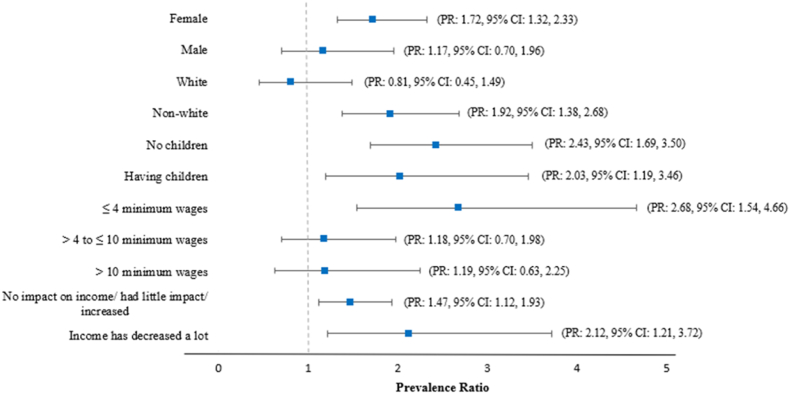
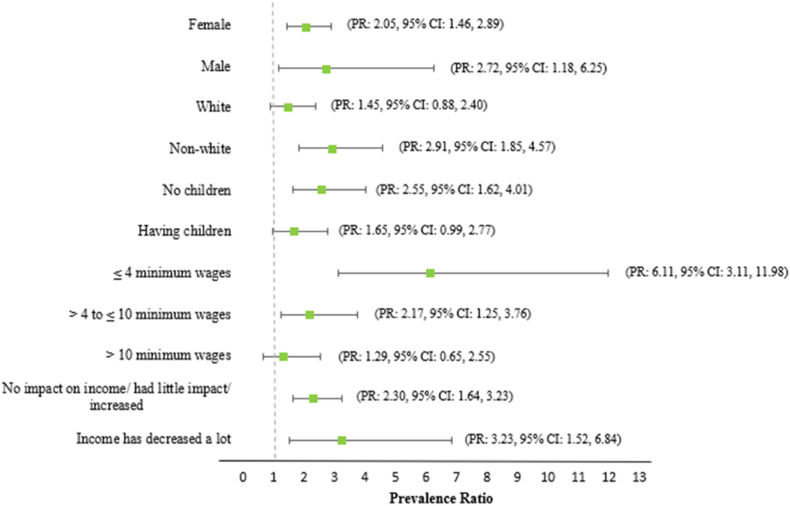
This study aimed to investigate the association between adult food insecurity (FI) and symptoms of generalized anxiety disorder (GAD) and major depressive disorder (MDD) in two Brazilian cities during the coronavirus disease (COVID-19) pandemic. This study used data derived from a cross-sectional survey of 1693 adults. Interviews were conducted using an electronic questionnaire. The FI was measured using the Brazilian Food Insecurity Scale. The Generalized Anxiety Disorder-7 was used to measure the symptoms of GAD. The Patient Health Questionnaire-9 was used for MDD symptoms. The association between FI, GAD, and MDD symptoms was investigated using a Poisson regression model with robust variance to estimate the prevalence ratio and 95% confidence interval (95% CI). In regression models, a linear association between FI levels and outcomes was observed, with severe food insecurity having a 3.56 higher prevalence of GAD symptoms (95% CI: 2.23, 5.68) and a 3.03 higher prevalence of MDD (95% CI: 1.55, 5.90). In the stratified analyses, worse results were observed for females and males, individuals with non-white race/skin color, those without children, and those with lower monthly family income. In conclusion, the FI was associated with symptoms of GAD and MDD, and the sociodemographic characteristics interfered in this association. Therefore, we recommend the improvement of public health and social protection policies for food-insecure people.
本研究旨在调查在冠状病毒病(COVID-19)大流行期间,巴西两个城市的成人粮食不安全状况(FI)与广泛性焦虑障碍(GAD)和重度抑郁症(MDD)症状之间的关联。本研究使用了对1693名成年人进行横断面调查得出的数据。访谈通过电子问卷进行。使用巴西粮食不安全量表来衡量粮食不安全状况。使用广泛性焦虑障碍量表-7来测量广泛性焦虑障碍的症状。使用患者健康问卷-9来评估重度抑郁症症状。使用具有稳健方差的泊松回归模型来研究粮食不安全状况、广泛性焦虑障碍和重度抑郁症症状之间的关联,以估计患病率比和95%置信区间(95%CI)。在回归模型中,观察到粮食不安全水平与结果之间存在线性关联,严重粮食不安全状况下广泛性焦虑障碍症状的患病率高3.56倍(95%CI:2.23,5.68),重度抑郁症的患病率高3.03倍(95%CI:1.55,5.90)。在分层分析中,女性和男性、非白人种族/肤色的个体、没有孩子的个体以及家庭月收入较低的个体的结果更差。总之,粮食不安全状况与广泛性焦虑障碍和重度抑郁症症状相关,社会人口学特征对此关联有影响。因此,我们建议改善针对粮食不安全人群的公共卫生和社会保护政策。