
粪便免疫化学检测阳性结果及其与类风湿关节炎、系统性红斑狼疮和银屑病关节炎发病的相关性:一项百万人全国结直肠癌筛查计划结果分析。
A positive faecal immunochemical test result and its association with the incidence of rheumatoid arthritis, systemic lupus erythematosus, and psoriatic arthritis: an analysis of one-million national colorectal cancer screening programme results.
机构信息
Department of Gastroenterology, Ajou University School of Medicine, Suwon, Republic of Korea.
Department of Medical Sciences, Biomedical Informatics, Graduate School of Ajou University, Suwon, Republic of Korea.
出版信息
BMC Med. 2022 Jul 4;20(1):226. doi: 10.1186/s12916-022-02416-y.
BACKGROUND
Accumulating evidence now indicates that the presence of faecal haemoglobin, in the absence of gastrointestinal bleeding, may be an indicator of systemic inflammation and is linked to the development of human diseases. We evaluated whether a positive faecal immunochemical test (FIT) is associated with the development of immune-mediated inflammatory diseases (IMIDs).
METHODS
Data from the nationwide colorectal cancer screening programme from 2009 to 2013 were used. Participants (n=8,646,887) were divided into FIT (+) and FIT (-) groups by performing a 1:1 random sampling matched by age and sex. Participants with concurrent haemorrhoids, colorectal cancer (CRC), inflammatory bowel disease (IBD), and missed CRC and IBD were excluded using the colonoscopy results, ICD-10 codes, and the special exemption code (V code). Endpoints were the incidence of IMIDs (rheumatoid arthritis [RA], systemic lupus erythematosus [SLE], and psoriatic arthritis [PsA]) after FIT.
RESULTS
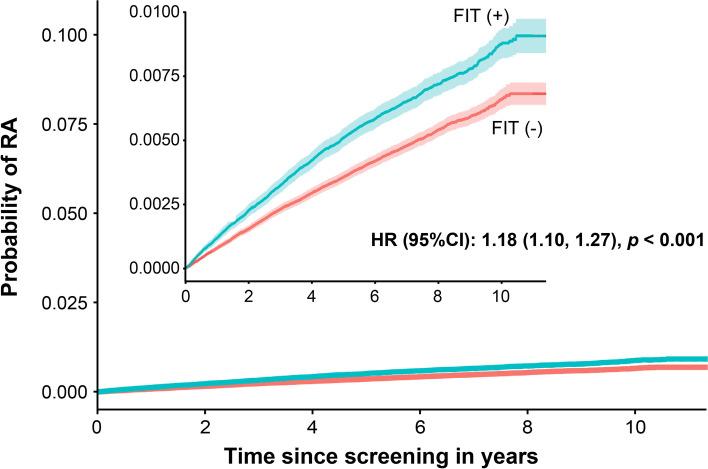
Of the 1,044,955 eligible participants, 229,594 and 815,361 individuals were included in the FIT (+) and the FIT (-) groups, respectively. During the mean follow-up period of 7.59 years, a total of 7645 (incidence rate [IR] 9.56/10,000 person-years [PY]), 208 (IR 0.26/10,000 PY), and 101 (IR 0.13/10,000 PY) patients were diagnosed with RA, SLE, and PsA, respectively. An adjusted Cox analysis demonstrated that FIT positivity conferred a 1.16 (95% confidence interval [CI] 1.09-1.24, p<0.001) times greater risk of developing RA. Kaplan-Meier analysis in the 1:2 propensity-score matched population also confirmed these results (hazard ratio [HR] 1.18, 95% CI 1.10-1.27, p<0.001).
CONCLUSIONS
Positive FIT is associated with increased risk of RA in the general population, corroborating that aberrancies of gut mucosa are associated with the development of IMIDs. Vigilant monitoring and early referral to a specialist upon medical suspicion is required in this population.
TRIAL REGISTRATION
Retrospectively registered.
背景
越来越多的证据表明,粪便血红蛋白的存在,即使没有胃肠道出血,也可能是全身炎症的一个指标,并与人类疾病的发展有关。我们评估了粪便免疫化学检测(FIT)阳性是否与免疫介导的炎症性疾病(IMIDs)的发生有关。
方法
使用了 2009 年至 2013 年全国范围内的结直肠癌筛查计划的数据。通过按年龄和性别进行 1:1 随机抽样匹配,将参与者(n=8,646,887)分为 FIT(+)和 FIT(-)组。使用结肠镜检查结果、ICD-10 代码和特殊豁免代码(V 代码)排除同时患有痔疮、结直肠癌(CRC)、炎症性肠病(IBD)和漏诊 CRC 和 IBD 的参与者。终点是 FIT 后 IMIDs(类风湿关节炎[RA]、系统性红斑狼疮[SLE]和银屑病关节炎[PsA])的发生率。
结果
在 1,044,955 名合格参与者中,229,594 人和 815,361 人分别纳入 FIT(+)和 FIT(-)组。在平均 7.59 年的随访期间,共有 7645 例(发病率[IR]9.56/10,000 人年[PY])、208 例(IR 0.26/10,000 PY)和 101 例(IR 0.13/10,000 PY)患者被诊断为 RA、SLE 和 PsA。调整后的 Cox 分析表明,FIT 阳性使 RA 的发病风险增加 1.16 倍(95%置信区间[CI] 1.09-1.24,p<0.001)。在 1:2 倾向评分匹配人群中的 Kaplan-Meier 分析也证实了这一结果(风险比[HR]1.18,95%CI 1.10-1.27,p<0.001)。
结论
FIT 阳性与一般人群中 RA 风险增加有关,这证实了肠道黏膜的异常与 IMIDs 的发展有关。在这一人群中,需要进行警惕监测,并在出现医学怀疑时及早转介给专家。
试验注册
回顾性注册。

 Zotero 插件