Shu Yamin, He Xucheng, Liu Yanxin, Wu Pan, Zhang Qilin
Department of Pharmacy, Tongji Hospital, Tongji Medical College, Huazhong University of Science and Technology, Wuhan, People's Republic of China.
Department of Pharmacy, Pengzhou Second People's Hospital, Pengzhou, People's Republic of China.
Clin Epidemiol. 2022 Jun 28;14:789-802. doi: 10.2147/CLEP.S365513. eCollection 2022.
Olaparib, the world's first poly ADP-ribose polymerase (PARP) inhibitor (PARPi), has been approved for treatment of ovarian cancer, breast cancer, pancreatic cancer and prostate cancer by FDA. The current study was to assess olaparib-related adverse events (AEs) of real-world through data mining of the US Food and Drug Administration Adverse Event Reporting System (FAERS).
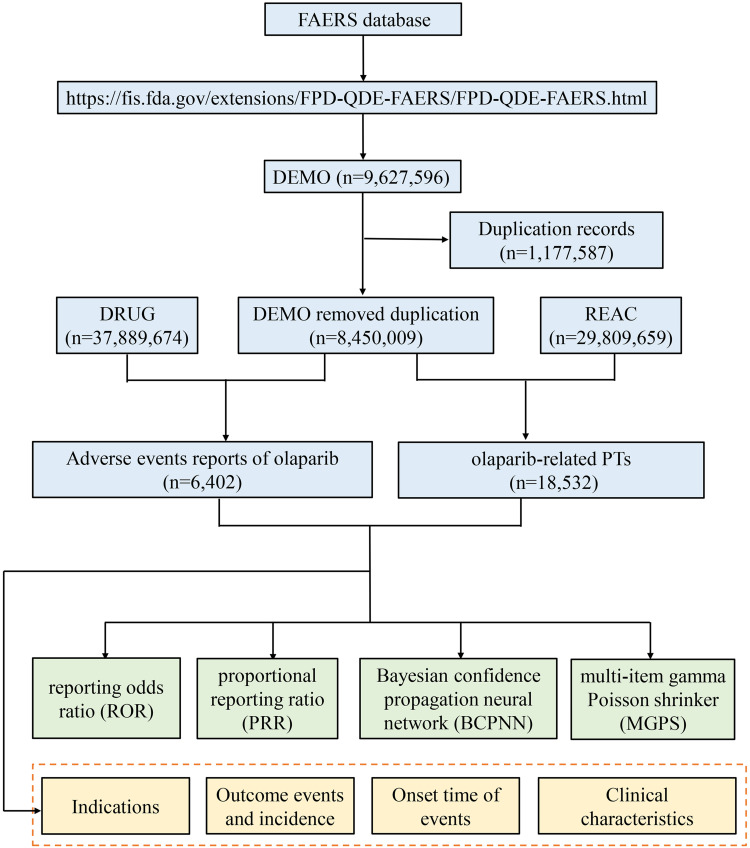
Disproportionality analyses, including the reporting odds ratio (ROR), the proportional reporting ratio (PRR), the Bayesian confidence propagation neural network (BCPNN) and the multi-item gamma Poisson shrinker (MGPS) algorithms were employed to quantify the signals of olaparib-associated AEs.
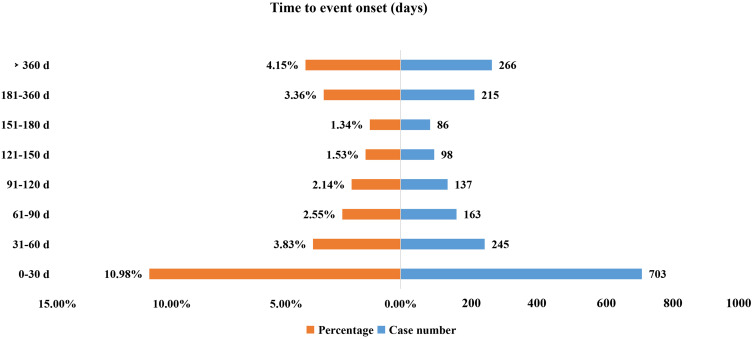
Out of 8,450,009 reports collected from the FAERS database, 6402 reports of olaparib-associated AEs were identified. A total of 118 significant disproportionality preferred terms (PTs) conforming to the four algorithms simultaneously were retained. The most common AEs included anemia, thrombocytopenia, nausea, decreased appetite, blood creatinine increased and dermatomyositis, which were corresponding to those reported in the specification and clinical trials. Unexpected significant AEs as interstitial lung disease, pneumonia, folate deficiency, renal impairment and intestinal obstruction might also occur. The median onset time of olaparib-related AEs was 61 days (interquartile range [IQR] 14-182 days), and most of the cases occurred within the first 1 month after olaparib initiation.
Results of our study were consistent with clinical observations, and we also found potential new and unexpected AEs signals for olaparib, suggesting prospective clinical studies were needed to confirm these results and illustrate their relationship. Our results could provide valuable evidence for further safety studies of olaparib.
奥拉帕利是全球首个聚腺苷酸二磷酸核糖聚合酶(PARP)抑制剂,已获美国食品药品监督管理局(FDA)批准用于治疗卵巢癌、乳腺癌、胰腺癌和前列腺癌。本研究旨在通过挖掘美国食品药品监督管理局不良事件报告系统(FAERS)的数据,评估奥拉帕利在真实世界中的相关不良事件(AE)。
采用不成比例分析方法,包括报告比值比(ROR)、比例报告比(PRR)、贝叶斯置信传播神经网络(BCPNN)和多项目伽马泊松收缩器(MGPS)算法,对奥拉帕利相关AE的信号进行量化。
从FAERS数据库收集的8450009份报告中,识别出6402份奥拉帕利相关AE的报告。共保留了118个同时符合四种算法的显著不成比例首选术语(PT)。最常见的AE包括贫血、血小板减少、恶心、食欲减退、血肌酐升高和皮肌炎,与说明书和临床试验中报告的一致。也可能发生间质性肺病、肺炎、叶酸缺乏、肾功能损害和肠梗阻等意外显著AE。奥拉帕利相关AE的中位发病时间为61天(四分位间距[IQR]14 - 182天),大多数病例发生在开始使用奥拉帕利后的前1个月内。
我们的研究结果与临床观察一致,并且我们还发现了奥拉帕利潜在的新的和意外的AE信号,提示需要进行前瞻性临床研究以证实这些结果并阐明它们之间的关系。我们的结果可为奥拉帕利进一步的安全性研究提供有价值的证据。