Department of Psychiatry and Behavioral Sciences, Albert Einstein College of Medicine, New York, New York.
Department of Psychiatry and Behavioral Sciences, University of Minnesota, Minneapolis.
JAMA Psychiatry. 2022 Aug 1;79(8):760-769. doi: 10.1001/jamapsychiatry.2022.1717.
There are no approved medications for the core symptoms of autism spectrum disorder (ASD), socialization and communication difficulties.
To evaluate the efficacy and safety of balovaptan, an oral selective vasopressin 1a receptor antagonist, compared with placebo in children and adolescents with ASD.
DESIGN, SETTING, AND PARTICIPANTS: The aV1ation study was a randomized, double-blind, 24-week, parallel-group, placebo-controlled phase 2 trial. Between November 22, 2016, and September 3, 2019, individuals were screened and randomly assigned to treatment groups. The primary efficacy analysis population comprised participants taking age-adjusted balovaptan equivalent to a 10-mg adult dose and participants from the concurrently randomized placebo group. This multicenter trial took place across 41 sites in the US. Participants were aged 5 to 17 years with diagnosed ASD and an IQ of 70 or greater. Data were analyzed from April 8 to November 16, 2020.
Participants were randomly assigned to daily 4-mg or 10-mg adult-equivalent balovaptan or placebo, until the 4-mg group was discontinued.
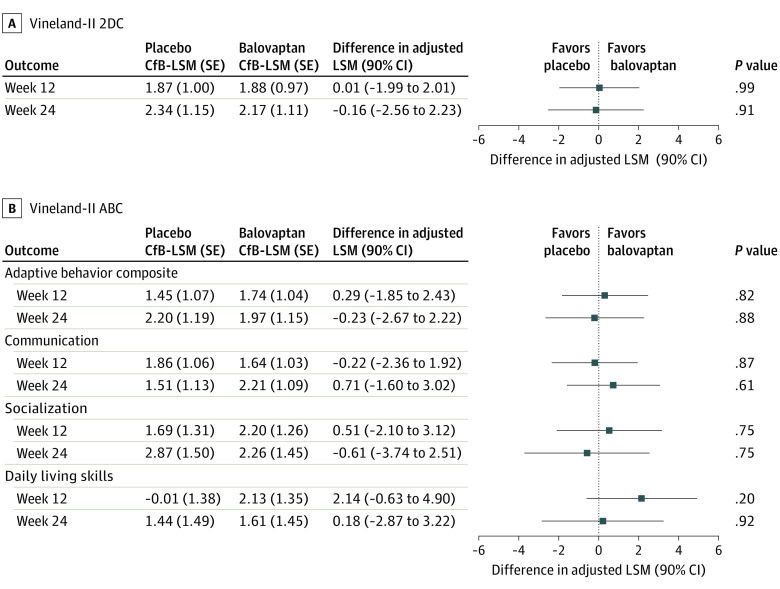
The primary end point was change from baseline on the Vineland-II two-domain composite (2DC; socialization and communication domains) score at week 24.
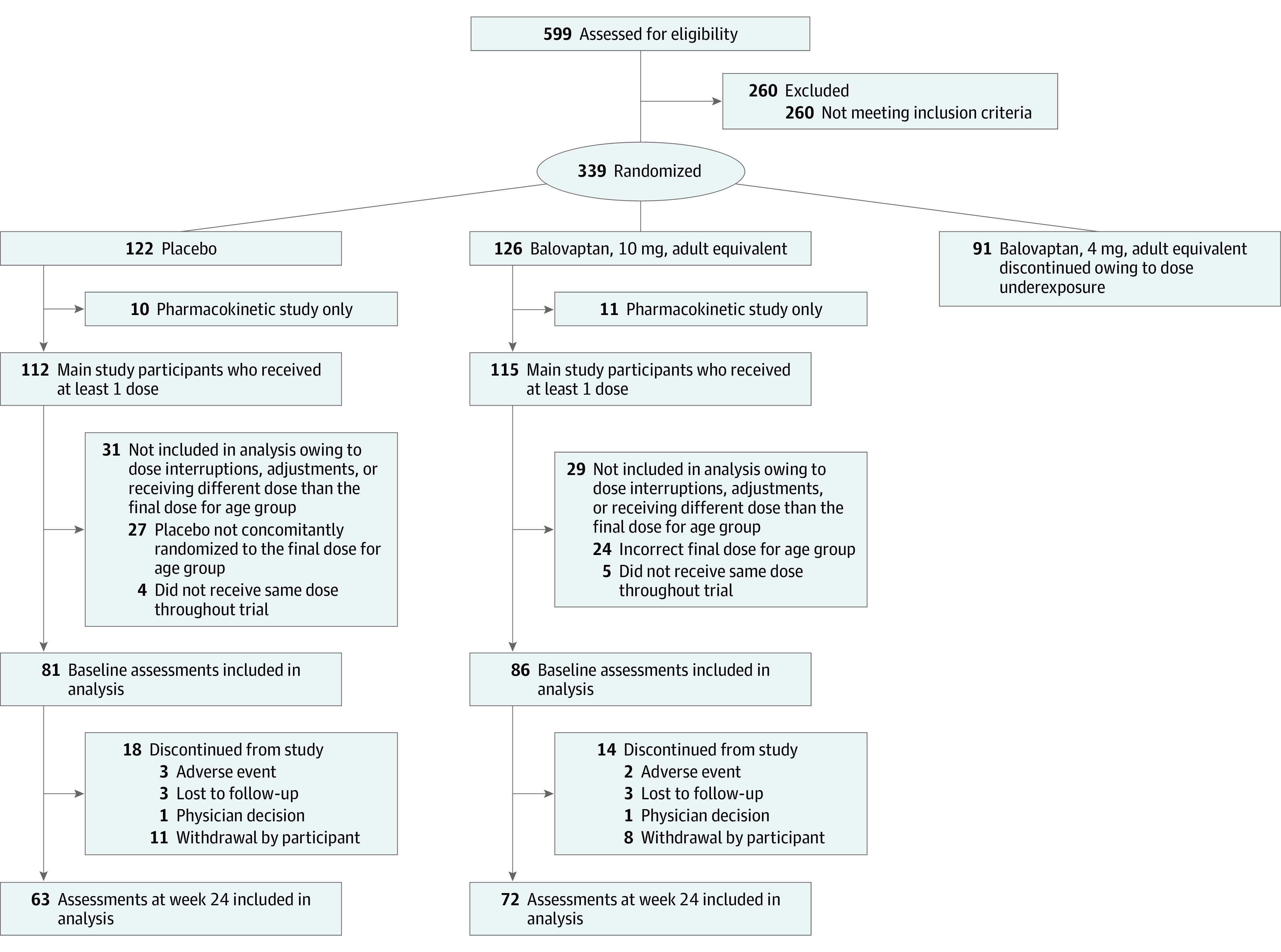
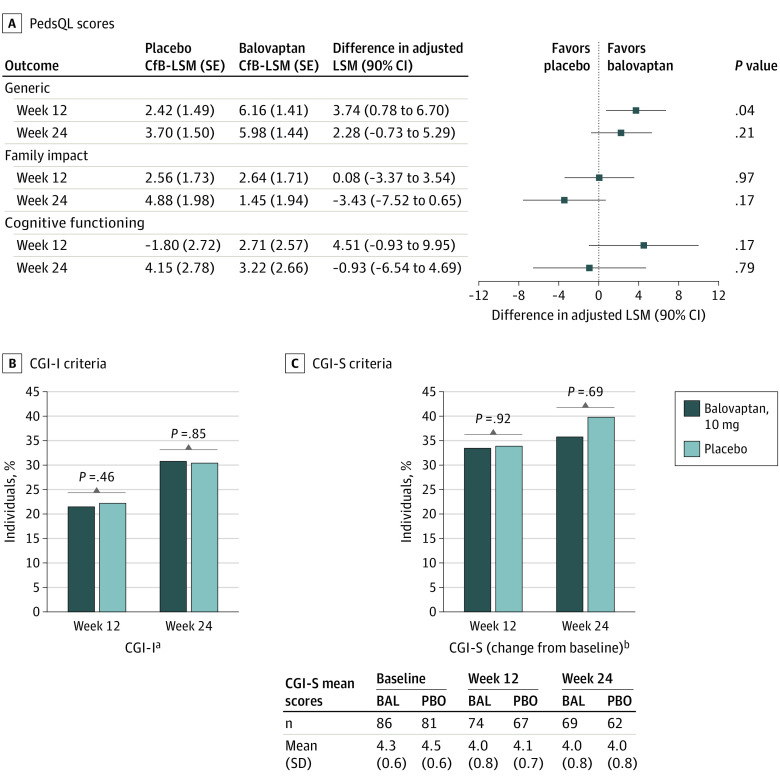
Between November 2016 and September 2019, a total of 599 individuals were screened and 339 participants were randomly assigned to receive 4-mg balovaptan adult-equivalent dose (91 [26.8%]), 10-mg balovaptan adult-equivalent dose (126 [37.2%]), or placebo (122 [36.0%]). Primary analysis included 86 participants assigned to receive 10-mg balovaptan adult-equivalent dose and 81 assigned to receive placebo (mean [SD] age, 12.1 [3.4] years; 139 male participants [83.2%]). No statistically significant differences were observed between the balovaptan and placebo groups in change from baseline on the Vineland-II 2DC score at week 24 (difference in adjusted least-squares mean, -0.16; 90% CI, -2.56 to 2.23; P = .91). No improvements for balovaptan vs placebo were observed at week 24 for any secondary end points. Balovaptan was well tolerated with no emerging safety concerns. Similar proportions of participants reported adverse events (balovaptan, 66 of 86 [76.7%] vs placebo, 61 of 81 [75.3%]) and serious adverse events (balovaptan, 1 of 86 [1.2%] vs placebo, 4 of 81 [4.9%]).
In this randomized clinical trial, balovaptan did not demonstrate efficacy in improvement of socialization and communication in this population with pediatric ASD. Balovaptan was well tolerated in children 5 years or older. Further development of robust, sensitive, and objective outcome measures may help to improve future studies in the assessment of therapies targeting communication and socialization in pediatric ASD.
ClinicalTrials.gov Identifier: NCT02901431.
目前尚无针对自闭症谱系障碍(ASD)核心症状(社交和沟通困难)的获批药物。
评估口服选择性血管加压素 1a 受体拮抗剂 balovaptan 与安慰剂相比在 ASD 儿童和青少年中的疗效和安全性。
设计、地点和参与者:aV1ation 研究是一项随机、双盲、24 周、平行组、安慰剂对照的 2 期试验。2016 年 11 月 22 日至 2019 年 9 月 3 日期间,进行了筛选并随机分配治疗组。主要疗效分析人群包括服用与成人 10mg 等效的年龄调整后的 balovaptan 的参与者和同时随机分配至安慰剂组的参与者。该多中心试验在美国 41 个地点进行。参与者年龄为 5 至 17 岁,确诊为 ASD,智商为 70 或更高。数据于 2020 年 4 月 8 日至 11 月 16 日进行分析。
参与者被随机分配接受每日 4mg 或 10mg 成人等效剂量的 balovaptan 或安慰剂,直至 4mg 组停药。
24 周时 Vineland-II 双域综合评分(2DC;社交和沟通领域)较基线的变化。
2016 年 11 月至 2019 年 9 月期间,共有 599 人接受了筛选,339 人被随机分配接受 4mg balovaptan 成人等效剂量(91 [26.8%])、10mg balovaptan 成人等效剂量(126 [37.2%])或安慰剂(122 [36.0%])。主要分析包括 86 名接受 10mg balovaptan 成人等效剂量的参与者和 81 名接受安慰剂的参与者(平均[SD]年龄,12.1[3.4]岁;139 名男性参与者[83.2%])。在 24 周时,Vineland-II 2DC 评分较基线的变化在 balovaptan 组和安慰剂组之间无统计学显著差异(调整后的最小二乘均值差异,-0.16;90%CI,-2.56 至 2.23;P=0.91)。在 24 周时,balovaptan 与安慰剂相比,任何次要终点均未显示出改善。balovaptan 耐受性良好,无新的安全性问题。报告不良事件的参与者比例相似(balovaptan,86 名中的 66 名[76.7%] vs 安慰剂,81 名中的 61 名[75.3%])和严重不良事件(balovaptan,1 名[1.2%] vs 安慰剂,4 名[4.9%])。
在这项随机临床试验中,balovaptan 并未显示在该儿科 ASD 人群中改善社交和沟通的疗效。balovaptan 在 5 岁及以上儿童中耐受性良好。进一步开发稳健、敏感和客观的结局指标可能有助于改善未来评估针对儿科 ASD 中沟通和社交的治疗方法的研究。
ClinicalTrials.gov 标识符:NCT02901431。