Department of Epidemiology, Infectious Disease Control and Prevention, Graduate School of Biomedical and Health Sciences, Hiroshima University.
Hiroshima Prefecture Health and Welfare Bureau.
Environ Health Prev Med. 2022;27:30. doi: 10.1265/ehpm.22-00016.
This longitudinal study aimed to determine chronological changes in the seroprevalence of prior SARS-CoV-2 infection, including asymptomatic infections in Hiroshima Prefecture, Japan.
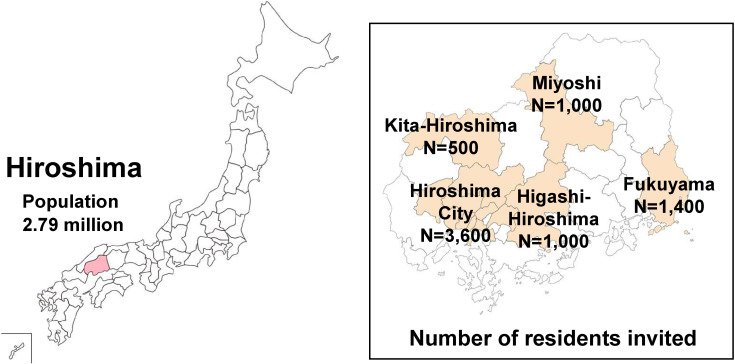
A stratified random sample of 7,500 residents from five cities of Hiroshima Prefecture was selected to participate in a three-round survey from late 2020 to early 2021, before the introduction of the COVID-19 vaccine. The seroprevalence of anti-SARS-CoV-2 antibodies was calculated if at least two of four commercially available immunoassays were positive. Then, the ratio between seroprevalence and the prevalence of confirmed COVID-19 cases in Hiroshima was calculated and compared to the results from other prefectures where the Ministry of Health, Labour and Welfare conducted a survey by using the same reagents at almost the same period.
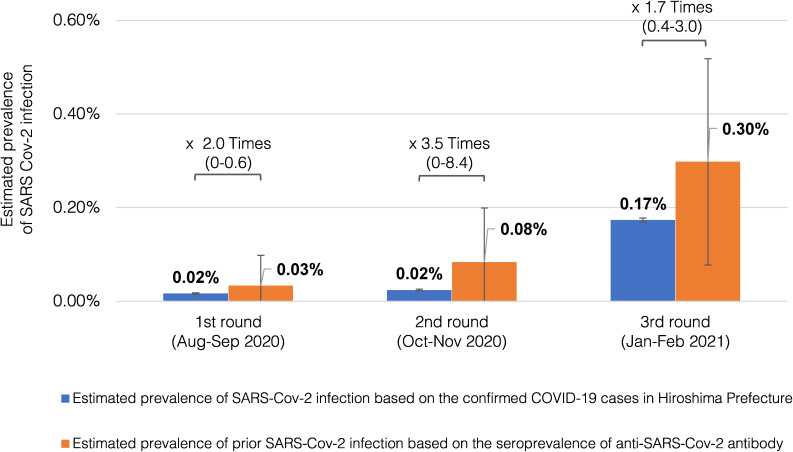
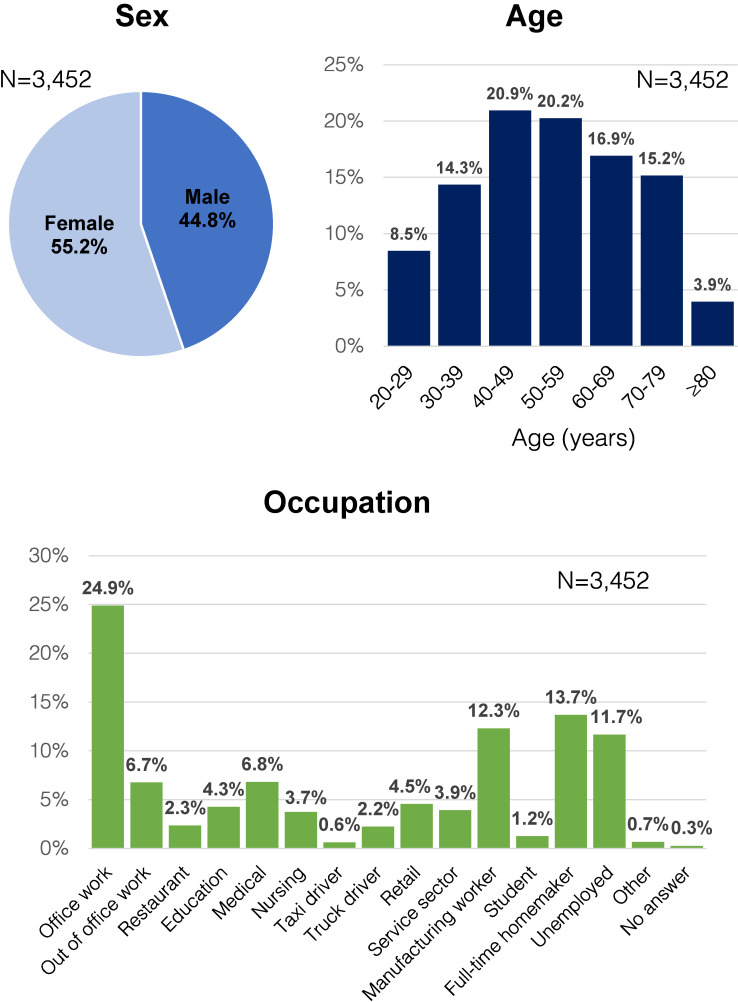
The numbers of participants in the first, second, and third rounds of the survey were 3025, 2396, and 2351, respectively and their anti-SARS-CoV-2 antibodies seroprevalences were 0.03% (95% confidence interval: 0.00-0.10%), 0.08% (0.00-0.20%), and 0.30% (0.08-0.52%), respectively. The ratio between the seroprevalence and the prevalence of confirmed COVID-19 cases in Hiroshima was 1.2, which was smaller than that in similar studies in other prefectures.
The seroprevalence of anti-SARS-CoV-2 antibodies in Hiroshima increased tenfold in a half year. The difference between seroprevalence and the prevalence of confirmed COVID-19 cases in Hiroshima was smaller than that in other prefectures, suggesting that asymptomatic patients were more actively detected in Hiroshima.
本纵向研究旨在确定日本广岛县既往 SARS-CoV-2 感染(包括无症状感染)的血清流行率随时间的变化。
从广岛县的五个城市中抽取了 7500 名居民作为分层随机样本,于 2020 年底至 2021 年初,在引入 COVID-19 疫苗之前,参加了三轮调查。如果至少两种四种市售免疫测定法呈阳性,则计算抗 SARS-CoV-2 抗体的血清流行率。然后,计算广岛的血清流行率与确诊 COVID-19 病例的比例,并与其他县的结果进行比较,这些县在同期使用相同的试剂由厚生劳动省进行了调查。
第一轮、第二轮和第三轮调查的参与者人数分别为 3025 人、2396 人和 2351 人,其抗 SARS-CoV-2 抗体的血清流行率分别为 0.03%(95%置信区间:0.00-0.10%)、0.08%(0.00-0.20%)和 0.30%(0.08-0.52%)。广岛的血清流行率与确诊 COVID-19 病例的比例为 1.2,低于其他县的类似研究。
广岛抗 SARS-CoV-2 抗体的血清流行率在半年内增加了十倍。广岛的血清流行率与确诊 COVID-19 病例的比例差异小于其他县,这表明在广岛更积极地检测到了无症状患者。