Department of Neurology, Soonchunhyang University Seoul Hospital, Soonchunhyang University School of Medicine, 59 Daesagwan-ro, Yongsan-gu, Seoul, 04401, Republic of Korea.
Department of Biostatistics, Soonchunhyang University Seoul Hospital, Soonchunhyang University School of Medicine, Seoul, Republic of Korea.
Sci Rep. 2022 Jul 6;12(1):11461. doi: 10.1038/s41598-022-15630-8.
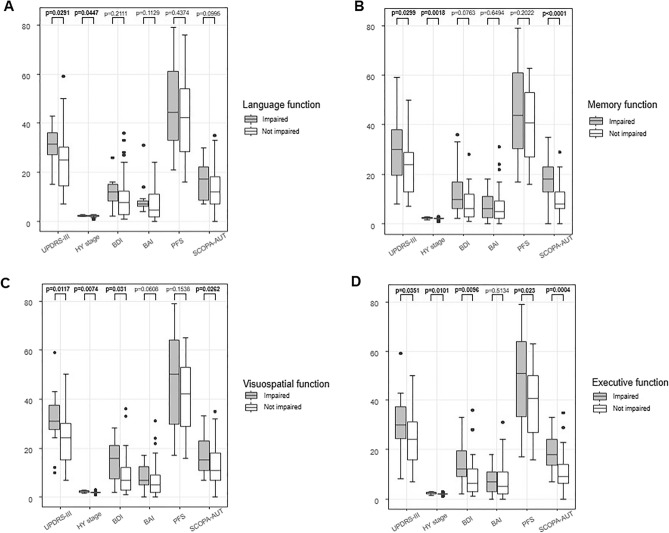
The risk factors of mild cognitive impairment (MCI) in patients with de novo Parkinson's disease (PD) remain unclear. Therefore, the objective of this study was to compare motor and non-motor symptoms between de novo patients with PD with and without MCI. Moreover, detailed relationships between each cognitive deficit and other clinical characteristics in de novo patients with PD were investigated. Consecutive patients with de novo PD were retrospectively enrolled in this study. Motor symptoms were assessed using the Unified Parkinson's Disease Rating Scale (UPDRS) part-III and the Hoehn and Yahr (HY) stage. Non-motor symptoms including depression, anxiety, fatigue, and autonomic dysfunction were measured using representative questionnaires. Motor symptoms, depression, and dysautonomia were associated with MCI in de novo patients with PD. Compared with the non-MCI group with PD, the MCI group with PD had higher scores of UPDRS-III, HY stage, depression, and dysautonomia, but not fatigue or anxiety. Both UPDRS-III and HY stage were significantly linked to all cognitive deficits except attention. Logistic regression analysis showed that depression was associated with memory, visuospatial, and executive impairment, and dysautonomia was related to visuospatial and executive impairment. The results of this study suggest that cognitive impairment in PD might have a different relationship pattern to the motor and some non-motor symptoms.
新发帕金森病患者轻度认知障碍的危险因素仍不清楚。因此,本研究的目的是比较有和无轻度认知障碍的新发帕金森病患者的运动和非运动症状。此外,还研究了新发帕金森病患者认知缺陷与其他临床特征之间的详细关系。
本研究回顾性纳入了连续的新发帕金森病患者。运动症状采用帕金森病统一评定量表(UPDRS)第三部分和 Hoehn 和 Yahr(HY)分期进行评估。非运动症状包括抑郁、焦虑、疲劳和自主神经功能障碍,采用代表性问卷进行测量。
在新发帕金森病患者中,运动症状、抑郁和自主神经功能障碍与轻度认知障碍有关。与非轻度认知障碍帕金森病组相比,轻度认知障碍帕金森病组的 UPDRS-III 评分、HY 分期、抑郁和自主神经功能障碍较高,但疲劳和焦虑评分无差异。UPDRS-III 和 HY 分期与除注意力以外的所有认知缺陷均显著相关。
Logistic 回归分析显示,抑郁与记忆、视空间和执行功能障碍有关,自主神经功能障碍与视空间和执行功能障碍有关。
这项研究的结果表明,帕金森病患者的认知障碍可能与运动和一些非运动症状有不同的关系模式。