Department of Cardiovascular Surgery, The Quzhou Affiliated Hospital of Wenzhou Medical University, Quzhou People's Hospital, Quzhou, 324000, China.
Department of Vascular Surgery, Changhai Hospital, Navy Medical University, Shanghai, 200433, China.
J Transl Med. 2022 Jul 6;20(1):305. doi: 10.1186/s12967-022-03482-9.
Increasing evidence indicates that myocardial oxidative injury plays a crucial role in the pathophysiology of cardiac hypertrophy (CH) and heart failure (HF). The active component of rhubarb, rhein exerts significant actions on oxidative stress and inflammation. Nonetheless, its role in cardiac remodeling remains unclear.
CH was induced by angiotensin II (Ang II, 1.4 mg/kg/d for 4 weeks) in male C57BL/6 J mice. Then, rhein (50 and 100 mg/kg) was injected intraperitoneally for 28 days. CH, fibrosis, oxidative stress, and cardiac function in the mice were examined. In vitro, neonatal rat cardiomyocytes (CMs) and cardiac fibroblasts (CFs) pre-treated with rhein (5 and 25 μM) were challenged with Ang II. We performed RNA sequencing to determine the mechanistic role of rhein in the heart.
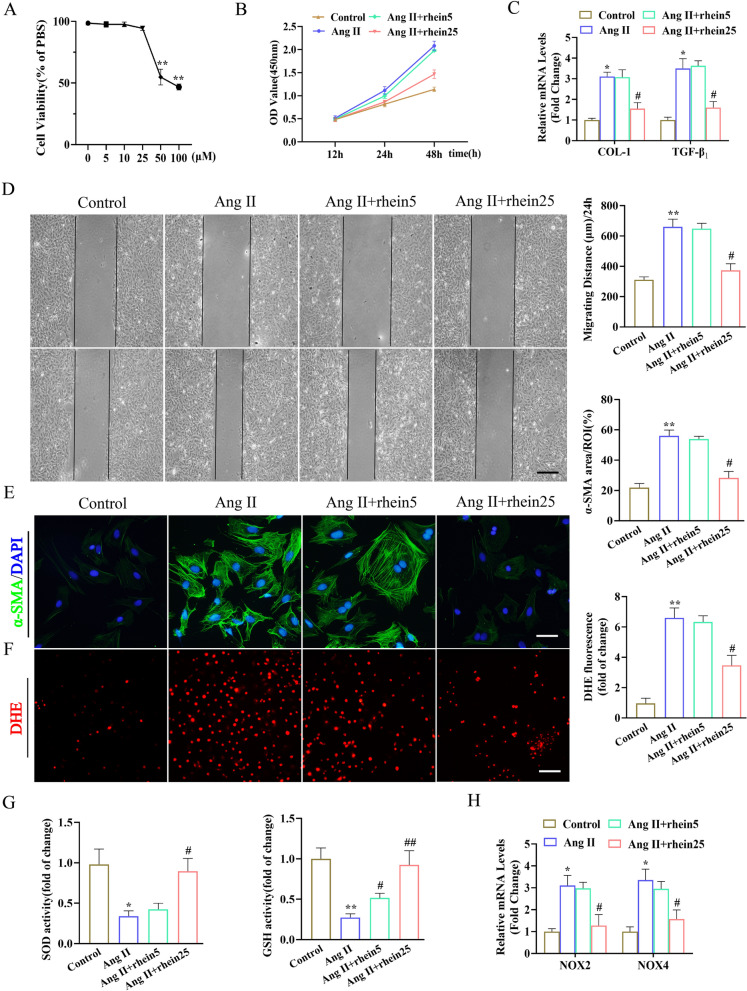
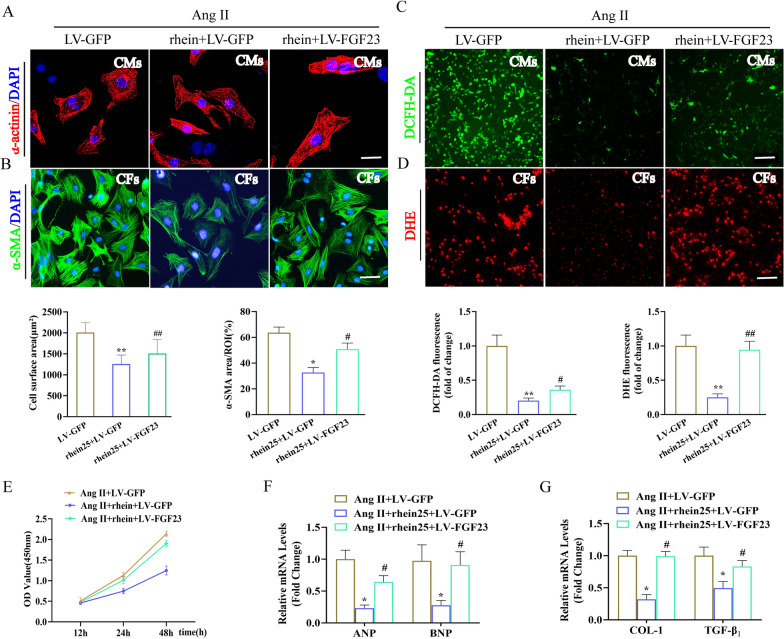
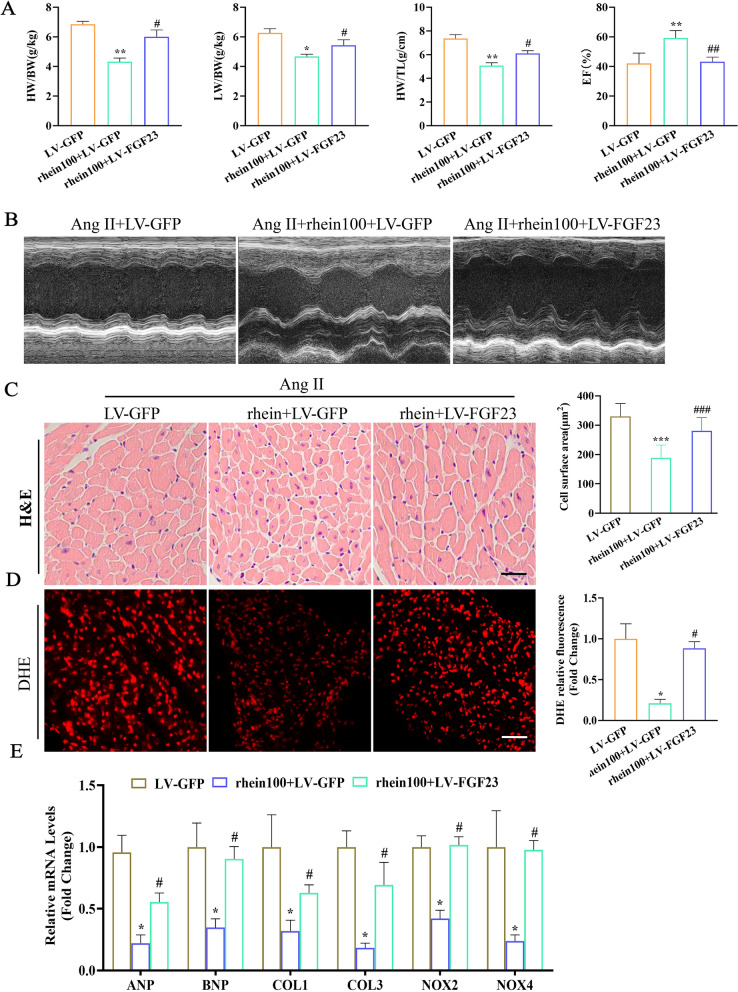
Rhein significantly suppressed Ang II-induced CH, fibrosis, and reactive oxygen species production and improved cardiac systolic dysfunction in vivo. In vitro, rhein significantly attenuated Ang II-induced CM hypertrophy and CF collagen expression. In addition, rhein obviously alleviated the increased production of superoxide induced by Ang II. Mechanistically, rhein inhibited FGF23 expression significantly. Furthermore, FGF23 overexpression abolished the protective effects of rhein on CMs, CFs, and cardiac remodeling. Rhein reduced FGF23 expression, mostly through the activation of AMPK (AMP-activated protein kinase). AMPK activity inhibition suppressed Ang II-induced CM hypertrophy and CF phenotypic transformation.
Rhein inhibited Ang II-induced CH, fibrosis, and oxidative stress during cardiac remodeling through the AMPK-FGF23 axis. These findings suggested that rhein could serve as a potential therapy in cardiac remodeling and HF.
越来越多的证据表明,心肌氧化损伤在心脏肥大(CH)和心力衰竭(HF)的病理生理学中起着关键作用。大黄的活性成分大黄酸对氧化应激和炎症有显著作用。然而,其在心脏重构中的作用尚不清楚。
雄性 C57BL/6J 小鼠用血管紧张素 II(Ang II,1.4mg/kg/d,持续 4 周)诱导 CH。然后,腹腔内注射大黄酸(50 和 100mg/kg)28 天。检测小鼠 CH、纤维化、氧化应激和心功能。体外,用 Ang II 预处理大黄酸(5 和 25μM)的乳鼠心肌细胞(CMs)和心肌成纤维细胞(CFs)。我们进行了 RNA 测序,以确定大黄酸在心脏中的作用机制。
大黄酸显著抑制 Ang II 诱导的 CH、纤维化和活性氧产生,并改善体内心脏收缩功能障碍。体外,大黄酸显著减轻 Ang II 诱导的 CMs 肥大和 CF 胶原表达。此外,大黄酸明显减轻 Ang II 诱导的超氧阴离子产生增加。机制上,大黄酸显著抑制 FGF23 的表达。此外,FGF23 的过表达消除了大黄酸对 CMs、CFs 和心脏重构的保护作用。大黄酸通过激活 AMPK(AMP 激活蛋白激酶)降低 FGF23 的表达。AMPK 活性抑制抑制 Ang II 诱导的 CMs 肥大和 CF 表型转化。
大黄酸通过 AMPK-FGF23 轴抑制 Ang II 诱导的 CH、纤维化和心脏重构中的氧化应激。这些发现表明,大黄酸可作为心脏重构和 HF 的潜在治疗方法。