Department of Clinical and Experimental Medicine, University of Pisa, Psychiatry Unit, Pisa, Italy.
Psychiatry Unit, Azienda Ospedaliero-Universitaria Pisana, Pisa, Italy.
Curr Neuropharmacol. 2023;21(12):2516-2542. doi: 10.2174/1570159X20666220706110157.
An increased risk of manic episodes has been reported in patients with neurodegenerative disorders, but the clinical features of bipolar disorder (BD) in different subtypes of dementia have not been thoroughly investigated.
The main aim of this study is to systematically review clinical and therapeutic evidence about manic syndromes in patients with Alzheimer's disease (AD), vascular dementia (VaD), and frontotemporal dementia (FTD). Since manic-mixed episodes have been associated to negative outcomes in patients with dementia and often require medical intervention, we also critically summarized selected studies with relevance for the treatment of mania in patients with cognitive decline.
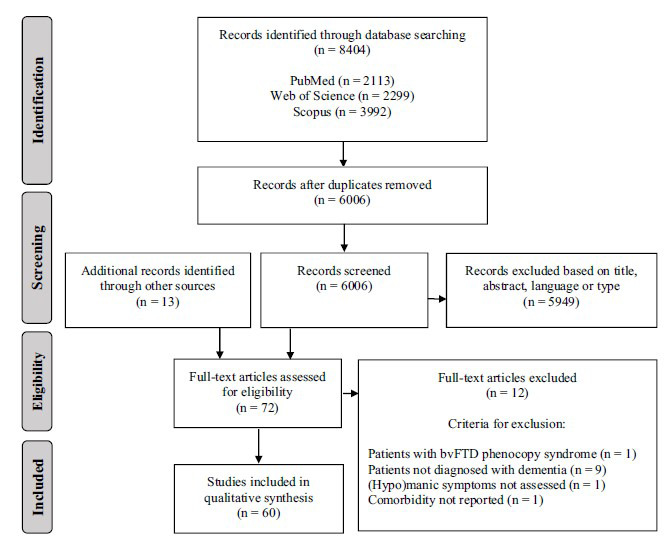
A systematic review of the literature was conducted according to PRISMA guidelines. PubMed, Scopus, and Web of Science databases were searched up to February 2022. Sixty-one articles on patients with AD, VaD, or FTD and BD or (hypo) mania have been included.
Manic symptoms seem to be associated to disease progression in AD, have a greatly variable temporal relationship with cognitive decline in VaD, and frequently coincide with or precede cognitive impairment in FTD. Overall, mood stabilizers, and electroconvulsive therapy may be the most effective treatments, while the benefits of short-term treatment with antipsychotic agents must be balanced with the associated risks. Importantly, low-dose lithium salts may exert neuroprotective activity in patients with AD.
Prevalence, course, and characteristics of manic syndromes in patients with dementia may be differentially affected by the nature of the underlying neurodegenerative conditions.
有报道称,神经退行性疾病患者发生躁狂发作的风险增加,但不同类型痴呆症中双相障碍(BD)的临床特征尚未得到充分研究。
本研究的主要目的是系统回顾关于阿尔茨海默病(AD)、血管性痴呆(VaD)和额颞叶痴呆(FTD)患者躁狂综合征的临床和治疗证据。由于躁狂混合发作与痴呆患者的不良结局相关,且常需要医疗干预,因此我们还批判性地总结了与认知下降患者治疗躁狂相关的精选研究。
根据 PRISMA 指南进行文献系统回顾。检索了 PubMed、Scopus 和 Web of Science 数据库,截至 2022 年 2 月。共纳入了 61 篇关于 AD、VaD 或 FTD 患者合并 BD 或(轻)躁狂的文章。
在 AD 中,躁狂症状似乎与疾病进展相关,在 VaD 中与认知衰退的时间关系变化很大,而在 FTD 中常与认知障碍同时发生或先于认知障碍。总的来说,心境稳定剂和电惊厥治疗可能是最有效的治疗方法,而短期使用抗精神病药物治疗的益处必须与相关风险相平衡。重要的是,低剂量锂盐可能对 AD 患者具有神经保护作用。
痴呆患者躁狂综合征的患病率、病程和特征可能因潜在神经退行性疾病的性质而不同。