Wang Lindsey, Berger Nathan A, Davis Pamela B, Kaelber David C, Volkow Nora D, Xu Rong
Center for Science, Health, and Society, Case Western Reserve University School of Medicine, Cleveland, OH, USA.
Center for Community Health Integration, Case Western Reserve University School of Medicine, Cleveland, OH, USA.
medRxiv. 2022 Jun 22:2022.06.21.22276724. doi: 10.1101/2022.06.21.22276724.
Recent case reports document that some patients who were treated with Paxlovid experienced rebound COVID-19 infections and symptoms 2 to 8 days after completing a 5-day course of Paxlovid. The Centers for Disease Control and Prevention (CDC) has recently issued a Health Alert Network Health Advisory to update the public on the potential for COVID-19 rebound after Paxlovid treatments. However, the rates of COVID-19 rebound in a real-world population or whether rebound is unique to Paxlovid remains unknown.
To examine the rates and relative risks of COVID-19 rebound in patients treated with Paxlovid or with Molnupiravir and to compare characteristics of patients who experienced COVID-19 rebound to those who did not.
Retrospective cohort study of electronic health records (EHRs) of 92 million patients from a multicenter and nationwide database in the US. The study population comprised 13,644 patients age ≥ 18 years who contracted COVID-19 between 1/1/2022-6/8/2022 and were treated with Paxlovid (n =11,270) or with Molnupiravir (n =2,374) within 5 days of their COVID-19 infection.
Paxlovid or Molnupiravir.
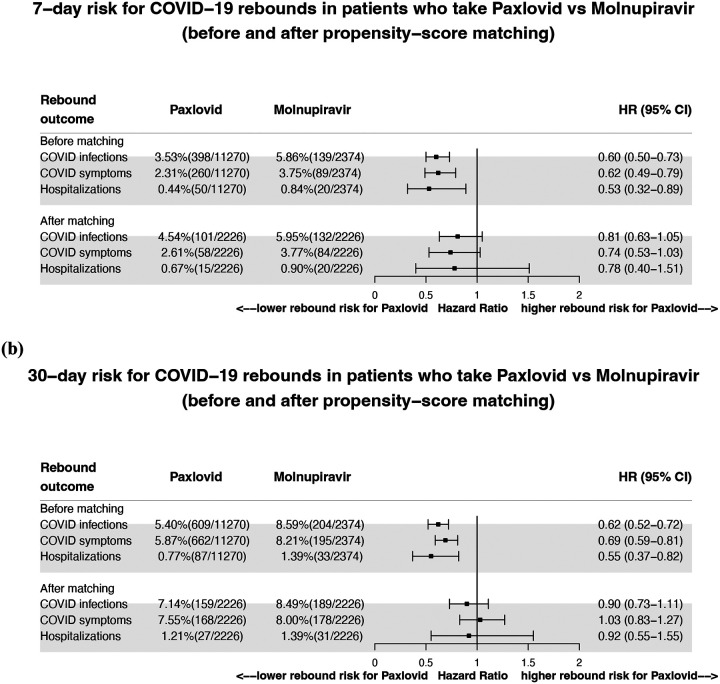
Three types of COVID-19 rebound outcomes (COVID-19 infections, COVID-19 related symptoms, and hospitalizations) were examined. Hazard ratios and 95% confidence interval (CI) of 7-day and 30-day risk for COVID-19 rebound between patients treated with Paxlovid and patients treated with Molnupiravir were calculated before and after propensity-score matching.
The 7-day and 30-day COVID-19 rebound rates after Paxlovid treatment were 3.53% and 5.40% for COVID-19 infection, 2.31% and 5.87% for COVID-19 symptoms, and 0.44% and 0.77% for hospitalizations. The 7-day and 30-day COVID-19 rebound rates after Molnupiravir treatment were 5.86% and 8.59% for COVID-19 infection, 3.75% and 8.21% for COVID-19 symptoms, and 0.84% and 1.39% for hospitalizations. After propensity-score matching, there were no significant differences in COVID-19 rebound risks between Paxlovid and Molnupiravir: infection (HR 0.90, 95% CI: 0.73-1.11), COVID-19 symptoms (HR: 1.03, 95% CI: 0.83-1.27), or hospitalizations (HR: 0.92, 95% CI: 0.56-1.55). Patients with COVID-19 rebound had significantly higher prevalence of underlying medical conditions than those without.
COVID-19 rebound occurred both after Paxlovid and Molnupiravir, especially in patients with underlying medical conditions. This indicates that COVID-19 rebound is not unique to Paxlovid and the risks were similar for Paxlovid and Molnupiravir. For both drugs the rates of COVID-19 rebound increased with time after treatments. Our results call for continuous surveillance of COVID-19 rebound after Paxlovid and Molnupiravir treatments. Studies are necessary to determine the mechanisms underlying COVID-19 rebounds and to test dosing and duration regimes that might prevent such rebounds in vulnerable patients.
近期病例报告表明,一些接受帕罗韦德治疗的患者在完成5天疗程后2至8天出现新冠病毒感染反弹及症状。美国疾病控制与预防中心(CDC)最近发布了一份健康警报网络健康咨询报告,向公众通报帕罗韦德治疗后新冠病毒反弹的可能性。然而,真实世界人群中新冠病毒反弹的发生率,以及反弹是否为帕罗韦德所特有,仍不明确。
研究接受帕罗韦德或莫努匹韦治疗的患者中新冠病毒反弹的发生率及相对风险,并比较出现新冠病毒反弹的患者与未出现反弹的患者的特征。
设计、背景与参与者:对来自美国一个多中心全国性数据库的9200万患者的电子健康记录(EHR)进行回顾性队列研究。研究人群包括13644名年龄≥18岁的患者,他们在2022年1月1日至2022年6月8日期间感染新冠病毒,并在感染新冠病毒后5天内接受了帕罗韦德(n = 11270)或莫努匹韦(n = 2374)治疗。
帕罗韦德或莫努匹韦。
研究了三种类型的新冠病毒反弹结局(新冠病毒感染、新冠病毒相关症状和住院)。在倾向得分匹配前后,计算了接受帕罗韦德治疗的患者与接受莫努匹韦治疗的患者之间新冠病毒反弹7天和30天风险的风险比及95%置信区间(CI)。
帕罗韦德治疗后,新冠病毒感染的7天和30天反弹率分别为3.53%和5.40%,新冠病毒相关症状的反弹率分别为2.31%和5.87%,住院的反弹率分别为0.44%和0.77%。莫努匹韦治疗后,新冠病毒感染的7天和30天反弹率分别为5.86%和8.59%,新冠病毒相关症状的反弹率分别为3.75%和8.21%,住院的反弹率分别为0.84%和1.39%。倾向得分匹配后,帕罗韦德和莫努匹韦在新冠病毒反弹风险方面无显著差异:感染(风险比0.90,95%置信区间:0.73 - 1.1)、新冠病毒相关症状(风险比:1.03,95%置信区间:0.83 - 1.27)或住院(风险比:0.92,95%置信区间:0.56 - 1.55)。出现新冠病毒反弹的患者合并基础疾病的患病率显著高于未出现反弹的患者。
帕罗韦德和莫努匹韦治疗后均出现了新冠病毒反弹,尤其是合并基础疾病的患者。这表明新冠病毒反弹并非帕罗韦德所特有,帕罗韦德和莫努匹韦出现反弹的风险相似。两种药物的新冠病毒反弹率均随治疗后时间的推移而增加。我们的研究结果呼吁对帕罗韦德和莫努匹韦治疗后的新冠病毒反弹进行持续监测。有必要开展研究以确定新冠病毒反弹的潜在机制,并测试可能预防易感患者出现此类反弹的给药剂量和疗程方案。
