Department of Rheumatology, University Medical Centre Ljubljana, Vodnikova 62, 1000, Ljubljana, Slovenia.
Medical Faculty, University of Ljubljana, Ljubljana, Slovenia.
Clin Rheumatol. 2022 Aug;41(8):2449-2456. doi: 10.1007/s10067-022-06157-4. Epub 2022 Apr 2.
Patients with giant cell arteritis (GCA) represent a fragile population with an increased infection risk. In a recent study, older age, a higher number of comorbidities, higher disease activity and prednisolone ≥ 10 mg/day were associated with worse COVID-19 outcome. We aimed to evaluate the frequency and severity of COVID-19 in a well-defined GCA cohort.
We reviewed medical records of histologically and/or by imaging-proven GCA patients diagnosed between September 2011 and February 2020 at our secondary/tertiary centre and followed during the COVID-19 pandemic between March 2020 and February 2022 (24 months). Descriptive statistics were used to explore the studied population.
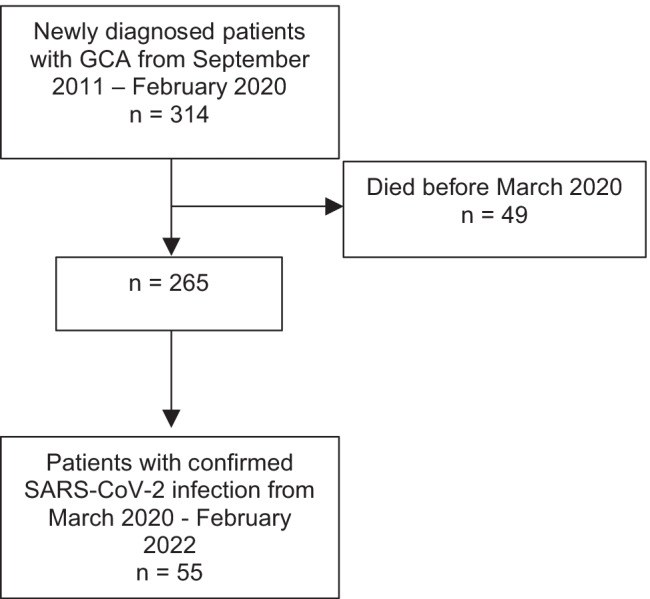
Of 314 patients with GCA diagnosed for the first time during a 102-month period, 49 patients died before March 2020. Of the remaining 265 patients, 55 (20.8%) patients suffered from a total of 57 SARS-CoV-2 infections. We observed 44 (77.2%) mild and 13 (22.8%) severe COVID-19 episodes (the latter defined as needing hospitalization, death or thrombotic complication). Patients with severe COVID-19 were more likely to have arterial hypertension (12 [92.3%] vs. 25 [56.8%]; p = 0.022), cardiovascular disease (7 [53.8%] vs. 10 [22.7%]; p = 0.043) or obesity (5 [38.5%] vs. 5 [11.4%]; p = 0.038). Neither prednisolone dose 1-5 mg/day (p = 0.483) nor leflunomide use (p = 1.000) was associated with COVID-19 course. There were no significant differences in sex, age, GCA type, GCA disease duration and other comorbidities in patients with mild and severe COVID-19 in our cohort.
More than a fifth of our GCA patients had severe COVID-19. Treatment with leflunomide or low doses of glucocorticoids were not associated with severe course in our cohort. Key Points • Treatment with leflunomide or low doses of glucocorticoids were not associated with worse COVID-19 outcome. • Outcomes of COVID-19 improved as the COVID-19 pandemic, prevention and treatment options evolved. • Arterial hypertension, cardiovascular disease or obesity were associated with severe COVID-19.
巨细胞动脉炎(GCA)患者是一个脆弱的群体,感染风险增加。在最近的一项研究中,年龄较大、合并症较多、疾病活动度较高和泼尼松龙剂量≥10mg/天与 COVID-19 结局较差相关。我们旨在评估在明确的 GCA 队列中 COVID-19 的频率和严重程度。
我们回顾了 2011 年 9 月至 2020 年 2 月在我们的二级/三级中心诊断的经组织学和/或影像学证实的 GCA 患者的病历,并在 2020 年 3 月至 2022 年 2 月(24 个月)期间 COVID-19 大流行期间对其进行了随访。使用描述性统计数据来探索研究人群。
在 102 个月期间首次诊断为 GCA 的 314 名患者中,有 49 名患者在 2020 年 3 月之前死亡。在其余 265 名患者中,共有 55 名(20.8%)患者总共发生了 57 例 SARS-CoV-2 感染。我们观察到 44 例(77.2%)为轻度 COVID-19 发作和 13 例(22.8%)为严重 COVID-19 发作(后者定义为需要住院、死亡或血栓并发症)。严重 COVID-19 患者更有可能患有动脉高血压(12 [92.3%] vs. 25 [56.8%];p=0.022)、心血管疾病(7 [53.8%] vs. 10 [22.7%];p=0.043)或肥胖症(5 [38.5%] vs. 5 [11.4%];p=0.038)。泼尼松龙剂量 1-5mg/天(p=0.483)或使用来氟米特(p=1.000)均与 COVID-19 病程无关。在我们的队列中,患有轻度和重度 COVID-19 的患者在性别、年龄、GCA 类型、GCA 疾病持续时间和其他合并症方面没有显著差异。
我们的 GCA 患者中有超过五分之一患有严重 COVID-19。在我们的队列中,使用来氟米特或低剂量糖皮质激素治疗与严重病程无关。
来氟米特或低剂量糖皮质激素治疗与 COVID-19 不良结局无关。
COVID-19 结局随着 COVID-19 大流行、预防和治疗方案的发展而改善。
动脉高血压、心血管疾病或肥胖症与严重 COVID-19 相关。