Endocrine Bone Unit, Imperial College Healthcare NHS Trust, London, United Kingdom.
Section of Endocrinology and Investigative Medicine, Imperial College London, London, United Kingdom.
Front Endocrinol (Lausanne). 2022 Jun 20;13:923791. doi: 10.3389/fendo.2022.923791. eCollection 2022.
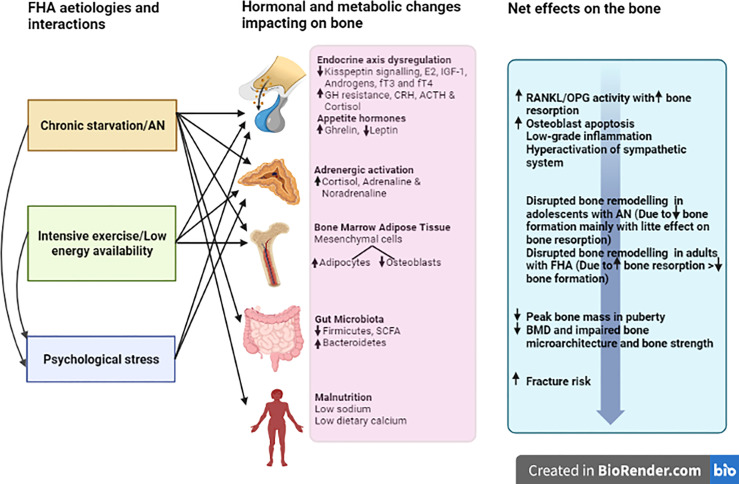
One of the most important and potentially long-lasting detrimental consequences of Functional Hypothalamic Amenorrhoea (FHA) is on skeletal homeostasis. Beyond oestrogen deficiency, FHA is associated with a cascade of additional neuro-endocrine and metabolic alterations, some adaptive, but which combine to disrupt skeletal homeostasis. Ultimately, this leads to a two-fold increased risk of fractures in women with FHA compared to healthy eumenorrhoeic women. Although the cornerstone of management of FHA-related bone loss remains recovery of menses restoration of metabolic/psychological balance, there is rapidly developing evidence for hormonal manipulations (with a particular emphasis on route of administration) and other pharmacological treatments that can protect or improve skeletal homeostasis in FHA. In this mini-review, we provide an update on the pathophysiology, clinical management and future avenues in the field from a bone perspective.
功能性下丘脑性闭经(FHA)的最重要且可能长期存在的有害后果之一是对骨骼内稳态的影响。除了雌激素缺乏之外,FHA 还与一系列额外的神经内分泌和代谢改变相关,其中一些是适应性的,但它们共同破坏了骨骼内稳态。最终,与健康的月经正常女性相比,FHA 女性骨折的风险增加了两倍。尽管 FHA 相关骨丢失管理的基石仍然是恢复月经周期,恢复代谢/心理平衡,但越来越多的证据表明激素治疗(特别强调给药途径)和其他可保护或改善 FHA 中骨骼内稳态的药物治疗。在这篇迷你综述中,我们从骨骼的角度提供了 FHA 领域的病理生理学、临床管理和未来发展方向的最新信息。