Fisser Christoph, Gall Lara, Bureck Jannis, Vaas Victoria, Priefert Jörg, Fredersdorf Sabine, Zeman Florian, Linz Dominik, Woehrle Holger, Tamisier Renaud, Teschler Helmut, Cowie Martin R, Arzt Michael
Department of Internal Medicine II, University Medical Centre Regensburg, Regensburg, Germany.
Center for Clinical Studies, University Medical Centre Regensburg, Regensburg, Germany.
Front Cardiovasc Med. 2022 Jun 20;9:896917. doi: 10.3389/fcvm.2022.896917. eCollection 2022.
The SERVE-HF trial investigated the effect of treating central sleep apnoea (CSA) with adaptive servo-ventilation (ASV) in patients with heart failure with reduced ejection fraction (HFrEF).
The aim of the present ancillary analysis of the SERVE-HF major substudy (NCT01164592) was to assess the effects of ASV on the burden of nocturnal ventricular arrhythmias as one possible mechanism for sudden cardiac death in ASV-treated patients with HFrEF and CSA.
Three hundred twelve patients were randomized in the SERVE-HF major substudy [no treatment of CSA (control) vs. ASV]. Polysomnography including nocturnal ECG fulfilling technical requirements was performed at baseline, and at 3 and 12 months. Premature ventricular complexes (events/h of total recording time) and non-sustained ventricular tachycardia were assessed. Linear mixed models and generalized linear mixed models were used to analyse differences between the control and ASV groups, and changes over time.
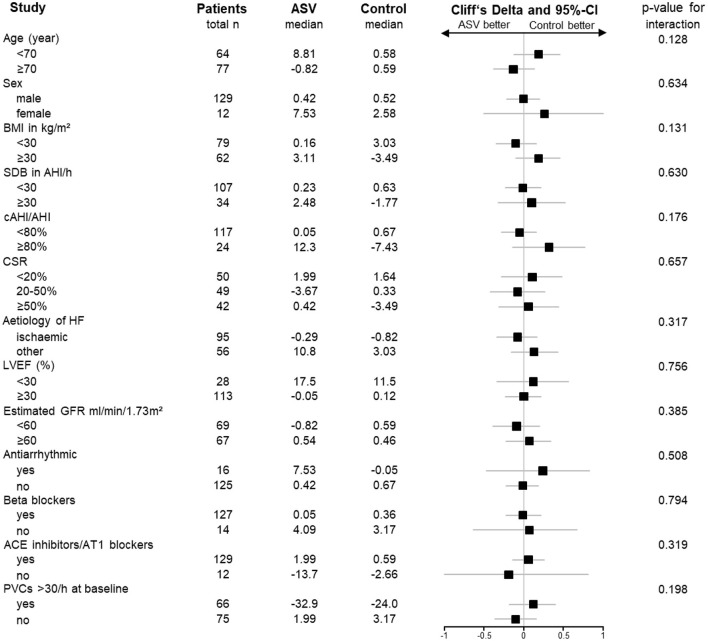
From baseline to 3- and 12-month follow-up, respectively, the number of premature ventricular complexes (control: median 19.7, 19.0 and 19.0; ASV: 29.1, 29.0 and 26.0 events/h; = 0.800) and the occurrence of ≥1 non-sustained ventricular tachycardia/night (control: 18, 25, and 18% of patients; ASV: 24, 16, and 24% of patients; = 0.095) were similar in the control and ASV groups.
Addition of ASV to guideline-based medical management had no significant effect on nocturnal ventricular ectopy or tachyarrhythmia over a period of 12 months in alive patients with HFrEF and CSA. Findings do not further support the hypothesis that ASV may lead to sudden cardiac death by triggering ventricular tachyarrhythmia.
SERVE-HF试验研究了采用适应性伺服通气(ASV)治疗射血分数降低的心力衰竭(HFrEF)患者的中枢性睡眠呼吸暂停(CSA)的效果。
本项SERVE-HF主要子研究(NCT01164592)的辅助分析旨在评估ASV对夜间室性心律失常负担的影响,这是ASV治疗的HFrEF和CSA患者发生心源性猝死的一种可能机制。
312例患者在SERVE-HF主要子研究中被随机分组[不治疗CSA(对照组)与ASV组]。在基线、3个月和12个月时进行包括满足技术要求的夜间心电图的多导睡眠图检查。评估室性早搏(每小时总记录时间的事件数)和非持续性室性心动过速。采用线性混合模型和广义线性混合模型分析对照组和ASV组之间的差异以及随时间的变化。
从基线到3个月和12个月随访时,对照组和ASV组的室性早搏数量(对照组:中位数分别为19.7、19.0和19.0;ASV组:分别为29.1、29.0和26.0次事件/小时;P = 0.800)以及≥1次非持续性室性心动过速/夜的发生率(对照组:患者比例分别为18%、25%和18%;ASV组:患者比例分别为24%、16%和24%;P = 0.095)相似。
在基于指南的药物治疗基础上加用ASV,在12个月期间对存活的HFrEF和CSA患者的夜间室性异位心律或快速性心律失常无显著影响。研究结果不支持ASV可能通过触发室性快速性心律失常导致心源性猝死这一假说。