Mourão João Luiz Veloso, Borella Luiz Fernando Monte, Duarte Juliana Ávila, Dalaqua Mariana, Fernandes Daniel Alvarenga, Reis Fabiano
Department of Radiology, Universidade Estadual de Campinas (Unicamp), Campinas, SP, Brazil.
Department of Radiology and Diagnostic Imaging, Hospital de Clínicas de Porto Alegre (HCPA), Porto Alegre, RS, Brazil.
Radiol Bras. 2022 May-Jun;55(3):188-192. doi: 10.1590/0100-3984.2021.0080-en.
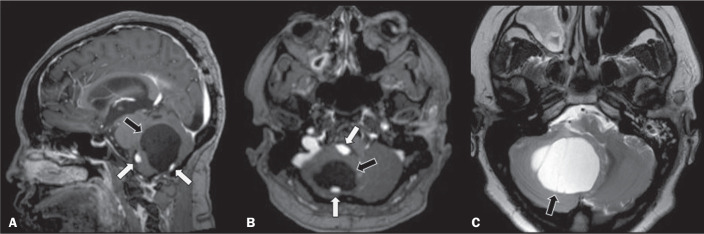
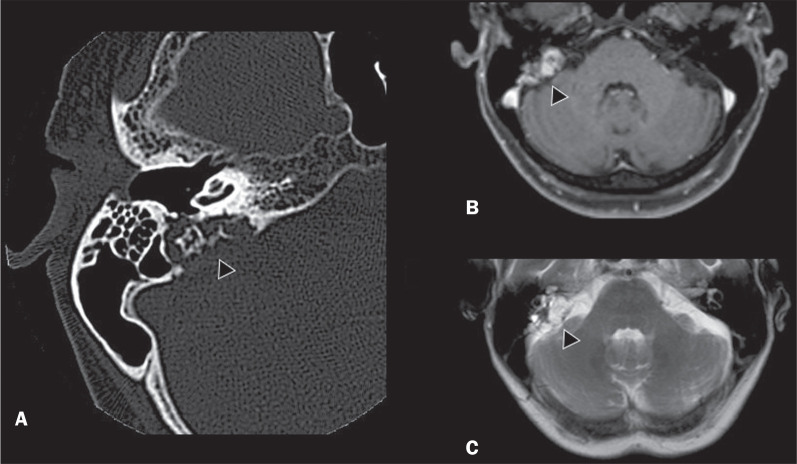
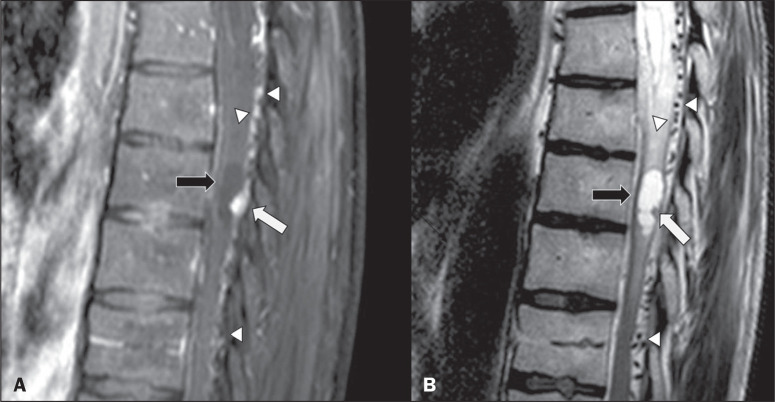
Von Hippel-Lindau (VHL) disease is a rare, autosomal dominant inherited syndrome that affects the germline of the VHL gene, a tumor suppressor gene. VHL disease is characterized by the multisystemic development of a variety of benign and malignant tumors, especially in the central nervous system (CNS). Such tumors include retinal and CNS hemangioblastomas, as well as endolymphatic sac tumors. The various tumor sites are responsible for the diversity of signs and symptoms related to the disease. The mean age at symptom onset is 33 years. Despite medical advances, the average life expectancy of patients with VHL disease is 49 years. Imaging plays a pivotal role in the clinical diagnosis and is essential to the follow-up of patients with VHL disease. This pictorial essay describes characteristic CNS manifestations of VHL disease-related tumors that all radiology residents should be aware of.
冯·希佩尔-林道(VHL)病是一种罕见的常染色体显性遗传综合征,它影响肿瘤抑制基因VHL基因的种系。VHL病的特征是多种良性和恶性肿瘤在多系统发生,尤其是在中枢神经系统(CNS)。此类肿瘤包括视网膜和中枢神经系统血管母细胞瘤,以及内淋巴囊肿瘤。不同的肿瘤部位导致了与该疾病相关的体征和症状的多样性。症状出现的平均年龄为33岁。尽管医学取得了进展,但VHL病患者的平均预期寿命为49岁。影像学在临床诊断中起着关键作用,对于VHL病患者的随访至关重要。这篇图文并茂的文章描述了所有放射科住院医师都应了解的与VHL病相关肿瘤的中枢神经系统特征性表现。