Department of Clinical Medicine, Macquarie University, Sydney, New South Wales, Australia.
Department of Ophthalmology, Flinders Health and Medical Research Institute, Flinders University, Adelaide, South Australia, Australia.
Clin Exp Ophthalmol. 2022 Sep;50(7):724-735. doi: 10.1111/ceo.14134. Epub 2022 Jul 26.
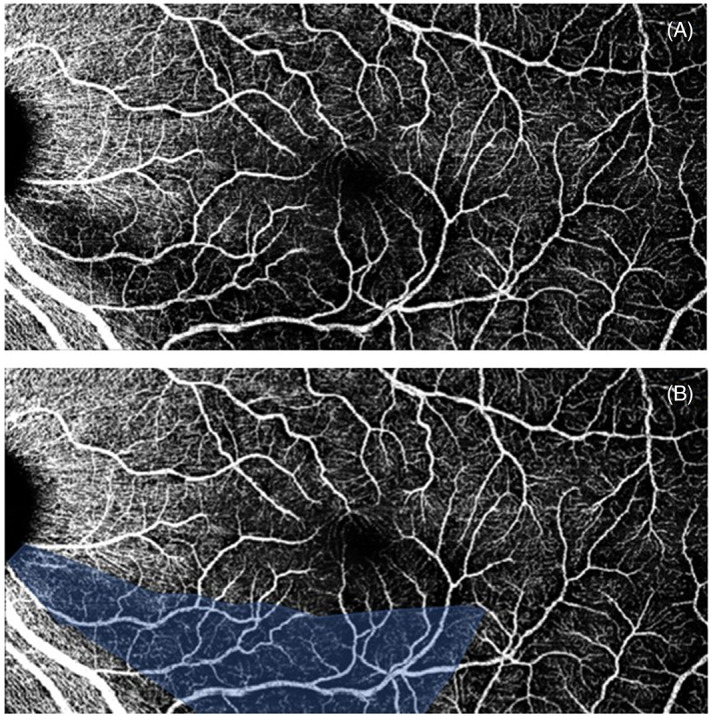
Vascular dysfunction plays a considerable role in glaucoma pathogenesis. Previous glaucoma case studies described localised wedge-shaped vascular defects, similar to retinal nerve fibre layer (RNFL) wedge defects. This study investigates the prevalence and quantification of this vessel loss, in relation to primary open angle glaucoma (POAG) parameters.
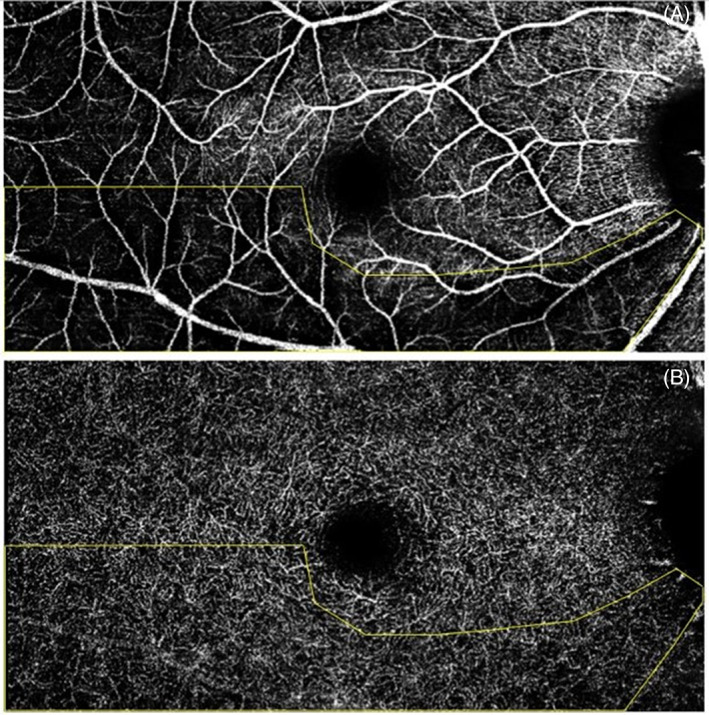
This study included 608 eyes (351 participants): 192 PROGRESSA study participants (342 eyes) with suspect, preperimetric or early manifest POAG, observed for vascular wedge defect presence (cohort one); an additional 114 individuals (cohort two-208 eyes) with POAG at various stages of progression for wedge characterisation; and 38 controls (56 eyes). Vascular wedge defects were observed using optical coherence tomography angiography (OCTA). Wedge parameters and vessel densities were quantified using ImageJ software. RNFL and ganglion cell layer inner plexiform layer (GCLIPL) from OCT scans, and mean deviation (Humphrey visual field 24-2) were also assessed.
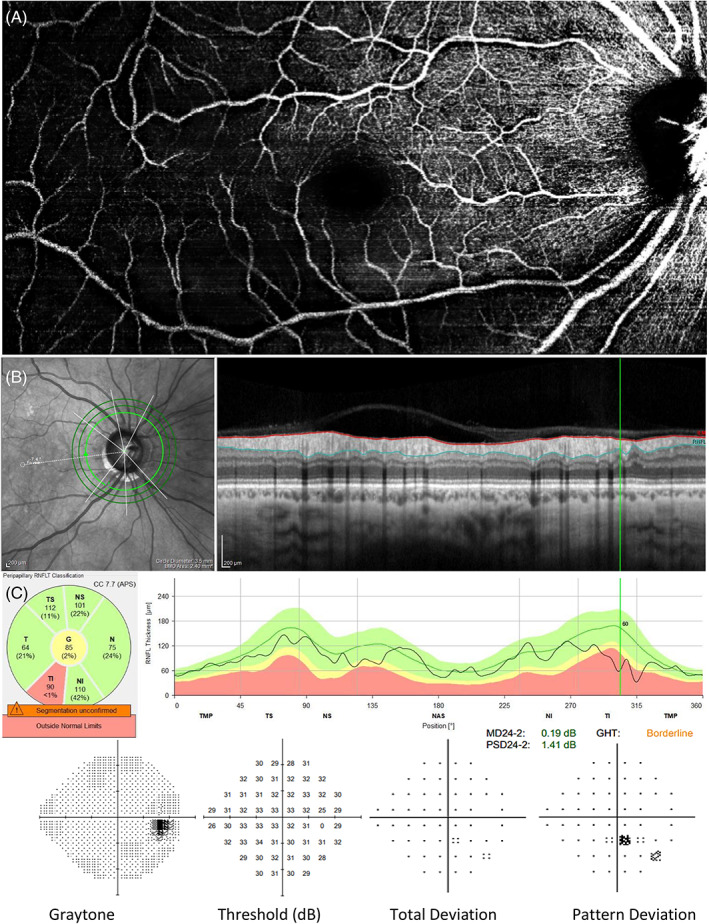
Vascular wedge defects were found in 45/342 eyes (13.2%) in cohort one, in 41/208 eyes (19.7%) in cohort two and were not found in controls. Wedge defects were mostly inferotemporal (80%), and present at all disease stages. They were associated with visual field loss in the opposite hemisphere, thinner RNFL (p < 0.001), thinner GCLIPL (p = 0.003), and focal RNFL loss corresponding with the vascular defect region.
Vascular wedge defects are present at all POAG stages even before functional change and are strongly concordant with focal RNFL loss. Further research is needed to explore these defects in particular their temporal relationship with clinical measures of POAG.
血管功能障碍在青光眼发病机制中起着重要作用。以前的青光眼病例研究描述了局部楔形血管缺陷,类似于视网膜神经纤维层 (RNFL) 楔形缺陷。本研究调查了这种血管损失的患病率和定量,与原发性开角型青光眼 (POAG) 参数有关。
本研究包括 608 只眼(351 名参与者):192 名 PROGRESSA 研究参与者(342 只眼)患有可疑、前期或早期显性 POAG,观察血管楔形缺陷的存在(队列一);另外 114 名处于不同进展阶段的 POAG 患者(队列二-208 只眼)进行楔形特征描述;和 38 名对照者(56 只眼)。使用光学相干断层扫描血管造影术 (OCTA) 观察血管楔形缺陷。使用 ImageJ 软件定量楔形参数和血管密度。还评估了 OCT 扫描的 RNFL 和节细胞层内丛状层 (GCLIPL) 以及平均偏差 (Humphrey 视野 24-2)。
在队列一的 342 只眼中发现了 45 只(13.2%)眼有血管楔形缺陷,在队列二的 208 只眼中发现了 41 只(19.7%)眼有血管楔形缺陷,对照组未发现。楔形缺陷主要位于下颞侧(80%),并存在于所有疾病阶段。它们与对侧半球的视野损失有关,与 RNFL 变薄(p<0.001)、GCLIPL 变薄(p=0.003)以及与血管缺陷区域相对应的局部 RNFL 损失有关。
血管楔形缺陷存在于 POAG 的所有阶段,甚至在功能改变之前,并且与局部 RNFL 损失强烈一致。需要进一步研究这些缺陷,特别是它们与 POAG 的临床测量的时间关系。