Sino-French Institute for Earth System Science, College of Urban and Environmental Sciences, Peking University, Beijing, China.
Department of Earth and Environmental Engineering, Columbia University, New York, NY, USA.
Nat Commun. 2022 Jul 7;13(1):3925. doi: 10.1038/s41467-022-31671-z.
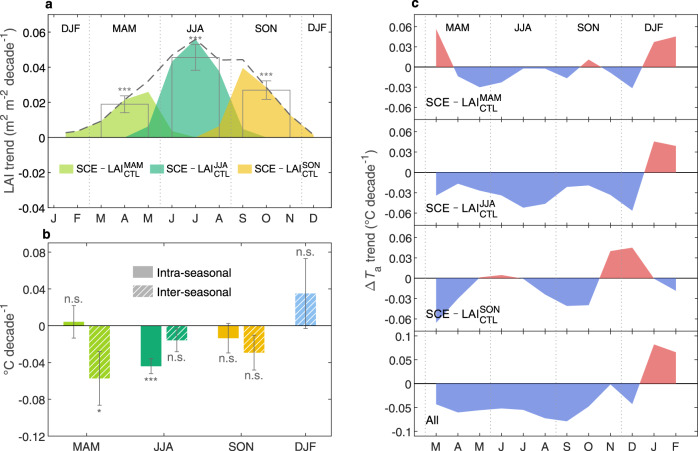
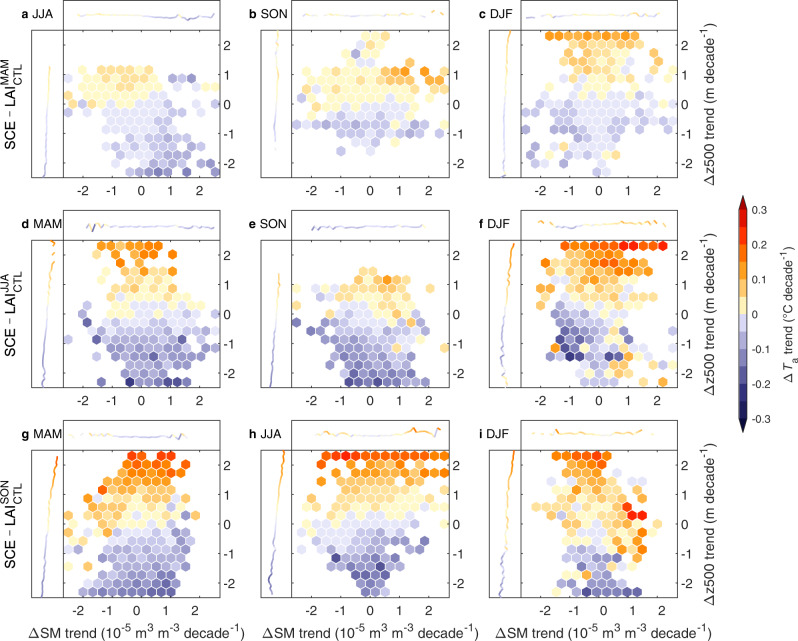
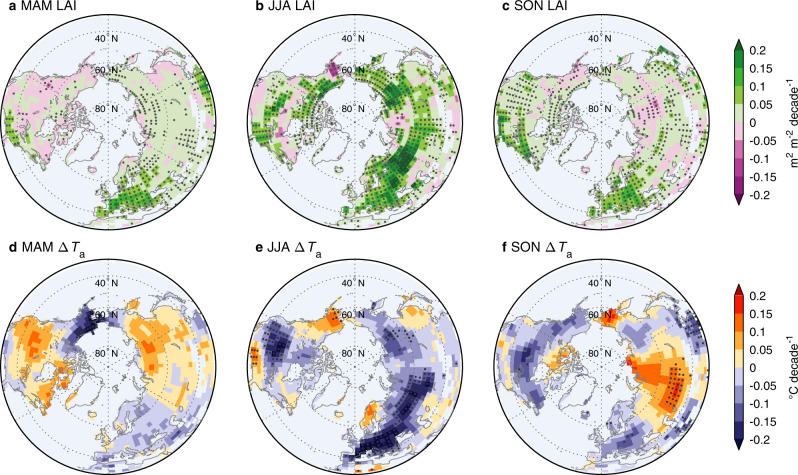
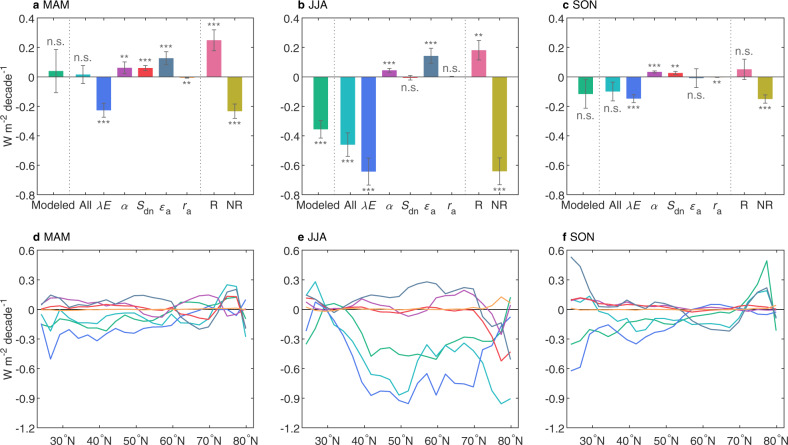
The seasonal greening of Northern Hemisphere (NH) ecosystems, due to extended growing periods and enhanced photosynthetic activity, could modify near-surface warming by perturbing land-atmosphere energy exchanges, yet this biophysical control on warming seasonality is underexplored. By performing experiments with a coupled land-atmosphere model, here we show that summer greening effectively dampens NH warming by -0.15 ± 0.03 °C for 1982-2014 due to enhanced evapotranspiration. However, greening generates weak temperature changes in spring (+0.02 ± 0.06 °C) and autumn (-0.05 ± 0.05 °C), because the evaporative cooling is counterbalanced by radiative warming from albedo and water vapor feedbacks. The dwindling evaporative cooling towards cool seasons is also supported by state-of-the-art Earth system models. Moreover, greening-triggered energy imbalance is propagated forward by atmospheric circulation to subsequent seasons and causes sizable time-lagged climate effects. Overall, greening makes winter warmer and summer cooler, attenuating the seasonal amplitude of NH temperature. These findings demonstrate complex tradeoffs and linkages of vegetation-climate feedbacks among seasons.
北半球(NH)生态系统的季节性绿化,由于生长周期延长和光合作用增强,可能通过改变陆地-大气能量交换来改变近地表变暖,但这种对变暖季节性的生物物理控制还未得到充分探索。通过使用一个耦合的陆气模式进行实验,我们表明,由于蒸散增强,1982-2014 年夏季绿化有效地使 NH 变暖减少了-0.15±0.03°C。然而,绿化在春季(+0.02±0.06°C)和秋季(-0.05±0.05°C)产生微弱的温度变化,因为反照率和水汽反馈的辐射变暖抵消了蒸散冷却。冷却季节蒸发冷却的减少也得到了最先进的地球系统模型的支持。此外,绿化引发的能量不平衡通过大气环流向前传播到后续季节,并导致相当大的时间滞后气候效应。总的来说,绿化使冬季变暖,夏季凉爽,从而减弱了 NH 温度的季节性幅度。这些发现表明了植被-气候反馈在季节之间的复杂权衡和联系。