Department of Earth Science and Engineering, Imperial College London, South Kensington Campus, London, SW7 2AZ, UK.
Marine Biogeochemistry Division, GEOMAR Helmholtz Centre for Ocean Research, 24148, Kiel, Germany.
ISME J. 2022 Oct;16(10):2329-2336. doi: 10.1038/s41396-022-01280-1. Epub 2022 Jul 7.
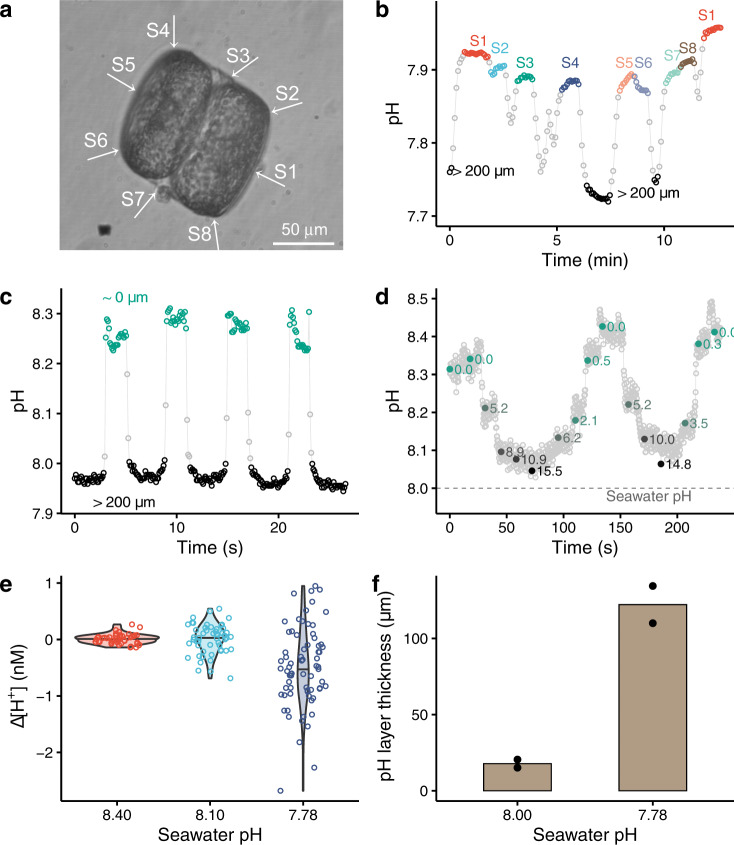
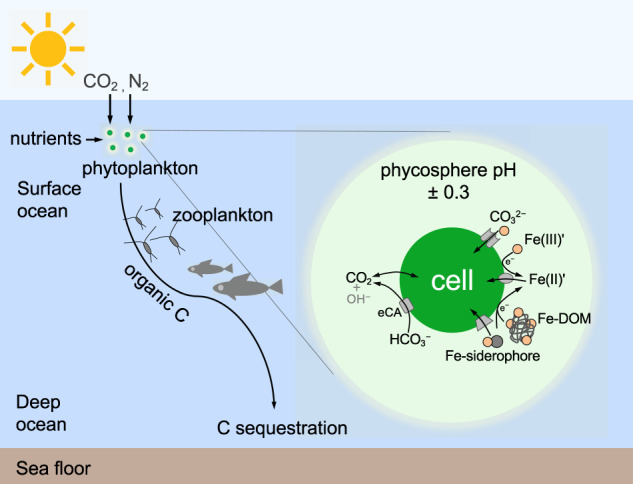
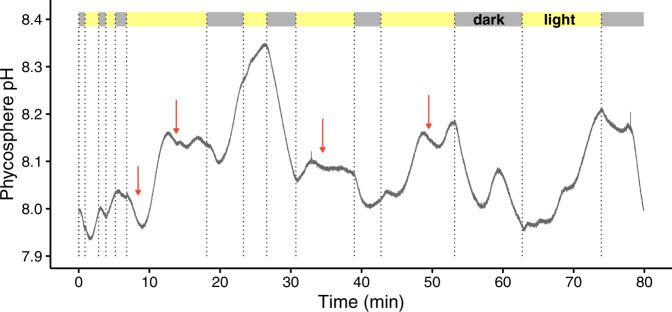
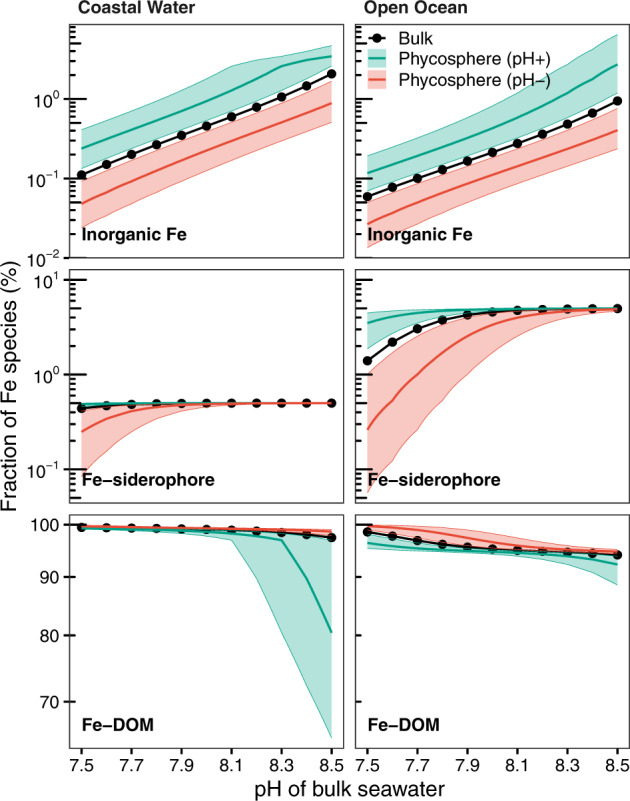
Surface ocean pH is declining due to anthropogenic atmospheric CO uptake with a global decline of ~0.3 possible by 2100. Extracellular pH influences a range of biological processes, including nutrient uptake, calcification and silicification. However, there are poor constraints on how pH levels in the extracellular microenvironment surrounding phytoplankton cells (the phycosphere) differ from bulk seawater. This adds uncertainty to biological impacts of environmental change. Furthermore, previous modelling work suggests that phycosphere pH of small cells is close to bulk seawater, and this has not been experimentally verified. Here we observe under 140 μmol photons·m·s the phycosphere pH of Chlamydomonas concordia (5 µm diameter), Emiliania huxleyi (5 µm), Coscinodiscus radiatus (50 µm) and C. wailesii (100 µm) are 0.11 ± 0.07, 0.20 ± 0.09, 0.41 ± 0.04 and 0.15 ± 0.20 (mean ± SD) higher than bulk seawater (pH 8.00), respectively. Thickness of the pH boundary layer of C. wailesii increases from 18 ± 4 to 122 ± 17 µm when bulk seawater pH decreases from 8.00 to 7.78. Phycosphere pH is regulated by photosynthesis and extracellular enzymatic transformation of bicarbonate, as well as being influenced by light intensity and seawater pH and buffering capacity. The pH change alters Fe speciation in the phycosphere, and hence Fe availability to phytoplankton is likely better predicted by the phycosphere, rather than bulk seawater. Overall, the precise quantification of chemical conditions in the phycosphere is crucial for assessing the sensitivity of marine phytoplankton to ongoing ocean acidification and Fe limitation in surface oceans.
由于人为的大气 CO 吸收,表层海洋 pH 值正在下降,到 2100 年全球 pH 值可能下降约 0.3。细胞外 pH 值会影响一系列生物过程,包括营养物质吸收、钙化和硅化。然而,关于围绕浮游植物细胞(菌席)的细胞外微环境中的 pH 值与海水主体之间的差异,目前的约束条件很差。这增加了环境变化对生物影响的不确定性。此外,先前的建模工作表明,小细胞的菌席 pH 值接近海水主体,而这尚未得到实验验证。在这里,我们观察到在 140μmol 光子·m·s 的光强下,Chlamydomonas concordia(直径 5μm)、Emiliania huxleyi(直径 5μm)、Coscinodiscus radiatus(直径 50μm)和 C. wailesii(直径 100μm)的菌席 pH 值分别比海水主体(pH 值 8.00)高 0.11±0.07、0.20±0.09、0.41±0.04 和 0.15±0.20(平均值±标准差)。当海水主体 pH 值从 8.00 降低到 7.78 时,C. wailesii 的 pH 边界层厚度从 18±4μm 增加到 122±17μm。菌席 pH 值受光合作用和细胞外碳酸碳酸氢盐的酶转化调节,还受光强、海水 pH 值和缓冲能力的影响。pH 值的变化改变了菌席中的铁形态,因此菌席而非海水主体更能预测浮游植物对铁的利用。总的来说,精确量化菌席中的化学条件对于评估海洋浮游植物对海洋酸化和表层海洋铁限制的敏感性至关重要。