Research Ethics in Medicine Study Group (REMEDY), Faculty of Health Sciences, Jagiellonian University Medical College, Kraków, Poland.
Institute of Psychology, University of Silesia, Katowice, Poland.
BMC Med. 2022 Jul 8;20(1):219. doi: 10.1186/s12916-022-02420-2.
Umbrella clinical trials in precision oncology are designed to tailor therapies to the specific genetic changes within a tumor. Little is known about the risk/benefit ratio for umbrella clinical trials. The aim of our systematic review with meta-analysis was to evaluate the efficacy and safety profiles in cancer umbrella trials testing targeted drugs or a combination of targeted therapy with chemotherapy.
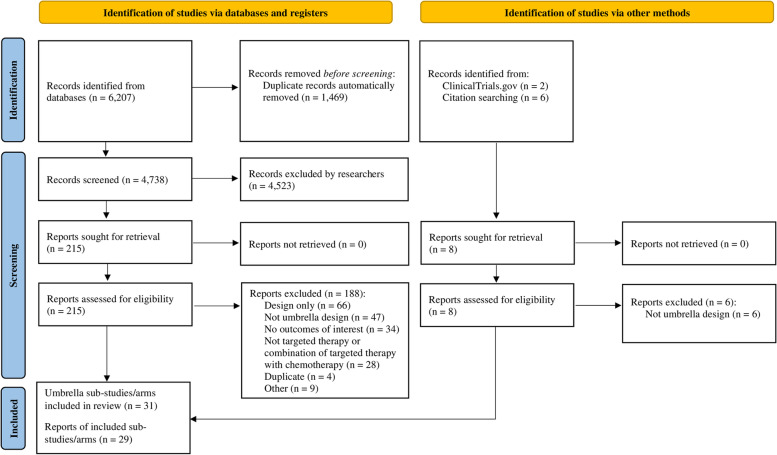
Our study was prospectively registered in PROSPERO (CRD42020171494). We searched Embase and PubMed for cancer umbrella trials testing targeted agents or a combination of targeted therapies with chemotherapy. We included solid tumor studies published between 1 January 2006 and 7 October 2019. We measured the risk using drug-related grade 3 or higher adverse events (AEs), and the benefit by objective response rate (ORR), progression-free survival (PFS), and overall survival (OS). When possible, data were meta-analyzed.
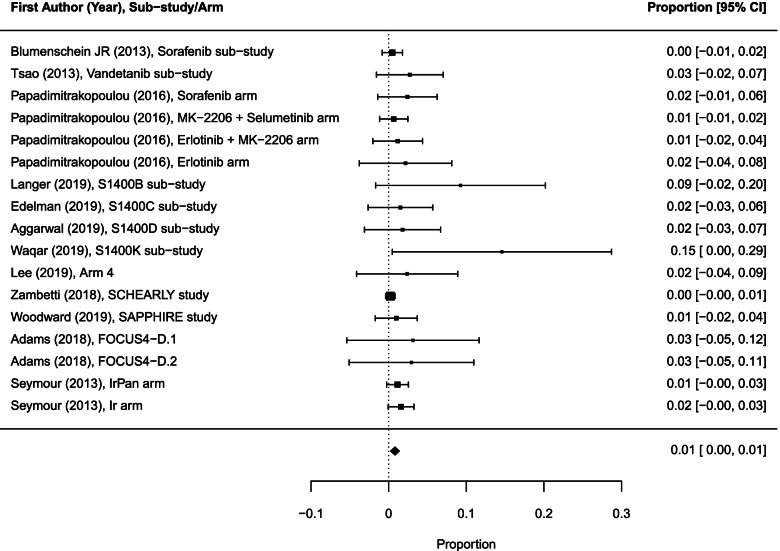
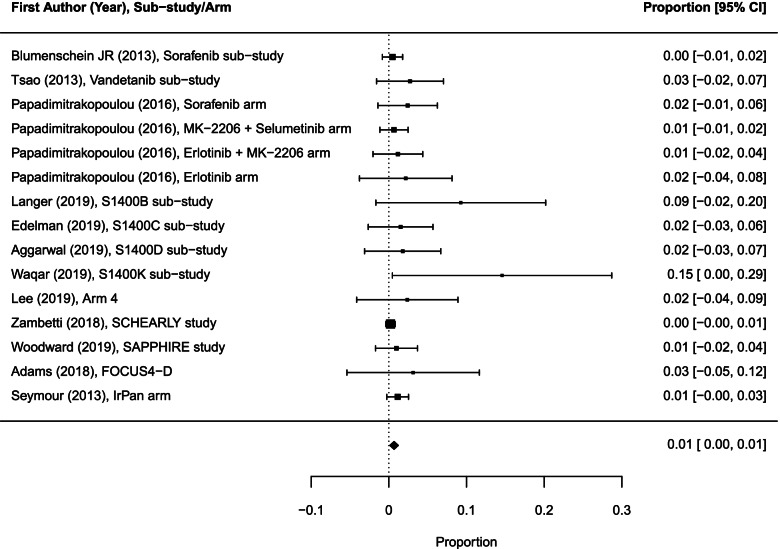
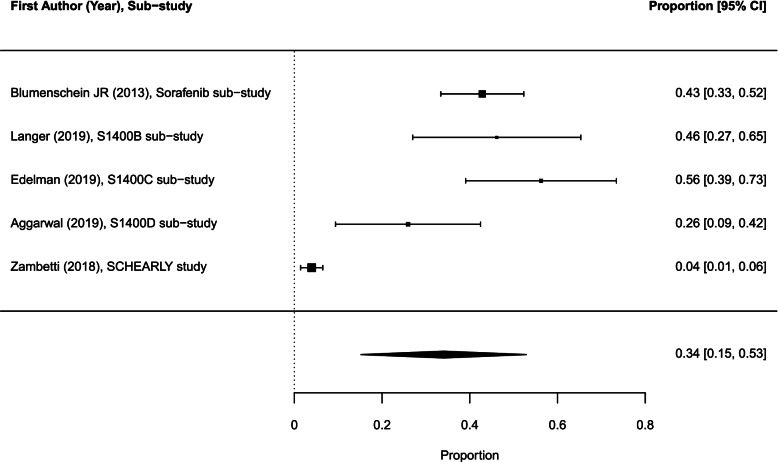
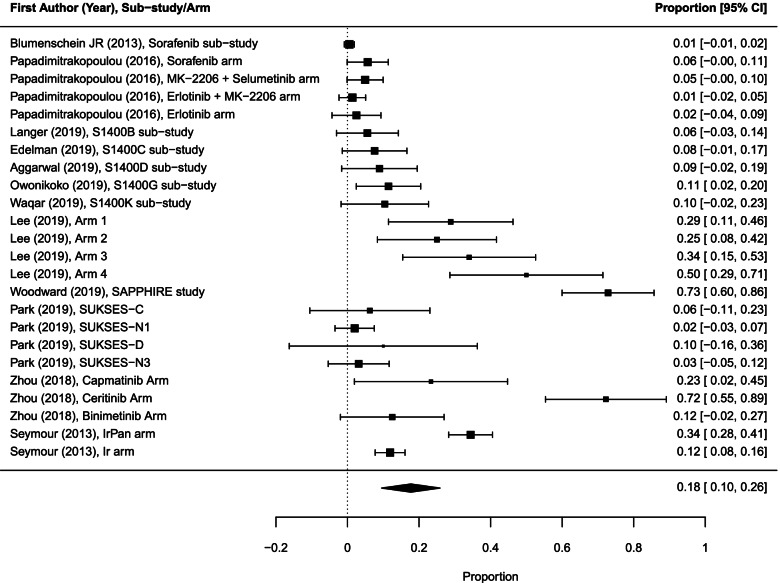
Of the 6207 records identified, we included 31 sub-trials or arms of nine umbrella trials (N = 1637). The pooled overall ORR was 17.7% (95% confidence interval [CI] 9.5-25.9). The ORR for targeted therapies in the experimental arms was significantly lower than the ORR for a combination of targeted therapy drugs with chemotherapy: 13.3% vs 39.0%; p = 0.005. The median PFS was 2.4 months (95% CI 1.9-2.9), and the median OS was 7.1 months (95% CI 6.1-8.4). The overall drug-related death rate (drug-related grade 5 AEs rate) was 0.8% (95% CI 0.3-1.4), and the average drug-related grade 3/4 AE rate per person was 0.45 (95% CI 0.40-0.50).
Our findings suggest that, on average, one in five cancer patients in umbrella trials published between 1 January 2006 and 7 October 2019 responded to a given therapy, while one in 125 died due to drug toxicity. Our findings do not support the expectation of increased patient benefit in cancer umbrella trials. Further studies should investigate whether umbrella trial design and the precision oncology approach improve patient outcomes.
精准肿瘤学中的伞式临床试验旨在根据肿瘤内的特定遗传变化来定制治疗方法。对于伞式临床试验的风险/效益比知之甚少。我们的系统评价和荟萃分析的目的是评估在测试靶向药物或靶向治疗联合化疗的癌症伞式试验中的疗效和安全性概况。
我们的研究在 PROSPERO(CRD42020171494)中进行了前瞻性注册。我们在 Embase 和 PubMed 中搜索了测试靶向药物或靶向治疗联合化疗的癌症伞式试验。我们纳入了 2006 年 1 月 1 日至 2019 年 10 月 7 日发表的实体瘤研究。我们使用与药物相关的 3 级或更高的不良事件(AE)来衡量风险,使用客观缓解率(ORR)、无进展生存期(PFS)和总生存期(OS)来衡量益处。在可能的情况下,我们进行了荟萃分析。
在确定的 6207 条记录中,我们纳入了 9 项伞式试验的 31 个亚试验或臂(N = 1637)。汇总的总 ORR 为 17.7%(95%置信区间 [CI] 9.5-25.9)。实验臂中靶向治疗的 ORR 明显低于靶向治疗联合化疗药物的组合:13.3%比 39.0%;p = 0.005。中位 PFS 为 2.4 个月(95%CI 1.9-2.9),中位 OS 为 7.1 个月(95%CI 6.1-8.4)。总的药物相关死亡率(药物相关 5 级 AE 率)为 0.8%(95%CI 0.3-1.4),平均每人的药物相关 3/4 级 AE 发生率为 0.45(95%CI 0.40-0.50)。
我们的研究结果表明,在 2006 年 1 月 1 日至 2019 年 10 月 7 日发表的伞式试验中,平均每五名癌症患者中有一名对特定治疗有反应,而每 125 名患者中有一名因药物毒性而死亡。我们的研究结果不支持癌症伞式试验中增加患者受益的预期。进一步的研究应该调查伞式试验设计和精准肿瘤学方法是否改善了患者的预后。