Matos Rolando S, Maselli Davide, McVey John H, Heiss Christian, Campagnolo Paola
Cardiovascular Section, Department of Biochemical Sciences, Guildford, United Kingdom.
Clinical Medicine Section, Department of Clinical and Experimental Medicine, University of Surrey, Faculty of Health and Medical Sciences, University of Surrey, Guildford, United Kingdom.
Front Cardiovasc Med. 2022 Jun 21;9:864580. doi: 10.3389/fcvm.2022.864580. eCollection 2022.
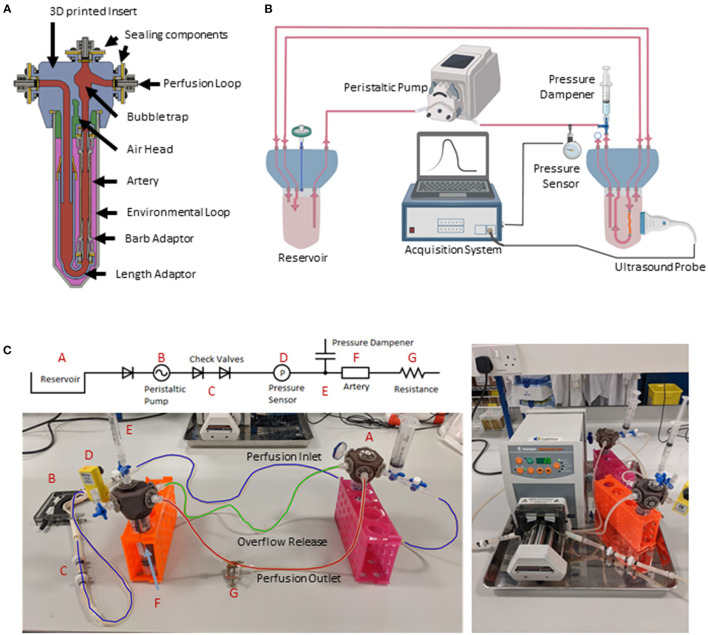
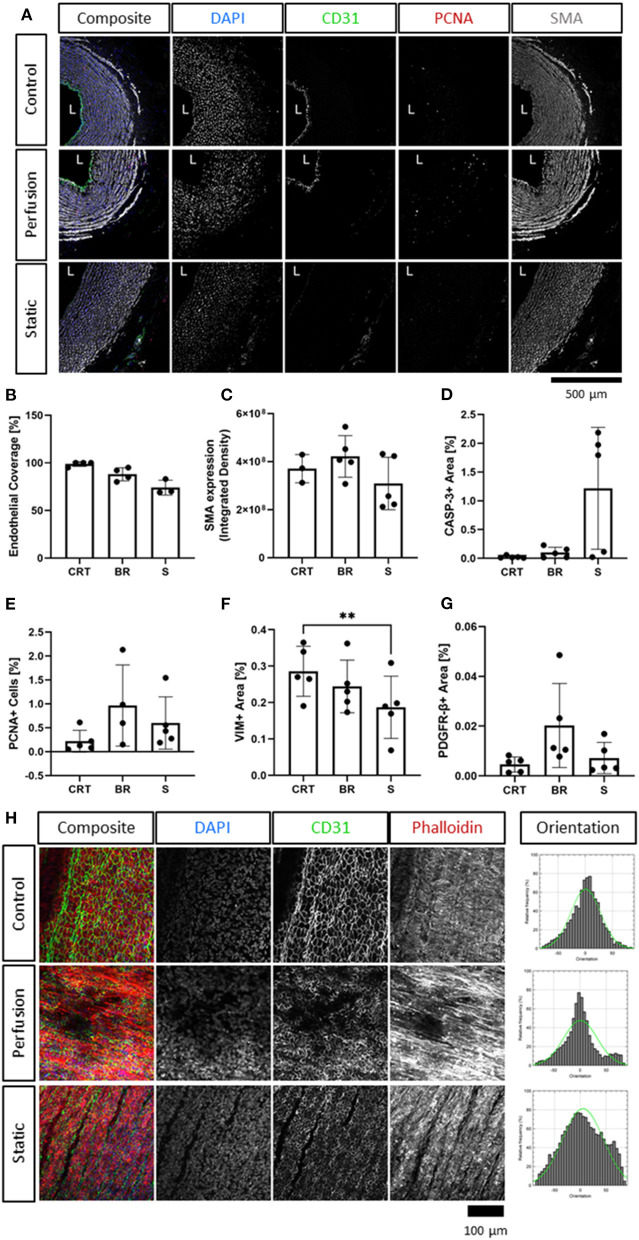
Routine interventions such as balloon angioplasty, result in vascular activation and remodeling, often requiring re-intervention. models and small animal experiments have enabled the discovery of important mechanisms involved in this process, however the clinical translation is often underwhelming. There is a critical need for an model representative of the human vascular physiology and encompassing the complexity of the vascular wall and the physical forces regulating its function. Vascular bioreactors for culture of large vessels are viable alternatives, but their custom-made design and insufficient characterization often hinders the reproducibility of the experiments. The objective of the study was to design and validate a novel 3D printed cost-efficient and versatile perfusion system, capable of sustaining the viability and functionality of large porcine arteries for 7 days and enabling early post-injury evaluations. MultiJet Fusion 3D printing was used to engineer the insert, converting a conventional 50 ml centrifuge tube into a mini bioreactor. Porcine carotid arteries either left untreated or injured with an angioplasty balloon, were cultured under pulsatile flow for up to 7 days. Pressure, heart rate, medium viscosity and shear conditions were adjusted to resemble arterial hemodynamics. Tissue viability, cell activation and matrix remodeling were analyzed by immunohistochemistry, and vascular function was monitored by duplex ultrasound. Culture conditions in the bioreactor preserved endothelial coverage and smooth muscle organization and extracellular matrix structure in the vessel wall, as compared to static culture. Injured arteries presented hallmarks of early remodeling, such as intimal denudation, smooth muscle cell disarray and media/adventitia activation in flow culture. Duplex ultrasound confirmed continuous pulsatile blood flow conditions, dose-dependent vasodilator response to nitroglycerin in untreated vessels and impaired dilator response in angioplastied vessels. The scope of this work is to validate a low-cost, robust and reproducible system to explore the culture of native and injured large arteries under pulsatile flow. While the study of vascular pathology is beyond the scope of the present paper, our system enables future investigations and provides a platform to test novel therapies and devices , in a patient relevant system.
诸如球囊血管成形术等常规干预措施会导致血管激活和重塑,常常需要再次干预。模型和小动物实验已促成了对这一过程中重要机制的发现,然而临床转化往往不尽人意。迫切需要一种能够代表人体血管生理学、涵盖血管壁复杂性以及调节其功能的物理力的模型。用于大血管培养的血管生物反应器是可行的替代方案,但其定制设计和表征不足常常阻碍实验的可重复性。本研究的目的是设计并验证一种新型的3D打印低成本且通用的灌注系统,该系统能够维持大型猪动脉的活力和功能达7天,并能进行损伤后早期评估。采用多射流熔融3D打印技术制造插入件,将传统的50毫升离心管转变为微型生物反应器。未处理的或经血管成形术球囊损伤的猪颈动脉在搏动流条件下培养长达7天。调节压力、心率、培养基粘度和剪切条件以模拟动脉血流动力学。通过免疫组织化学分析组织活力、细胞激活和基质重塑,并通过双功超声监测血管功能。与静态培养相比,生物反应器中的培养条件保留了血管壁的内皮覆盖、平滑肌组织和细胞外基质结构。损伤的动脉呈现早期重塑的特征,如内膜剥脱、平滑肌细胞紊乱以及在流动培养中的中膜/外膜激活。双功超声证实了持续的搏动血流状况、未处理血管中对硝酸甘油的剂量依赖性血管舒张反应以及血管成形术处理血管中受损的舒张反应。本工作的范围是验证一种低成本、稳健且可重复的系统,以探索在搏动流下天然和损伤的大动脉的培养。虽然血管病理学的研究超出了本文的范围,但我们的系统为未来的研究提供了可能,并提供了一个在与患者相关的系统中测试新型疗法和装置的平台。