Geng Min, Cui Weidong, Cheng Jiang, Li Liheng, Cheng Ruini, Wang Xiaofang
Department of Critical Care, Jincheng People's Hospital (Jincheng Hospital Affiliated to Changzhi Medical College), Jincheng, China.
Department of Paediatrics, Jincheng People's Hospital (Jincheng Hospital Affiliated to Changzhi Medical College), Jincheng, China.
Transl Pediatr. 2022 Jun;11(6):909-919. doi: 10.21037/tp-22-180.
Therapeutic hypothermia (TH) is effective to treat adult traumatic brain injury (TBI), but there is still controversy about its safety to treat the children with severe TBI.
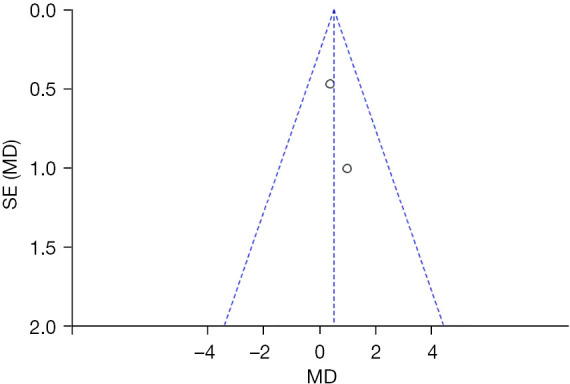
Clinical studies on TH in children with severe TBI from January 2000 to September 2020 were screened in PubMed, Web of Science, Embase, Cochrane Library, Nature, NCKI, and Wanfang online databases. Data were meta-analyzed by Rev Man 5.3. Differences in mortality, adverse outcomes, duration of Pediatric Intensive Care Unit (PICU), incidence of infection, and incidence of arrhythmia were compared between experimental group and control group. The heterogeneity of the results was evaluated by chi-square test and I test in Rev Man 5.3, and publication bias was evaluated by funnel plot.
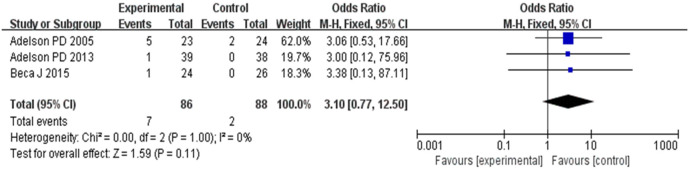
Five articles were included, including 421 children. Cochrane evaluation was B grade or above, and Jadad scale score was over three points. The overall mortality between two groups showed great difference [odds ratio (OR) =1.72, 95% CI: 0.98-3.02, Z=1.87, P=0.04]. The incidence of adverse outcomes (OR =1.39, 95% CI: 0.86-2.25, Z=1.34, P=0.18), the duration of PICU [mean difference (MD) =0.51, 95% CI: -0.33 to 1.35, Z=1.19, P=0.24], the incidence of infection (OR =0.79, 95% CI: 0.51-1.23, Z=1.03, P=0.30), and the incidence of arrhythmia (OR =3.10, 95% CI: 0.77-12.50, Z=1.59, P=0.11) were not considerably different.
TH significantly reduced overall mortality in children with severe TBI, but did not significantly improve the incidence of adverse outcomes, PICU duration, infection rate, or arrhythmia. These results provided a reference for selecting proper clinical treatment methods for children with severe TBI.
治疗性低温(TH)对治疗成人创伤性脑损伤(TBI)有效,但对于治疗重度TBI儿童的安全性仍存在争议。
在PubMed、科学网、Embase、Cochrane图书馆、《自然》、中国知网和万方在线数据库中筛选2000年1月至2020年9月期间关于重度TBI儿童TH治疗的临床研究。采用Rev Man 5.3进行荟萃分析。比较实验组和对照组在死亡率、不良结局、儿科重症监护病房(PICU)住院时间、感染发生率和心律失常发生率方面的差异。通过Rev Man 5.3中的卡方检验和I²检验评估结果的异质性,并通过漏斗图评估发表偏倚。
纳入5篇文章,共421名儿童。Cochrane评估为B级及以上,Jadad量表评分超过3分。两组的总体死亡率差异显著[比值比(OR)=1.72,95%置信区间:0.98 - 3.02,Z = 1.87,P = 0.04]。不良结局发生率(OR = 1.39,95%置信区间:0.86 - 2.25,Z = 1.34,P = 0.18)、PICU住院时间[平均差(MD)= 0.51,95%置信区间: - 0.33至1.35,Z = 1.19,P = 0.24]、感染发生率(OR = 0.79,95%置信区间:0.51 - 1.23,Z = 1.03,P = 0.30)和心律失常发生率(OR = 3.10,95%置信区间:0.77 - 12.50,Z = 1.59,P = 0.11)差异均不显著。
TH显著降低了重度TBI儿童的总体死亡率,但未显著改善不良结局发生率、PICU住院时间、感染率或心律失常发生率。这些结果为选择重度TBI儿童合适的临床治疗方法提供了参考。