Bartsch Caitlyn J, Nordman Jacob C
Department of Physiology, University of Southern Illinois Carbondale, Carbondale, IL, United States.
Department of Physiology, University of Southern Illinois School of Medicine, Carbondale, IL, United States.
Front Behav Neurosci. 2022 Jun 21;16:938044. doi: 10.3389/fnbeh.2022.938044. eCollection 2022.
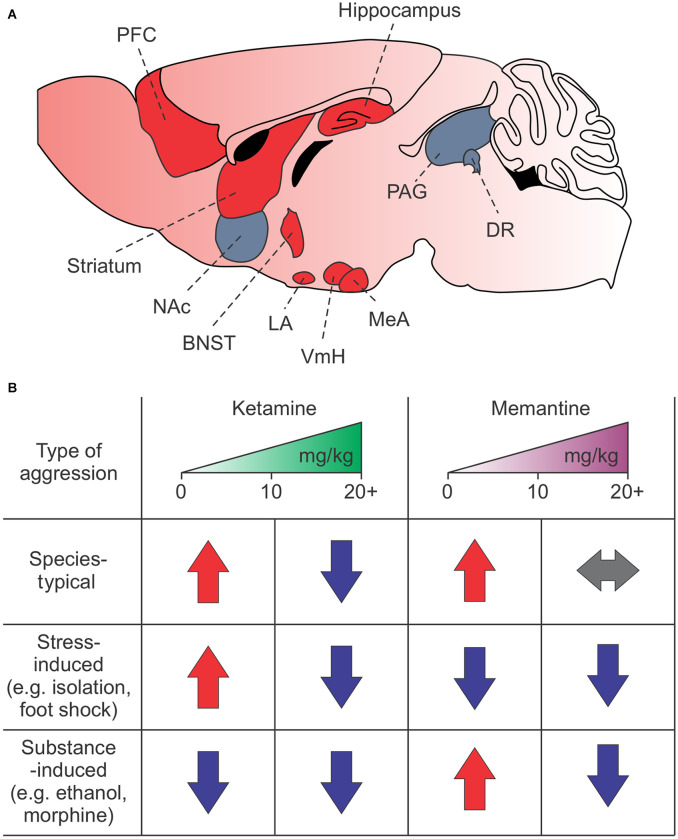
Treatment options for chronically aggressive individuals remain limited despite recent medical advances. Traditional pharmacological agents used to treat aggression, such as atypical antipsychotics, have limited efficacy and are often replete with dangerous side effects. The non-competitive NMDAR antagonists ketamine and memantine are promising alternatives, but their effects appear to be highly dependent on dosage, context, and personal experience. Importantly, these drugs can increase aggression when combined with substances of abuse or during periods of heightened stress. This is likely due to mechanistic differences operating at specific synapses under different contexts. Previous findings from our lab and others have shown that early life stress, substance abuse, and attack experience promote aggression through NMDAR-dependent synaptic plasticity within aggression-related brain circuits. Ketamine and memantine affect these types of aggression in opposite ways. This has led us to propose that ketamine and memantine oppositely affect aggression brought on by early life stress, substance abuse, or attack experience through opposite effects on NMDAR-dependent synaptic plasticity. This would account for the persistent effects of these drugs on aggression and suggest they could be leveraged as a more long-lasting treatment option. However, a more thorough examination of the effects of ketamine and memantine on cellular and synaptic function will be necessary for responsible administration. Additionally, because the effects of ketamine and memantine are highly dependent on prior drug use, traumatic stress, or a history of aggressive behavior, we propose a more thorough medical evaluation and psychiatric assessment will be necessary to avoid possible adverse interactions with these drugs.
尽管最近医学取得了进展,但针对慢性攻击性个体的治疗选择仍然有限。用于治疗攻击行为的传统药物,如非典型抗精神病药物,疗效有限,且往往伴有危险的副作用。非竞争性N-甲基-D-天冬氨酸受体(NMDAR)拮抗剂氯胺酮和美金刚是有前景的替代药物,但它们的效果似乎高度依赖于剂量、环境和个人经历。重要的是,这些药物在与滥用物质联合使用时或在压力增大期间会增加攻击行为。这可能是由于在不同环境下特定突触处的机制差异所致。我们实验室和其他机构之前的研究结果表明,早年生活压力、物质滥用和攻击经历通过与攻击相关的脑回路中依赖NMDAR的突触可塑性来促进攻击行为。氯胺酮和美金刚以相反的方式影响这些类型的攻击行为。这使我们提出,氯胺酮和美金刚通过对依赖NMDAR的突触可塑性产生相反的影响,以相反的方式影响由早年生活压力、物质滥用或攻击经历引发的攻击行为。这可以解释这些药物对攻击行为的持续影响,并表明它们可以作为一种更持久的治疗选择加以利用。然而,为了合理用药,有必要更全面地研究氯胺酮和美金刚对细胞和突触功能的影响。此外,由于氯胺酮和美金刚的效果高度依赖于先前的药物使用、创伤性应激或攻击行为史,我们建议进行更全面的医学评估和精神病学评估,以避免与这些药物可能产生的不良相互作用。