12267Wayne State University/Karmanos Cancer Institute, Detroit, MI, USA.
1877University of Colorado, Boulder, CO, USA.
Cancer Control. 2022 Jan-Dec;29:10732748221113905. doi: 10.1177/10732748221113905.
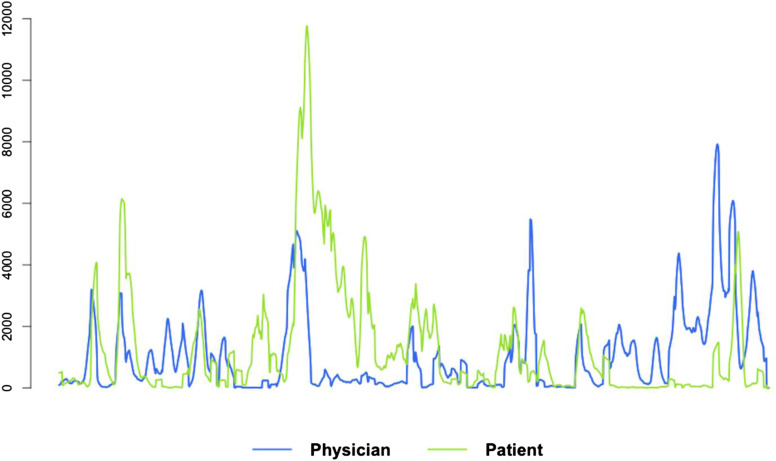
The aim of this cross-sectional study was to apply a novel software to measure and compare levels of nonverbal synchrony, as a potential indicator of communication quality, in video recordings of racially-concordant and racially-discordant oncology interactions. Predictions include that the levels of nonverbal synchrony will be greater during racially-concordant interactions than racially-discordant interactions, and that levels of nonverbal synchrony will be associated with traditional measures of communication quality in both racially-concordant and racially-discordant interactions.
This is a secondary observational analysis of video-recorded oncology treatment discussions collected from 2 previous studies.
Two National Cancer Institute-designated Comprehensive Cancer Centers and another large urban cancer center.
Participants from Study 1 include 161 White patients with cancer and 11 White medical oncologists. Participants from Study 2 include 66 Black/African-American patients with cancer and 17 non-Black medical oncologists. In both studies inclusion criteria for patients was a recent cancer diagnosis; in Study 2 inclusion criteria was identifying as Black/African American.
Nonverbal synchrony and communication quality.
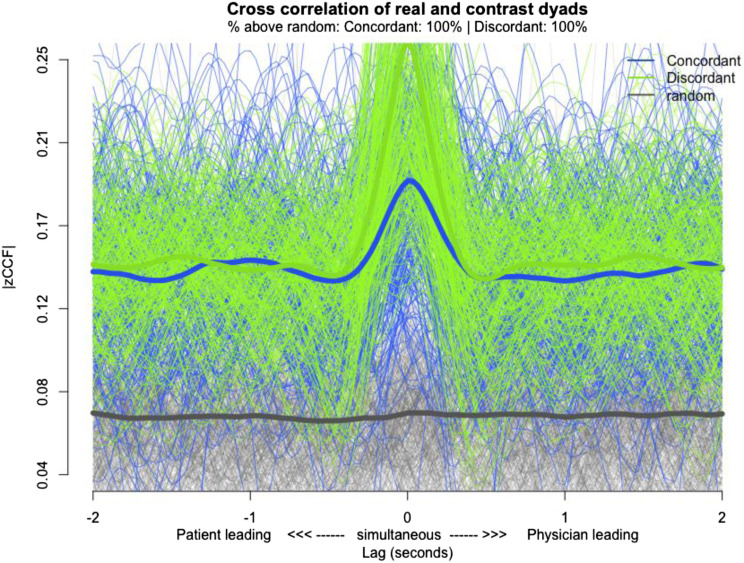
Greater levels of nonverbal synchrony were observed in racially-discordant interactions than in racially-concordant interactions. Levels of nonverbal synchrony were associated with indicators of communication quality, and these associations were more consistently found in racially-discordant interactions.
This study advances clinical communication and disparities research by successfully applying a novel approach capturing the unconscious nature of communication, and revealing differences in communication in racially-discordant and racially-concordant oncology interactions. This study highlights the need for further exploration of nonverbal aspects relevant to patient-physician interactions.
本横断面研究旨在应用一种新软件来测量和比较种族一致和种族不一致的肿瘤学互动录像中的非言语同步水平,作为沟通质量的潜在指标。预测包括种族一致的互动中非言语同步水平将高于种族不一致的互动,并且非言语同步水平将与种族一致和种族不一致的互动中的传统沟通质量测量指标相关。
这是对从之前两项研究中收集的肿瘤学治疗讨论的视频记录进行的二次观察性分析。
两个美国国立癌症研究所指定的综合性癌症中心和另一个大型城市癌症中心。
研究 1 的参与者包括 161 名白种癌症患者和 11 名白种肿瘤学家。研究 2 的参与者包括 66 名黑种/非裔美国癌症患者和 17 名非黑人肿瘤学家。在这两项研究中,患者的纳入标准是最近被诊断出患有癌症;在研究 2 中,纳入标准是自我认同为黑种/非裔美国人。
非言语同步和沟通质量。
种族不一致的互动中非言语同步水平高于种族一致的互动。非言语同步水平与沟通质量指标相关,并且这些关联在种族不一致的互动中更为一致。
本研究通过成功应用一种新方法来捕捉沟通的无意识性质,并揭示了种族不一致和种族一致的肿瘤学互动中沟通的差异,从而推进了临床沟通和差异研究。本研究强调了需要进一步探索与医患互动相关的非言语方面。