Neglected Tropical Diseases Unit, Centre for Global Health Research, Kenya Medical Research Institute, Kisumu, Kenya.
Department of Biomedical and Clinical Technology, Faculty of Health Sciences, Durban University of Technology, Durban, South Africa.
PLoS Negl Trop Dis. 2022 Jul 8;16(7):e0010473. doi: 10.1371/journal.pntd.0010473. eCollection 2022 Jul.
Female genital schistosomiasis (FGS) constitutes four different lesions known to be caused by Schistosoma haematobium ova deposited in the genital tract. Schistosoma mansoni ova may also be found in the genital tract. However, it is not known if S. mansoni causes lower genital tract lesions characteristic of FGS.
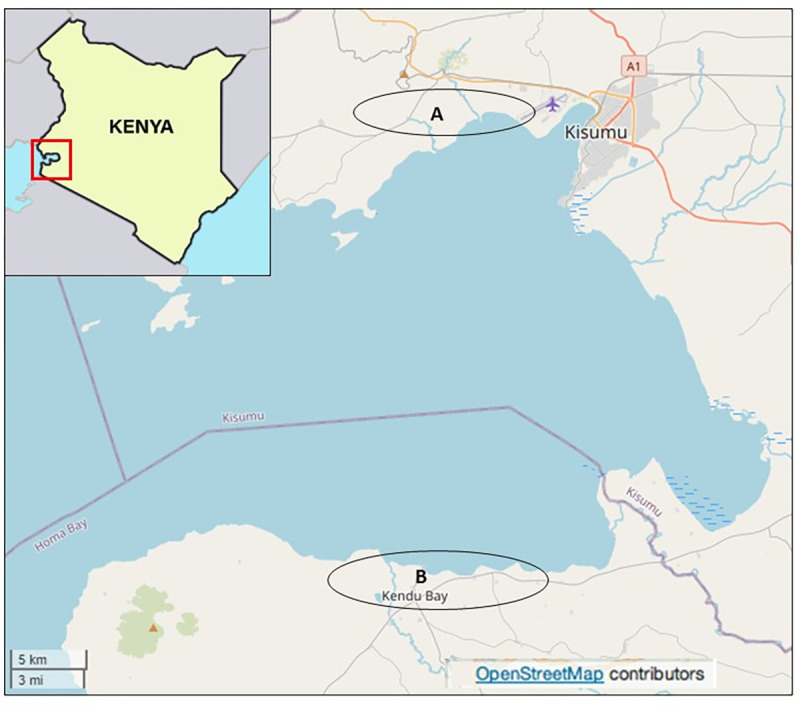
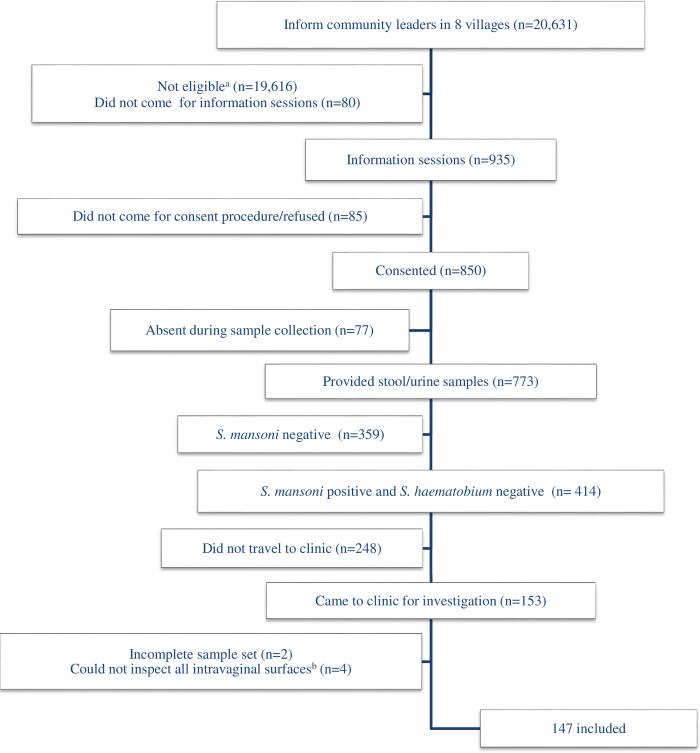
This study was conducted in 8 villages along the shores of Lake Victoria, western Kenya. Stool and urine samples, collected from women of reproductive age on three consecutive days, were analysed for S. mansoni and S. haematobium infection. S. mansoni positive and S. haematobium negative willing participants, aged 18-50 years were invited to answer a questionnaire (demographics, symptoms), undergo a gynaecological examination and cytology specimen collection by an FGS expert.
Gynaecologic investigations were conducted in 147 S. mansoni-positive women who had a mean infection intensity of 253.3 epg (95% CI: 194.8-311.9 epg). Nearly 90% of them used Lake Victoria as their main water source. None were found to have cervicovaginal grainy sandy patches or rubbery papules. Homogenous yellow patches were found in 12/147 (8.2%) women. Women with homogenous yellow patches were significantly older (47 years) than the rest (34 years, p = 0.001). No association was found between intensity of S. mansoni infection and homogenous yellow patches (p = 0.70) or abnormal blood vessels (p = 0.14). S. mansoni infection intensity was not associated with genital itch, bloody or malodorous vaginal discharge.
S. mansoni infection was neither associated with lower genital tract lesions nor symptoms typically found in women with FGS.
女性生殖器血吸虫病(FGS)由四种不同的病变组成,这些病变是由沉积在生殖道中的曼氏血吸虫卵引起的。生殖道中也可能发现曼氏血吸虫卵。然而,尚不清楚曼氏血吸虫是否会导致 FGS 特有的下生殖道病变。
本研究在肯尼亚维多利亚湖西岸的 8 个村庄进行。在连续三天收集育龄妇女的粪便和尿液样本,以分析曼氏血吸虫和埃及血吸虫感染情况。邀请年龄在 18-50 岁之间的曼氏血吸虫阳性且埃及血吸虫阴性的愿意参与者回答一份问卷(人口统计学、症状)、接受妇科检查和 FGS 专家进行细胞学标本采集。
对 147 名曼氏血吸虫阳性的妇女进行了妇科检查,她们的平均感染强度为 253.3 epg(95%CI:194.8-311.9 epg)。她们中近 90%的人将维多利亚湖作为主要水源。未发现宫颈阴道有颗粒状沙质斑块或橡胶样丘疹。在 147 名妇女中发现 12 名(8.2%)有均匀黄色斑块。有均匀黄色斑块的妇女明显比其他妇女年龄大(47 岁,p=0.001)。曼氏血吸虫感染强度与均匀黄色斑块(p=0.70)或异常血管(p=0.14)之间未发现关联。曼氏血吸虫感染强度与生殖器瘙痒、血性或恶臭阴道分泌物无关。
曼氏血吸虫感染既与下生殖道病变无关,也与 FGS 妇女中常见的症状无关。