Department of Maternal, Newborn, Child, and Adolescent Health, and Ageing, World Health Organization, Avenue Appia 20, 1202, Geneva, Switzerland.
University Research Co. LLC, 4600 Creek Shore Dr. Rockville, Rocville, MD, 20852, USA.
BMC Health Serv Res. 2022 Jul 8;22(1):887. doi: 10.1186/s12913-022-08234-5.
There are currently no global recommendations on a parsimonious and robust set of indicators that can be measured routinely or periodically to monitor quality of hospital care for children and young adolescents. We describe a systematic methodology used to prioritize and define a core set of such indicators and their metadata for progress tracking, accountability, learning and improvement, at facility, (sub) national, national, and global levels.
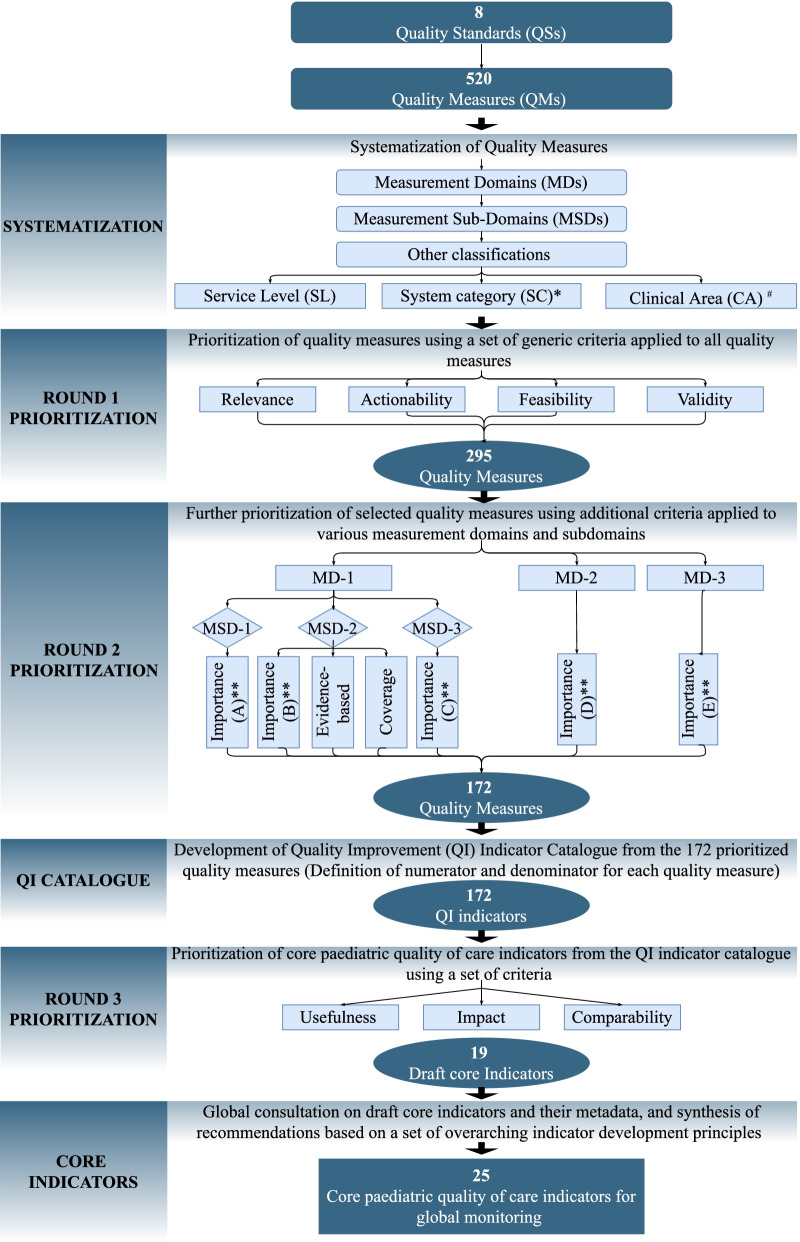
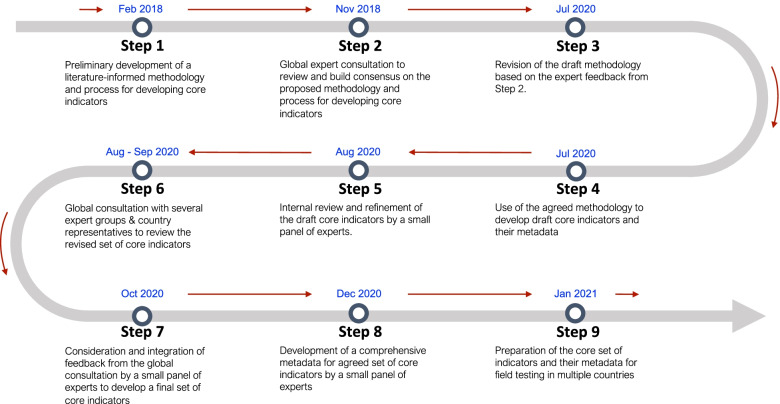
We used a deductive methodology which involved the use of the World Health Organization Standards for improving the quality-of-care for children and young adolescents in health facilities as the organizing framework for indicator development. The entire process involved 9 complementary steps which included: a rapid literature review of available evidence, the application of a peer-reviewed systematic algorithm for indicator systematization and prioritization, and multiple iterative expert consultations to establish consensus on the proposed indicators and their metadata.
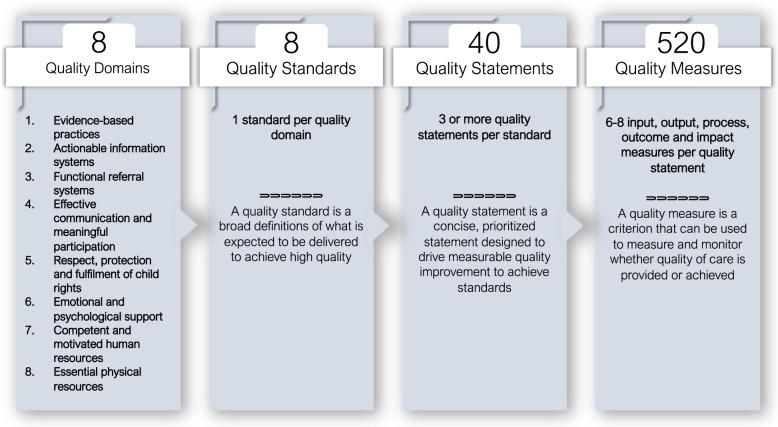
We derived a robust set of 25 core indicators and their metadata, representing all 8 World Health Organization quality standards, 40 quality statements and 520 quality measures. Most of these indicators are process-related (64%) and 20% are outcome/impact indicators. A large proportion (84%) of indicators were proposed for measurement at both outpatient and inpatient levels. By virtue of being a parsimonious set and given the stringent criteria for prioritizing indicators with "quality measurement" attributes, the recommended set is not evenly distributed across the 8 quality standards.
To support ongoing global and national initiatives around paediatric quality-of-care programming at country level, the recommended indicators can be adopted using a tiered approach that considers indicator measurability in the short-, medium-, and long-terms, within the context of the country's health information system readiness and maturity. However, there is a need for further research to assess the feasibility of implementing these indicators across contexts, and the need for their validation for global common reporting.
目前尚无一套精简而稳健的指标集,可用于常规或定期监测儿童和青少年医院护理质量。我们描述了一种系统方法,用于优先考虑和定义一套此类指标及其元数据,以用于设施、(次)国家、国家和全球各级的进展跟踪、问责制、学习和改进。
我们使用了演绎方法,该方法使用世界卫生组织标准作为指标开发的组织框架,以改善卫生设施中儿童和青少年的护理质量。整个过程涉及 9 个互补步骤,包括:快速审查现有证据、应用经过同行评审的系统算法对指标进行系统化和优先排序,以及多次迭代专家咨询,以就拟议指标及其元数据达成共识。
我们得出了一套由 25 个核心指标及其元数据组成的稳健指标集,涵盖了所有 8 项世界卫生组织质量标准、40 项质量声明和 520 项质量措施。这些指标大多数与过程相关(64%),20%为结果/影响指标。很大一部分(84%)指标被提议用于门诊和住院两个层面的测量。由于其作为一个简约的指标集,并具有具有“质量测量”属性的指标的严格优先级标准,因此建议的指标集在 8 项质量标准中分布不均。
为了支持全球和国家层面正在进行的儿童保健质量计划倡议,建议的指标可以采用分层方法采用,考虑到在国家卫生信息系统准备情况和成熟度的背景下,短期、中期和长期的指标可测量性。然而,需要进一步研究来评估在不同情况下实施这些指标的可行性,以及需要对这些指标进行全球通用报告的验证。